How Long to Boil Shrimp: Exact Times, Sizes, Shell-On vs. Peeled, and How to Never Overcook Them Again
Rubbery Shrimp? Here's the Real Boiling Time No One Told You About

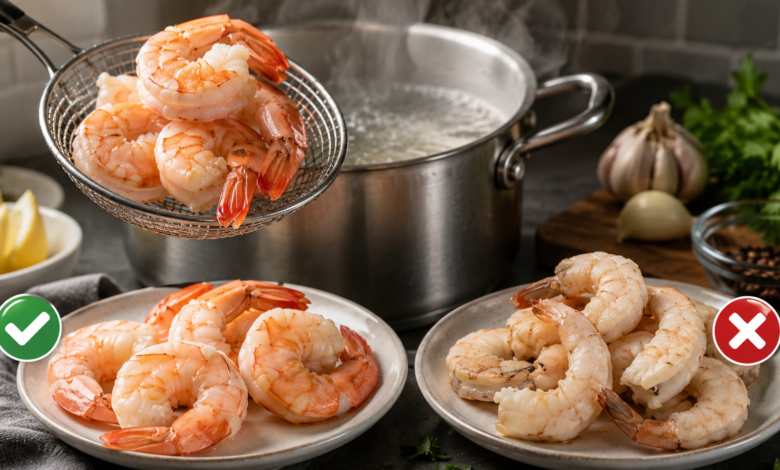
Shrimp is one of the fastest-cooking proteins available — and also one of the most frequently ruined by home cooks who add 2 extra minutes “just to be safe.” Those 2 minutes are the difference between plump, juicy shrimp and something with the texture of a rubber band. The margin for error is genuinely narrow: most shrimp sizes go from raw to perfectly cooked in 2–5 minutes in boiling water, and from perfectly cooked to overdone in another 60–90 seconds.
Why Most People Overcook Boiled Shrimp — and the Science Behind It
Shrimp muscle is composed of short, laterally arranged myofibrils rather than the long parallel fiber bundles found in beef or poultry. This structure means heat penetrates the protein very quickly from all sides — the cooking process is nearly instantaneous compared to other proteins of similar mass. A single large shrimp weighing 20–25g reaches a safe internal temperature of 63°C (145°F) in water at a full rolling boil within 2 minutes of submersion.
The problem is visual timing. Most cooks use color as their primary doneness indicator — they wait for shrimp to turn fully pink and opaque before pulling them from the water. By the time shrimp are uniformly pink across every surface, they have already crossed into overcooked territory in most cases. The correct visual cue is a loose C-shape — the shrimp curves but hasn’t tightened into a full circle. An O-shaped shrimp is overcooked.
The C vs. O shape rule:
- Raw shrimp: Straight or slightly curved
- Perfectly cooked: Loose C-shape — stop here
- Overcooked: Tight O-shape — the muscle proteins have contracted too far, squeezing out moisture
This is the single most useful piece of shrimp-cooking information that most recipe content fails to lead with clearly.
How Long to Boil Shrimp: Timing by Size
Shrimp are sold by count per pound — this is the standard sizing system. The number tells you how many shrimp of that size make up one pound. A package labeled “16/20” contains 16 to 20 shrimp per pound, meaning each shrimp is relatively large. A package labeled “51/60” contains 51 to 60 shrimp per pound — small shrimp with thin flesh that cook faster.
Boiling time from raw, shells on or off, at a full rolling boil:
Shrimp Size |
Count Per Pound |
Boiling Time (Peeled) |
Boiling Time (Shell-On) |
| Extra Colossal | U/10 (under 10) | 5–7 minutes | 7–8 minutes |
| Colossal | 10/15 | 4–5 minutes | 5–6 minutes |
| Extra Jumbo | 16/20 | 3–4 minutes | 4–5 minutes |
| Jumbo | 21/25 | 3 minutes | 3–4 minutes |
| Extra Large | 26/30 | 2–3 minutes | 3 minutes |
| Large | 31/40 | 2 minutes | 2–3 minutes |
| Medium | 41/50 | 1.5–2 minutes | 2 minutes |
| Small | 51/60 | 1–1.5 minutes | 1.5 minutes |
These timings assume a full rolling boil before the shrimp go in — not simmering, not just-started boiling, but a vigorous full boil that resumes quickly after the shrimp are added. If you add shrimp to water that isn’t fully boiling, or if you add so many shrimp that the water temperature drops significantly, the times above extend by 30–60 seconds per size category.
The ice bath rule: The moment shrimp are done, transfer immediately to a bowl of ice water. The ice bath stops carryover cooking — the residual heat inside the shrimp continues to cook the protein after they’re removed from the boiling water, and without the ice bath, that carryover adds the equivalent of 30–60 seconds of additional cooking.
How Long to Boil Shrimp on the Stove: The Standard Method
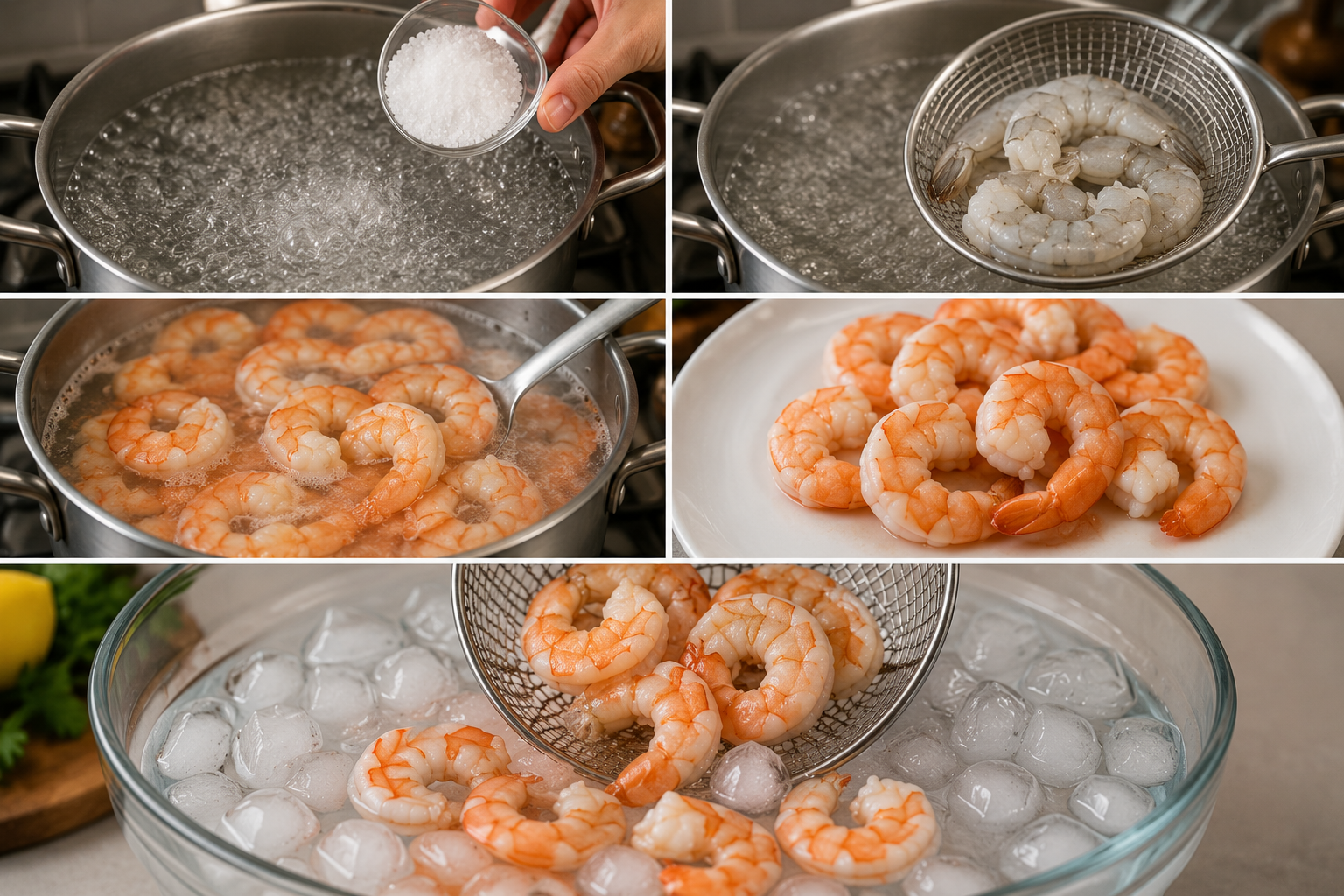
The most common scenario — bringing a pot of seasoned water to boil on the stove and cooking fresh or thawed shrimp — follows this sequence:
Water to shrimp ratio: Use at least 4 cups of water per pound of shrimp. The large volume maintains temperature after the shrimp are added and prevents the water from dropping below boiling, which would extend cook time inconsistently.
Salting the water: Add at minimum 1 tablespoon of salt per 4 cups of water. This is not optional for flavor. Shrimp absorb salt from the cooking water during boiling — under-salted water produces bland shrimp regardless of any seasoning added afterward. The water should taste pleasantly salty, like a mild ocean.
Bringing to a full boil: Wait until the water reaches a rolling, full boil — visible vigorous bubbles breaking the surface continuously — before adding shrimp. This ensures precise timing from the moment of submersion.
The visual check: Start watching at the lower end of the timing range for your shrimp size. The visual cue is the loose C-shape described above. For medium and large shrimp, the flesh at the thickest point should be opaque, not translucent.
Immediate ice bath: Have the ice bath prepared before you start boiling — a bowl large enough for all the shrimp, filled with cold water and a full tray of ice. Transfer shrimp with a slotted spoon immediately at the C-shape stage.
How Long to Boil Frozen Shrimp
Frozen shrimp can be boiled directly from frozen — no thawing required — though the cook time increases slightly.
From frozen, at a full rolling boil:
| Shrimp Size |
Boiling Time (Frozen, Shell-On) |
Boiling Time (Frozen, Peeled) |
| Extra Jumbo (16/20) | 6–8 minutes | 5–7 minutes |
| Jumbo (21/25) | 5–6 minutes | 4–5 minutes |
| Extra Large (26/30) | 4–5 minutes | 3–4 minutes |
| Large (31/40) | 3–4 minutes | 3 minutes |
| Medium (41/50) | 2.5–3 minutes | 2–2.5 minutes |
A critical note: when frozen shrimp hit boiling water, the water temperature drops more significantly than when fresh or thawed shrimp are added. This temperature drop extends initial cook time. Wait for the water to return to a full boil after adding frozen shrimp before you start your timer.
The better approach for frozen shrimp: If time allows, thaw shrimp under cold running water for 5–10 minutes before boiling. Place them in a colander in the sink and run cold water continuously. The flesh thaws completely within 5–7 minutes for most sizes, and you can then boil using the standard timings above. This produces more even cooking throughout the shrimp because the protein starts at uniform temperature rather than frozen-core/thawed-exterior.
Never thaw shrimp in warm or hot water. The outer layers of the shrimp reach the bacterial growth danger zone (above 4°C) while the interior is still frozen — uneven thawing combined with partial warming creates conditions for bacterial growth and produces an uneven, mushy exterior texture.
How to Boil Shrimp With Shell On
Shell-on boiling is preferable in most culinary contexts, and the reasons are both flavor-based and structural.
The shell acts as a barrier that slows moisture loss from the shrimp meat during cooking. This produces juicier, more tender shrimp than peeled-then-boiled equivalents at the same size and cook time. The shell also contains compounds — primarily chitin and aromatic amino acids — that leach into the cooking water and contribute flavor depth to the shrimp from the outside during boiling.
Shell-on shrimp take 30–60 seconds longer per size category than peeled shrimp because the shell slows heat penetration. This small extension is worth it in terms of end-product quality for most preparations.
How to boil shrimp with shell on correctly:
- Do not remove the shell, but do devein if desired. For shell-on shrimp, run a small sharp knife along the curved back of the shrimp through the shell and remove the dark vein (the digestive tract). This is cosmetic rather than food safety-critical for most farmed shrimp, but it improves the eating experience.
- Use well-salted, seasoned boiling water (see recipe below). The shell acts as a partial barrier, so the water needs to be more assertively seasoned than when boiling peeled shrimp.
- Boil using the shell-on timings in the table above. The visual C-shape rule applies equally — the shell curls along with the shrimp as the protein contracts.
- Ice bath immediately. Shell-on shrimp retain heat longer than peeled shrimp due to the shell’s insulating effect — the ice bath is even more important here to stop carryover cooking promptly.
- Serve shell-on for maximum juiciness, or peel after the ice bath for subsequent use in salads, pasta, or bowls.
How to Cook Whole Shrimp (Head-On)
Head-on shrimp — with the head, shell, antennae, and all intact — are common in Asian, Mediterranean, and Latin American cooking. In the US and UK, they’re less familiar but increasingly available at fish counters and Asian grocery stores.
Boiling whole (head-on) shrimp follows the same principles as shell-on boiling, with two additions:
Time extension: The head contains a significant mass of tissue that requires additional cooking time. Add approximately 1–2 minutes to the shell-on timings above for head-on shrimp of comparable body size.
The tomalley signal: The head of a shrimp contains the hepatopancreas, commonly called tomalley — a yellow-orange paste that turns from translucent to fully opaque when heated through. When this tissue is fully set and opaque, the rest of the shrimp is also cooked. This is an internal visual doneness indicator available only when cooking head-on.
Ingredients: Flavorful Boiled Shrimp Recipe
This is the standard recipe that produces boiled shrimp worth eating on their own — not just as a cooking step for something else. The difference between plain salted water and properly seasoned boiling water is significant and takes 3 minutes of prep.
Serves 2–4 as a main, 6–8 as an appetizer
For the seasoned boiling liquid:
- 8 cups (2 liters) water
- 2 tbsp fine sea salt
- 1 lemon, halved (squeeze juice into water, drop the halves in)
- 3 bay leaves
- 4 garlic cloves, smashed (not minced — just smashed with the flat of a knife)
- 1 tbsp Old Bay seasoning (or substitute: 1 tsp celery seed, ½ tsp paprika, ¼ tsp cayenne, ¼ tsp black pepper)
- ½ tsp whole black peppercorns
- Optional: 1 small onion, quartered; 2 sprigs fresh thyme; ¼ cup dry white wine
For the shrimp:
- 1 lb (450g) large shrimp (31/40 count), shell-on, deveined
- Ice bath: large bowl, cold water, 2 full trays of ice
For serving:
- Cocktail sauce or remoulade
- Lemon wedges
- Fresh parsley, chopped
Step-by-Step Recipe Method
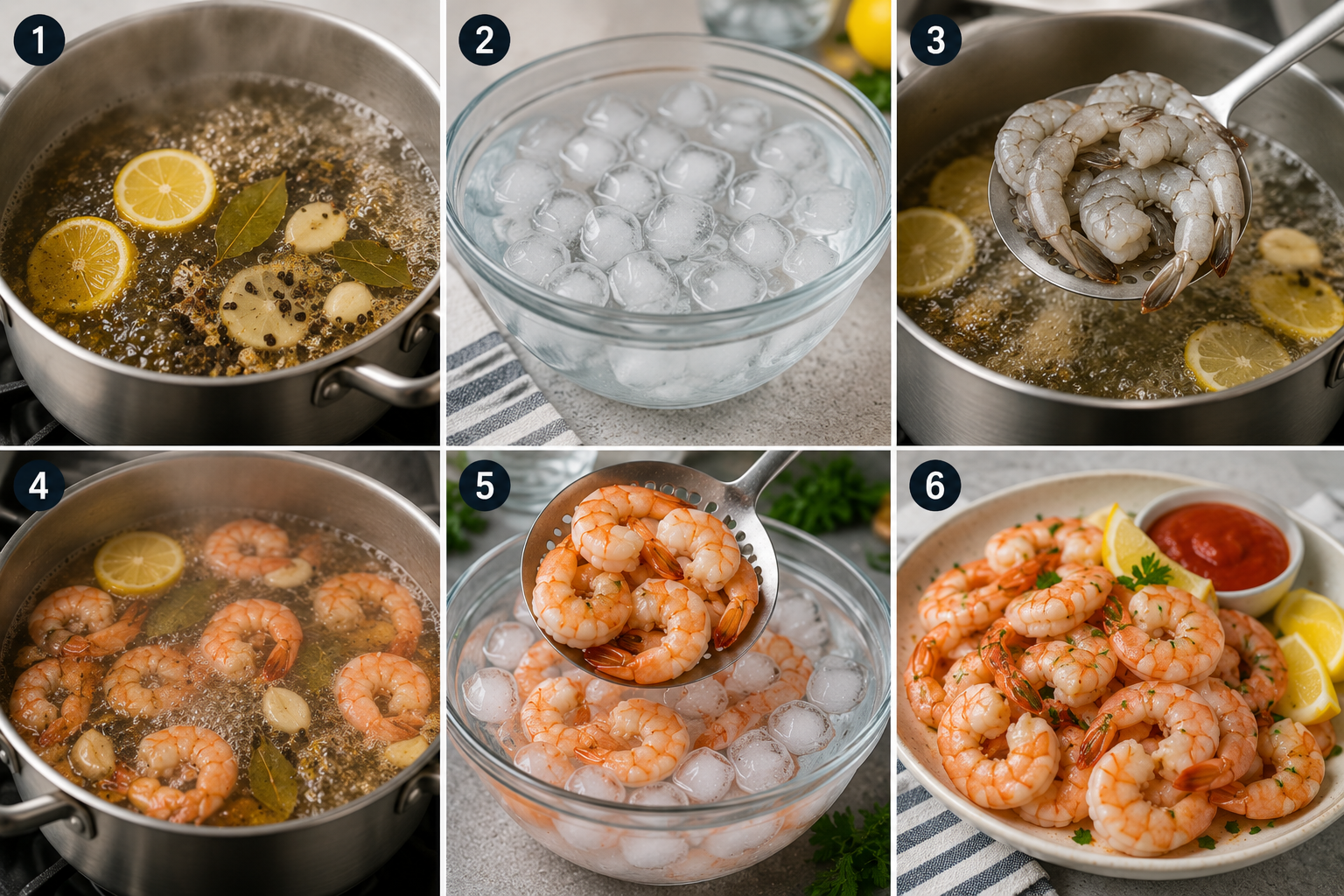
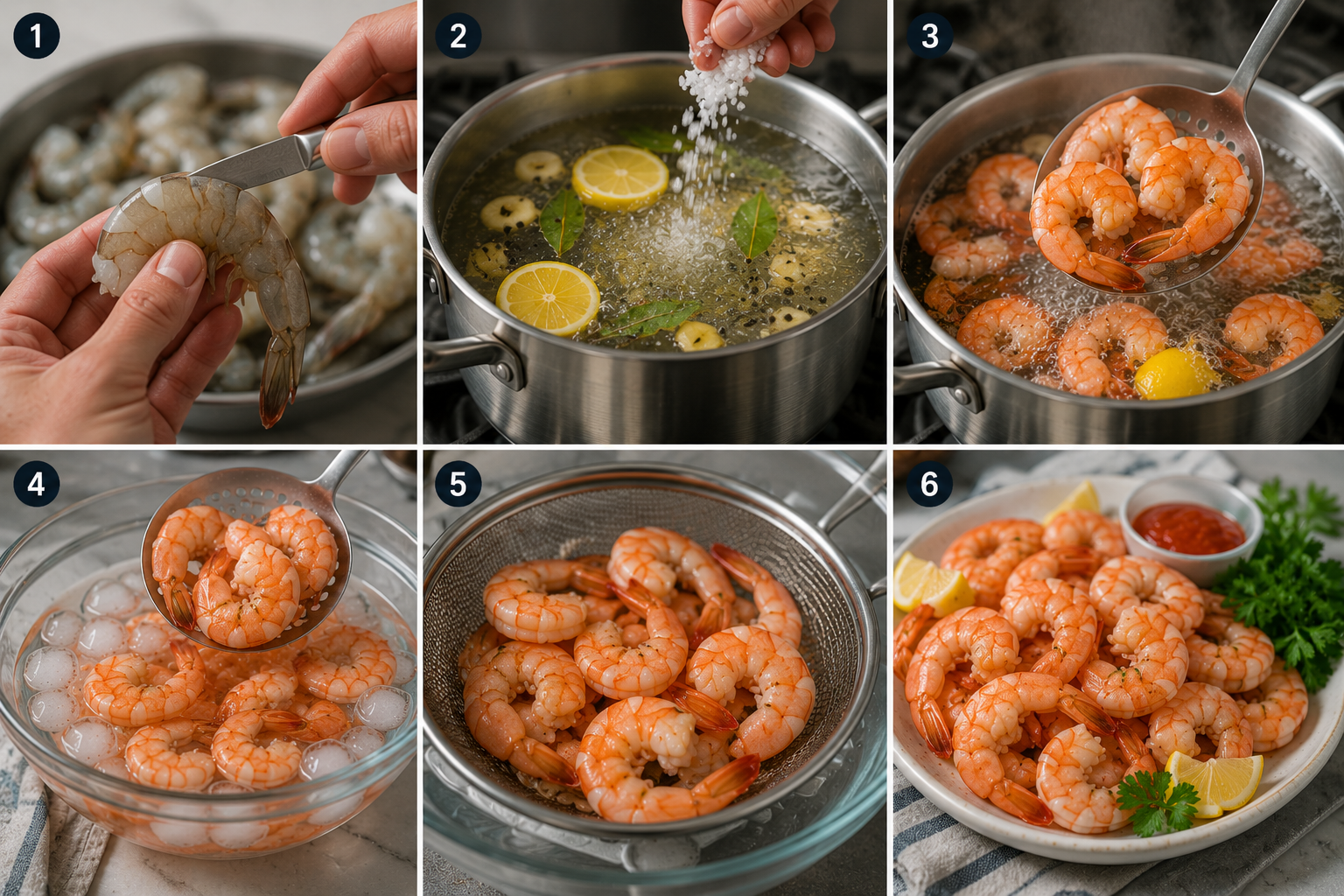
Step 1 — Build the boiling liquid: Combine water, salt, lemon juice and halves, bay leaves, smashed garlic, Old Bay, and peppercorns in a large pot. If using optional aromatics, add those now. Bring to a full rolling boil over high heat. This typically takes 8–10 minutes. Don’t add shrimp until the boil is vigorous — this matters for timing accuracy.
Step 2 — Prep the ice bath: While the water heats, fill a large bowl with cold water and a full tray of ice. Place it near the stove. The ice bath must be ready before the shrimp go in — you’ll need to transfer them immediately at doneness.
Step 3 — Add the shrimp: Lower the shrimp into the boiling liquid with a slotted spoon — don’t dump the entire pound in at once, which rapidly drops the water temperature. Add them gradually over 15–20 seconds, maintaining the boil as much as possible.
Step 4 — Time precisely: Start timing from when the water returns to a full boil after shrimp are added. For large (31/40) shell-on shrimp, begin checking at 2 minutes. Watch for the C-shape — the shrimp curves, the flesh is opaque at the thickest point, and the shell has turned bright pink-orange.
Step 5 — Transfer to ice bath immediately: As soon as shrimp reach the C-shape stage, transfer with a slotted spoon to the ice bath. Do not drain through a colander into the sink — you’ll lose control of timing for individual shrimp. The slotted spoon gives you direct control. Submerge fully in the ice water for at least 2 minutes.
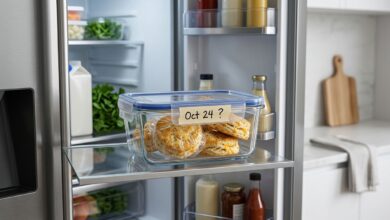
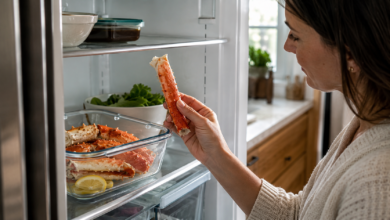
Step 6 — Drain and serve: Remove shrimp from the ice bath. Pat lightly dry if serving immediately. Serve shell-on with cocktail sauce and lemon, or peel and use in your intended recipe. Cooked shrimp can be refrigerated for up to 3 days in an airtight container.
How to Heat Precooked Shrimp
Precooked (already cooked) shrimp — whether from the grocery store frozen section or leftover from a previous meal — require warming rather than cooking. This is the distinction most people miss, and it’s why precooked shrimp so frequently come out rubbery: they’re treated like raw shrimp and cooked again.
The internal temperature target for precooked shrimp is just 60°C (140°F) — enough to be hot throughout without further protein contraction.
Best methods for heating precooked shrimp:
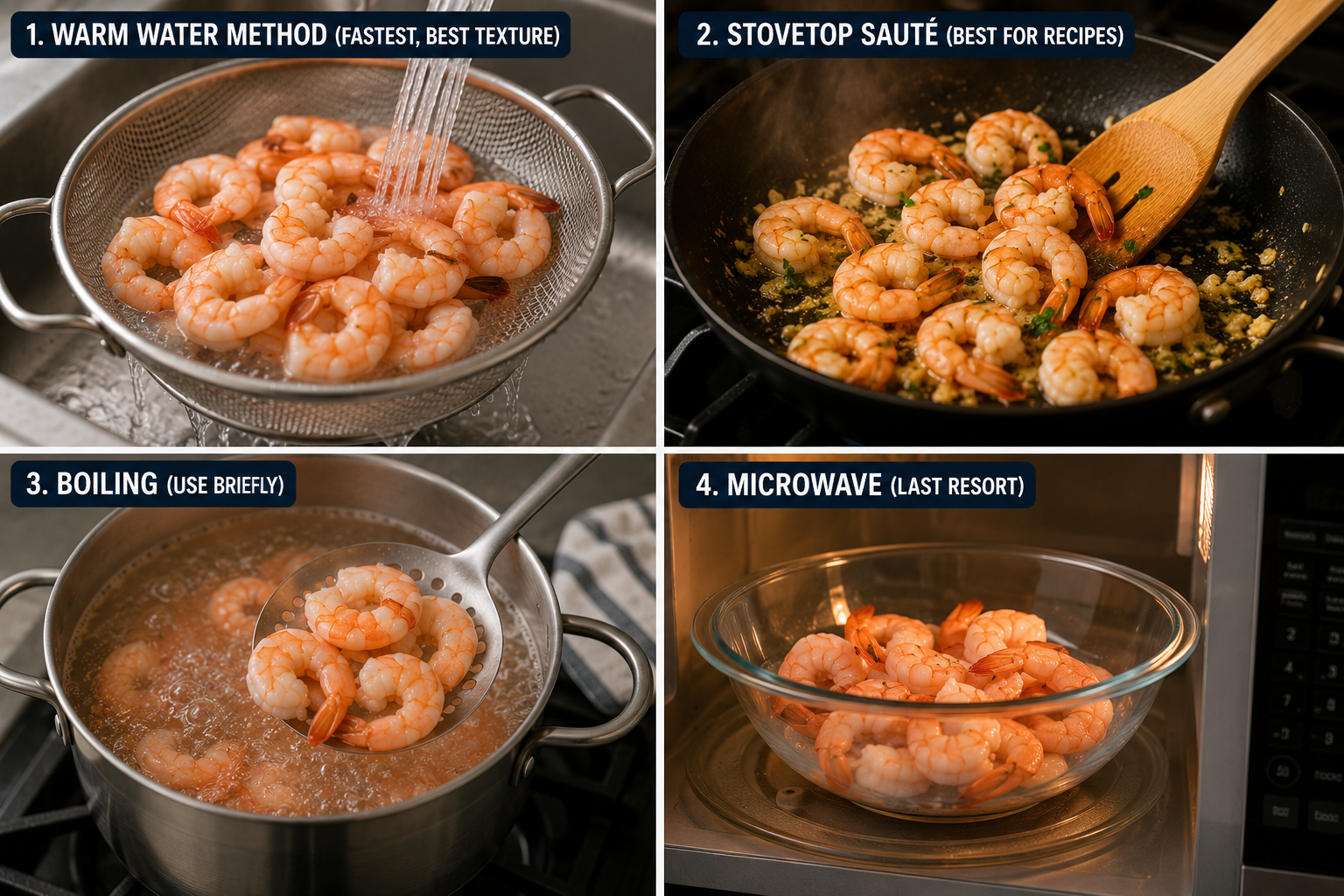
Warm water method (fastest, best texture): Place frozen precooked shrimp in a colander. Run warm (not hot) water over them for 3–5 minutes until fully thawed and warmed through. This is the gentlest method and produces the best texture — zero risk of overcooking because the water temperature never exceeds 40–45°C.
Stovetop sauté (best for recipes): Add precooked shrimp to a pan with butter, garlic, and olive oil over medium heat. Toss for 60–90 seconds — just long enough to heat through. Remove from heat before they change texture. They’re already cooked; you’re just warming them.
Boiling precooked shrimp: If you must boil them (for a shrimp boil or soup), submerge in boiling water for no more than 30–45 seconds. Pull out immediately — they need only to reach serving temperature, not cook through.
Microwave: Only recommended if no other method is available. Microwave on medium power (50%) in 30-second intervals, checking after each until warm. High-power microwaving creates steam inside the shrimp and produces significant texture degradation.
How Much Boiled Shrimp Per Person
The serving size depends on the role of the shrimp in the meal:
| Serving Context | Amount Per Person (Raw Weight) | Cooked Yield |
| Main course (shrimp only) | 300–350g (10–12 oz) raw | ~225–265g cooked |
| Main course (with sides/pasta) | 180–225g (6–8 oz) raw | ~135–170g cooked |
| Appetizer/cocktail shrimp | 100–150g (3.5–5 oz) raw | ~75–115g cooked |
| Shrimp boil (with corn, sausage, potatoes) | 225–300g (8–10 oz) raw | ~170–225g cooked |
.Tips for Boiling Shrimp Without Overcooking
Salt the water aggressively. Under-salted water produces shrimp that taste bland regardless of how good the shrimp were to start. The water should taste pleasantly salty — approximately 1% salinity, similar to mildly salted pasta water.
Never add shrimp to water that isn’t fully boiling. Water that’s just starting to boil, or simmering rather than boiling, creates an inconsistent cooking environment where shrimp in contact with the bottom of the pot cook faster than those near the surface. Full rolling boil only.
Add shrimp in batches if cooking large quantities. One pound of cold shrimp added to a pot of boiling water drops the temperature by 10–20°C immediately. For more than 1.5 lbs, add in two batches, allowing the water to return to a full boil between additions.
The C-shape is your only real timer. Size labels on shrimp packaging vary between suppliers, and actual shrimp size can differ from the count label. The C-shape doneness indicator works regardless of size, count, or supplier.
Prepare the ice bath first, always. Having to scramble to fill an ice bath while perfectly cooked shrimp sit in boiling water costs 30–60 seconds of carryover cooking. Set up the ice bath before you even turn on the burner.
Don’t devein after boiling. Deveining hot, shell-on shrimp after boiling is difficult, burns fingers, and results in uneven removal. Devein before boiling through the shell with a paring knife — it takes 30 seconds per shrimp and produces a cleaner result.
Rest time in ice bath: Leave shrimp in the ice bath for a full 2 minutes — not just a quick dip. The shrimp need to cool below 40°C internally before carryover cooking fully stops. A quick 10-second dip in ice water while the center is still very hot does not adequately halt the cooking process.
Calories in Boiled Shrimp
Boiled shrimp (without butter, oil, or heavy sauces) is one of the most calorie-efficient protein sources available. The boiling method itself adds virtually no calories — only the water and seasonings touch the protein, without any fat-based calorie contribution.
Per 100g cooked boiled shrimp (peeled, no sauce):
- Calories: 99 kcal
- Protein: 24g
- Total Fat: 0.9g
- Saturated Fat: 0.2g
- Carbohydrates: 0g
- Cholesterol: 189mg
- Sodium: ~190mg (varies by water salinity during boiling)
- Omega-3 (EPA + DHA): ~0.5g
- Selenium: ~38mcg (~70% of daily recommended intake)
- Iodine: significant source (supports thyroid function)
- Zinc: ~1.5mg (~14% DV)
- Vitamin B12: ~1.2mcg (~50% DV)
Serving size estimates:
Serving |
Calories |
Protein |
| 6 large boiled shrimp (~85g) | ~84 kcal | ~20g |
| 12 large boiled shrimp (~170g) | ~168 kcal | ~41g |
| Full lb (450g) cooked, peeled | ~446 kcal | ~108g |
The cholesterol content (189mg per 100g) looks high on paper, but dietary cholesterol’s impact on serum cholesterol is smaller than previously thought for most people. Shrimp is low in saturated fat, which has a more significant effect on LDL cholesterol than dietary cholesterol itself. Current evidence supports shrimp as a heart-healthy protein for most adults.
With cocktail sauce (2 tbsp): Add approximately 30–40 calories, 8–10g carbohydrates, and 300–350mg additional sodium. The sauce is where the calorie and sodium additions primarily come from in a shrimp cocktail preparation.
Healthy Version: Light Boiled Shrimp With Herbs
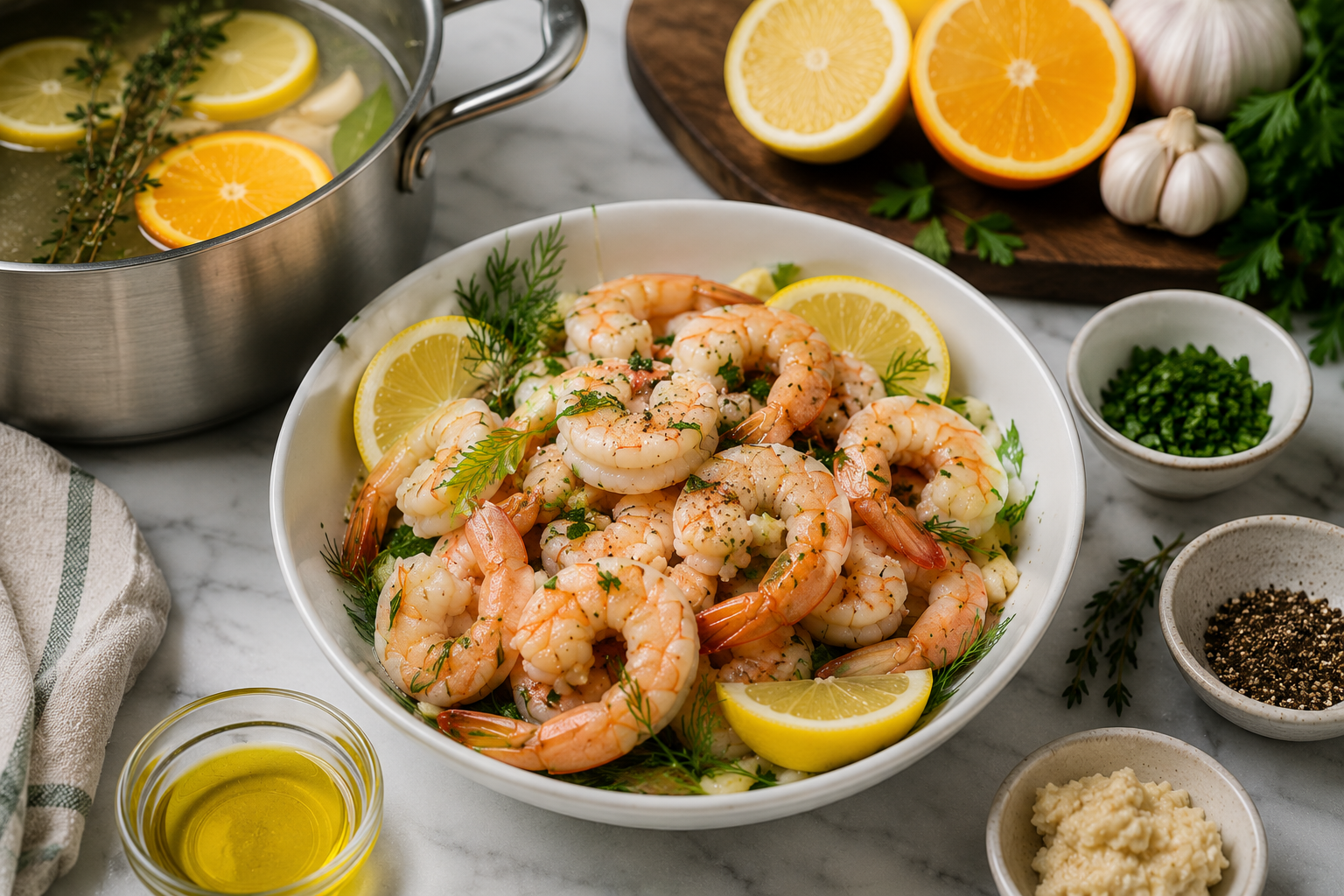
Standard boiled shrimp is already one of the healthiest protein preparations available. The “healthy version” adjustments focus on reducing sodium (the main consideration) and adding flavor without sauces.
Lower-sodium approach:
- Use 1 tbsp salt per 8 cups of water rather than 2 tbsp — still enough for flavor penetration without excessive salt load
- Avoid Old Bay if sodium is a concern (Old Bay contains approximately 160mg sodium per ¼ tsp) — replace with salt-free spice blends, fresh herbs, and lemon
- Choose fresh lemon juice and citrus aromatics heavily — acid mimics the flavor-enhancement function of salt and reduces how much salt you actually need
Salt-free boiling liquid (for sodium-managed diets):
- 8 cups water
- 1 lemon, halved and squeezed
- 1 orange, halved and squeezed
- 4 garlic cloves, smashed
- 1 tbsp apple cider vinegar
- 1 tsp celery seed
- 1 tsp black pepper
- 1 tsp dried thyme
- Bay leaves
Estimated sodium: ~90–110mg per 100g serving using this method (vs. ~190mg with standard salted water boiling).
Healthy serving approach: Skip cocktail sauce (300–400mg sodium per serving). Replace with:
- Fresh lemon juice squeezed directly over shrimp (~5 kcal, ~5mg sodium)
- Chopped fresh herbs: parsley, dill, or chives
- A small amount of prepared horseradish for heat (~15 kcal, ~50mg sodium per tsp)
- Grated fresh garlic or a light drizzle of good quality extra virgin olive oil for richness (~40 kcal per tsp)
Complete healthy boiled shrimp nutritional estimate per serving (150g cooked shrimp, herbs and lemon only):
- Calories: ~149 kcal
- Protein: ~36g
- Fat: ~1.5g
- Carbohydrates: ~2g
- Sodium: ~140–160mg
This is a genuinely exceptional nutritional profile for a satisfying, complete protein meal — 36g of protein at 149 calories with minimal fat and under 200mg of sodium.
Frequently Asked Questions
How long to boil shrimp on the stove? For large (31/40 count) shell-on shrimp in a full rolling boil: 2–3 minutes. For peeled large shrimp: 2 minutes. Always watch for the loose C-shape visual cue rather than relying solely on the clock. Transfer immediately to an ice bath when done.
How long to boil frozen shrimp? Frozen shrimp require 3–5 minutes depending on size, starting the timer after the water returns to a full boil following their addition. Thawing under cold running water for 5–7 minutes before boiling is preferable — it produces more even cooking throughout the shrimp and lets you use the standard (shorter) cook times.
How do you boil shrimp without overcooking? Three things: use a full rolling boil before adding shrimp, watch for the C-shape visual cue rather than counting minutes alone, and have an ice bath ready to halt carryover cooking the moment they’re done. Remove from the pot the instant the shrimp curves — don’t wait for full even pinkness across every surface.
How much boiled shrimp per person? For a main course, plan 300–350g (about ¾ lb) of raw shell-on shrimp per person. This accounts for shell weight and 25–30% moisture loss during cooking, leaving approximately 150–170g of actual cooked shrimp meat per person — a generous portion.
How do you heat precooked shrimp without overcooking? For precooked frozen shrimp, run warm (not hot) water over them in a colander for 3–5 minutes — this warms them gently without any risk of overcooking. For stovetop use, toss in butter and garlic over medium heat for 60–90 seconds maximum. Precooked shrimp need warming, not cooking — treat them accordingly.
Is it better to boil shrimp with or without the shell? Shell-on produces juicier, more flavorful shrimp because the shell slows moisture loss and contributes flavor compounds during boiling. If you’re eating them immediately — shrimp cocktail, shrimp boil — cook shell-on. If you’re using them in pasta, salads, or bowls where the shell is impractical to eat, peel before boiling and reduce cook time by 30–60 seconds per size.
Can you boil whole (head-on) shrimp? Yes — add 1–2 minutes to the shell-on timing for comparable body size. The head adds mass that requires additional cooking time. Use the opacity of the tomalley (yellow-orange tissue in the head) as a doneness indicator alongside the body’s C-shape. The cooking liquid from head-on shrimp becomes a flavorful quick stock worth saving.
How long do boiled shrimp last in the fridge? Cooked boiled shrimp keep for 3–4 days refrigerated in an airtight container. Store without the cooking liquid, which degrades the texture faster. For the best flavor and texture, eat within 2 days.
Conclusion
Boiling shrimp correctly comes down to four variables: full rolling boil before they go in, precise timing by size, the C-shape visual cue as your primary doneness indicator, and an ice bath the moment they’re done. Everything else — seasoned water, shell-on preparation, correct thawing for frozen shrimp — improves the result but these four are non-negotiable.
The most common mistake is not adding 2 or 3 extra minutes — it’s moving one step too slow on the ice bath, or waiting for full uniform pinkness before pulling them from the water.
Nutritionally, boiled shrimp without heavy sauces is among the cleanest protein preparations you can make: 24g of protein per 100g at 99 calories, minimal fat, meaningful selenium and B12, and essentially zero carbohydrates. A 150g serving at lunch or dinner delivers 36g of complete protein at roughly 150 calories — a protein efficiency that very few whole foods can match