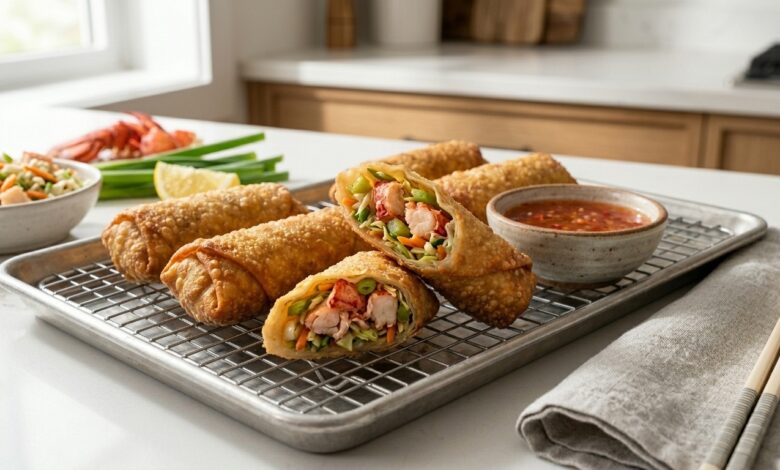
The lobster egg roll sits in an interesting position in the American food landscape — premium enough to appear on upscale gastropub menus alongside $18 craft cocktails, yet approachable enough that a home cook can produce a genuinely restaurant-quality version in under 45 minutes.
What actually makes a great lobster egg roll comes down to three things: how you handle the lobster, how you build the filling moisture balance, and how you manage the oil temperature during frying.
The Lobster Egg Roll: A Quick Origin Note Most People Skip
The egg roll is not a traditional Chinese dish in the way most Americans imagine. It’s a distinctly Chinese-American invention — a New York restaurant adaptation from the early 20th century, created to satisfy American diner preferences for crispy, portable appetizers. The original Chinese spring roll (chūn juǎn) uses a thinner, more delicate wrapper with a lighter filling. The American egg roll is a thicker, more robust product with a bubbly fried wrapper and a denser filling, built for a different eating context.
Lobster Egg Roll Ingredients
This ingredient list is designed for the best lobster egg roll recipe — one that prioritizes flavor balance, filling cohesion, and proper moisture control. Makes 8 full-sized egg rolls.
For the filling:
- 250g (about 9 oz) cooked lobster meat, roughly chopped into ½-inch pieces
- 100g (about 3.5 oz) cooked shrimp, roughly chopped (optional but highly recommended — see pairing section below)
- 1.5 cups green cabbage, very finely shredded
- ½ cup carrots, julienned or grated
- 3 green onions (scallions), thinly sliced — white and green parts separated
- 2 garlic cloves, minced
- 1 tsp fresh ginger, grated
- 1.5 tbsp soy sauce (low-sodium preferred)
- 1 tsp sesame oil
- 1 tsp oyster sauce
- ½ tsp white pepper
- 1 tsp cornstarch mixed with 2 tsp cold water (slurry)
- 1 tbsp neutral cooking oil (for sautéing)
For the wrappers and sealing:
- 8 egg roll wrappers (6×6 inch, standard grocery store size)
- 1 egg, beaten (egg wash for sealing)
For frying:
- Neutral oil with high smoke point (vegetable, canola, or peanut oil) — enough to fill a deep skillet or pot to about 3 inches depth
For dipping sauce options:
- Sweet chili sauce (store-bought, no adjustments needed)
- Spicy ginger-soy: 2 tbsp soy sauce, 1 tbsp rice vinegar, 1 tsp sesame oil, ½ tsp fresh grated ginger, pinch of red pepper flakes
- Garlic aioli with lemon (for a Western-leaning variation)
How to Make Lobster Egg Rolls: Step-by-Step Recipe Method
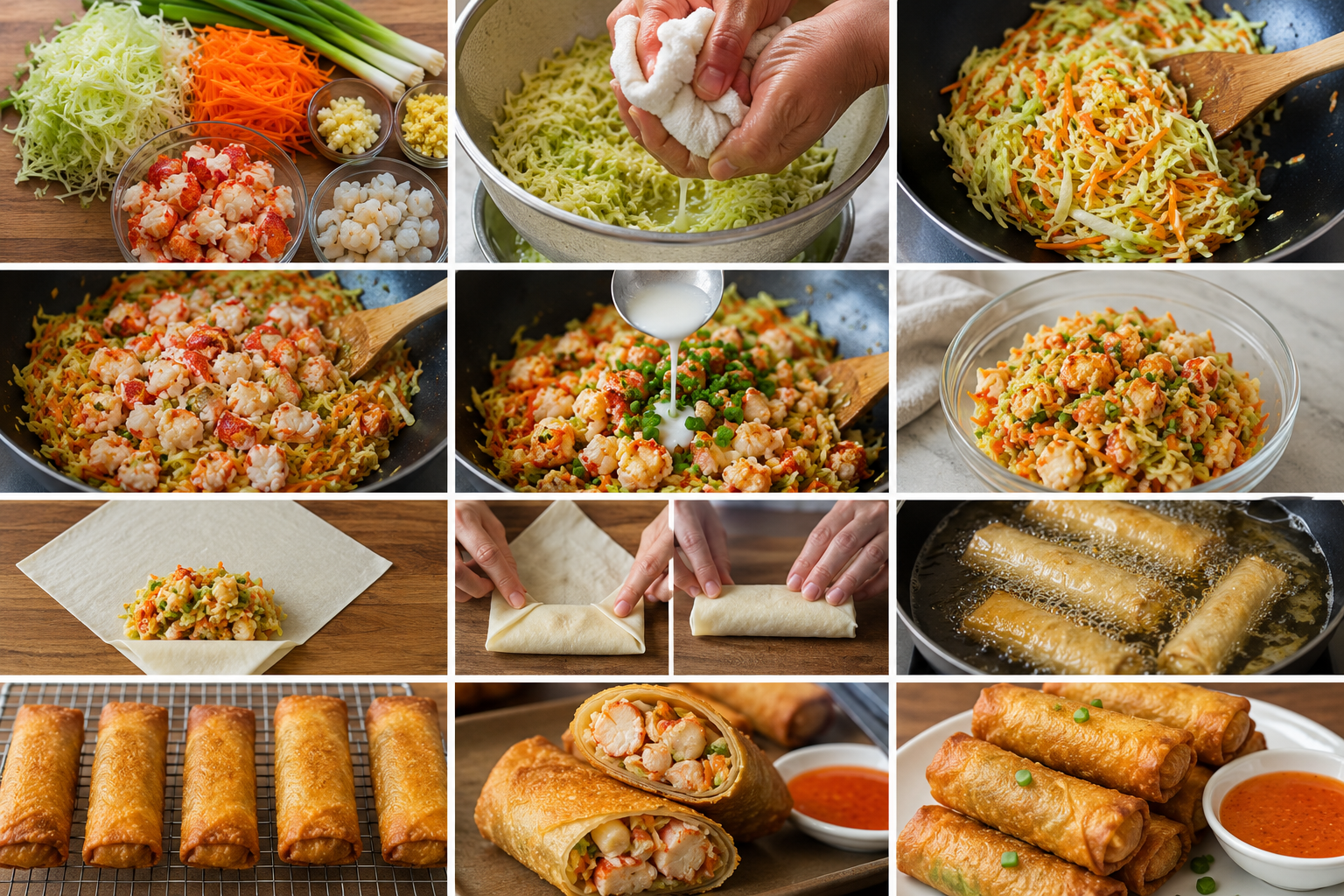
Step 1 — Prepare and dry the filling vegetables: Shred the cabbage and julienne the carrots as finely as possible — this matters more than most recipes acknowledge. Thick vegetable pieces create structural instability in the filling, push moisture into the wrapper during frying, and produce uneven bites. After shredding, salt the cabbage lightly, let it sit for 5 minutes, then squeeze out the excess liquid firmly using a clean kitchen towel. This single step significantly reduces wrapper sogginess.
Step 2 — Sauté the aromatics and vegetables: Heat 1 tbsp of neutral oil in a wok or wide skillet over medium-high heat. Add the white parts of the scallions, garlic, and ginger. Cook for 60 seconds until fragrant. Add the squeezed cabbage and carrots, sauté for 2–3 minutes until slightly softened but not limp — you want residual crunch. Add soy sauce, oyster sauce, sesame oil, and white pepper. Stir to combine.
Step 3 — Add seafood and bind the filling: Reduce heat to medium-low. Fold in the chopped lobster meat and shrimp (if using). Stir gently to avoid breaking up the lobster chunks — you want defined pieces in each bite, not a homogenous paste. Cook for 60–90 seconds only. Lobster is already cooked; you’re warming it through, not cooking it further. Add the cornstarch slurry, stir through, and cook for another 30 seconds until the filling tightens slightly and any remaining liquid is absorbed. The filling should be cohesive, not wet. Fold in the green parts of the scallions. Remove from heat and allow to cool completely before wrapping — at least 20 minutes at room temperature, or 10 minutes in the refrigerator.
Step 4 — Wrap the egg rolls: Place a wrapper on a clean surface in a diamond orientation (one corner pointing toward you). Spoon approximately 3 tablespoons of filling onto the center — avoid overfilling, which causes the wrapper to tear during frying. Fold the bottom corner up over the filling, then fold both side corners inward. Roll upward toward the top corner firmly, keeping even pressure. Seal the top corner with a brush of beaten egg. Set completed rolls seam-side down on a tray. Do not let them sit longer than 30 minutes before frying — the longer the filling contacts the wrapper, the more moisture transfers.
Step 5 — Fry to golden: Heat oil in a deep, heavy-bottomed pot or skillet to 175°C (350°F). Use a thermometer — oil temperature is not something you should guess for this dish. At temperatures below 165°C, the wrapper absorbs oil before it crisps. Above 185°C, the outside browns before the center heats through. Fry 3–4 egg rolls at a time, avoiding crowding. Turn every 60–90 seconds for even browning. Total fry time: 3–4 minutes per batch, until deep golden-amber all over. Drain on a wire rack (not paper towel — wire rack allows airflow underneath and prevents steaming of the bottom).
Step 6 — Rest and serve: Allow egg rolls to rest on the wire rack for 2 minutes before serving. This brief rest allows the internal steam to redistribute and the shell to firm up its final crunch. Serve immediately with dipping sauce.
Tips for the Best Lobster Egg Roll Result
Moisture is the enemy of crunch: Every step in this recipe that addresses moisture — salting and squeezing the cabbage, cooling the filling before wrapping, frying at proper temperature, draining on a wire rack — exists for the same reason: water turns wrappers soft. Most failed egg rolls trace back to moisture mismanagement, not technique errors.
Don’t skip cooling the filling: Filling that goes into the wrapper warm will steam the wrapper from the inside during frying, producing a soft rather than crispy result. Twenty minutes of cooling is minimum; the filling can be made the night before and refrigerated, which actually improves flavor as the soy, sesame, and ginger notes develop.
Use peanut oil if you can: Peanut oil has a smoke point of around 230°C — significantly higher than canola (204°C) or standard vegetable blends. The higher smoke point means you have more margin before the oil degrades, and peanut oil imparts a faint nuttiness that complements the sesame and ginger in the filling.
Lobster size matters: Chop the lobster into pieces roughly ½ inch in diameter. Smaller pieces blend into the background; larger pieces can create structural weak points in the wrapper where the filling shifts during rolling. Uniform medium pieces give you a recognizable lobster bite in every roll without tearing anything.
Test one roll first: Before frying the entire batch, cook a single egg roll as a test. This checks your oil temperature, confirms the filling cohesion, and verifies the seal is holding. Adjust before committing the full batch.
Freeze before frying for meal prep: Assembled, unfried egg rolls freeze beautifully. Lay them on a tray in a single layer, freeze until solid (about 2 hours), then transfer to a freezer bag. Cook directly from frozen at 175°C for 5–6 minutes, adding 90 seconds to the usual fry time.
Lobster Shrimp Egg Rolls: Why the Pairing Works
A lobster-only filling tastes good.The lobster meat, once chopped fine and mixed with vegetables, tends to blend into the background. Adding shrimp solves this by introducing a second shellfish with a different, slightly firmer texture and a more assertive brininess that lifts the overall flavor of the filling.
The ratio that works best is roughly 2.5 parts lobster to 1 part shrimp by weight. This keeps lobster as the dominant character — you can still taste it clearly — while the shrimp adds contrast. It also stretches the lobster further, which matters given its cost per serving.
Use cooked, peeled, and deveined shrimp with the tails removed, chopped into rough ½-inch pieces. Large or extra-large shrimp provide better texture than small/salad shrimp, which tend to disappear into the filling entirely. If you’re using raw shrimp, cook it briefly in the sautéing step (30 seconds in the pan before adding the vegetables) before proceeding.
What Goes with Lobster Egg Rolls
This is worth thinking about because lobster egg rolls are rich and savory — the sides and accompaniments you choose either balance that richness or amplify it, and the choice changes the entire eating experience.
For balance (the better choice most of the time):
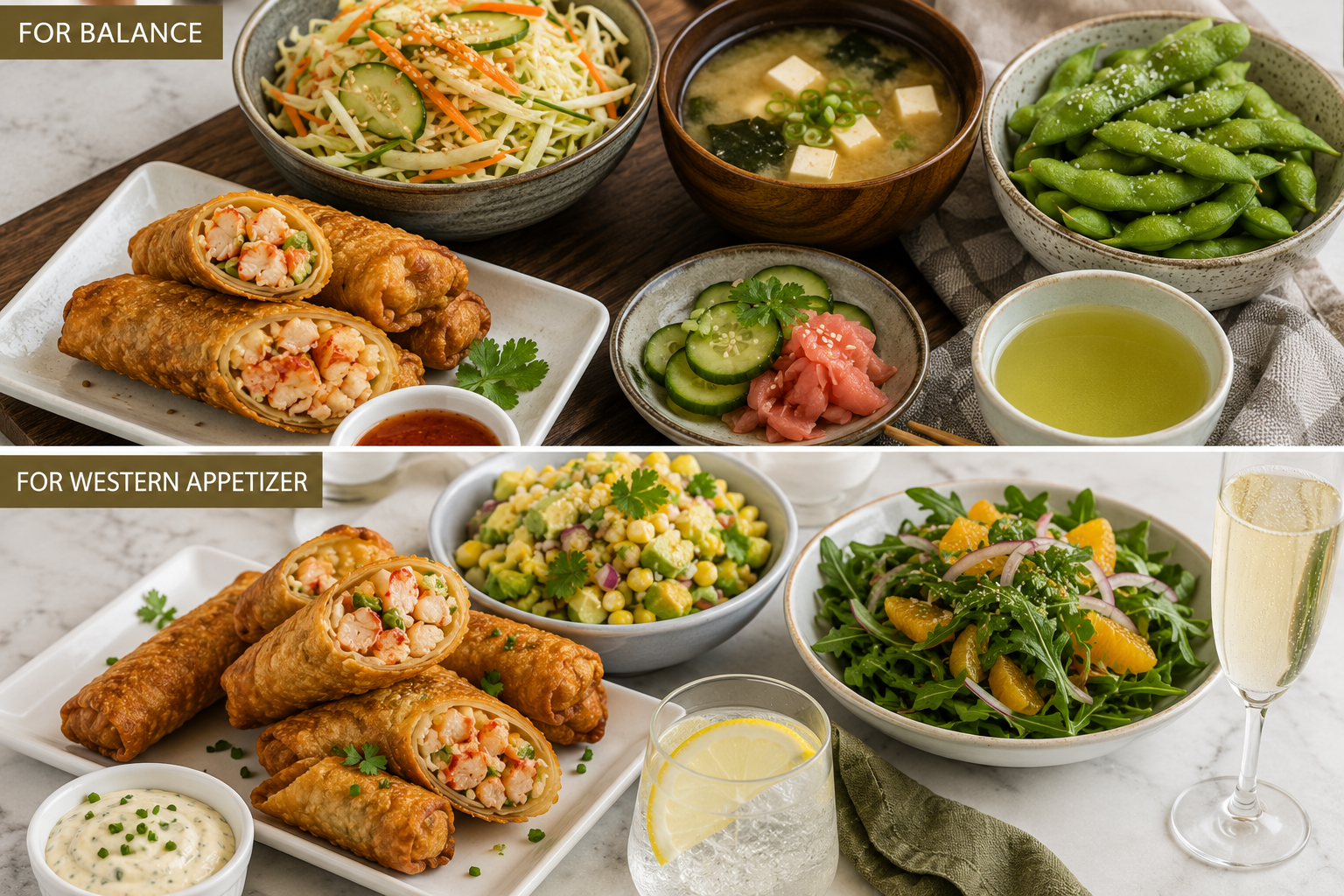
- Asian slaw — Finely shredded napa cabbage, thinly sliced cucumber, shredded carrots, dressed with rice vinegar, sesame oil, a small amount of honey, and toasted sesame seeds. The acidity and crunch cut directly through the richness of the fried egg roll and the lobster butter notes.
- Miso soup — Light, warm, and savory without being filling. A small bowl of miso with tofu and wakame alongside 2–3 egg rolls makes a complete, balanced light meal.
- Pickled ginger and cucumber — Simple quick pickles in rice vinegar and salt provide acid contrast without adding calories or competing flavors.
- Steamed edamame with sea salt — Earthy, protein-rich, and textually neutral. A good pairing for a fuller meal scenario.
For a Western appetizer presentation:
- Roasted corn and avocado salsa — The sweetness of corn, creaminess of avocado, and lime acidity create a dip-and-dip moment with the egg roll that works particularly well at gatherings.
- Light citrus salad — Arugula, orange segments, thinly sliced red onion, and a lemon vinaigrette. The bitterness of the arugula and citrus brightness pair well with the fried richness.
- Garlic aioli — For those who find Asian dipping sauces unfamiliar, a lemon-garlic aioli bridges the flavor gap without any friction.
For drinks: Dry sparkling wine (Cava, Prosecco, or Champagne), dry Riesling, or a crisp lager. f non-alcoholic, sparkling water with a slice of lemon or a green tea with honey works well.
Frozen Lobster Egg Rolls: Are They Worth It?
Frozen lobster egg rolls have improved significantly in quality over the past few years. The most common issue with frozen varieties has historically been thin or poorly-distributed lobster filling — a marketing-heavy product where “lobster” appears in the name but accounts for a minor percentage of the actual filling volume.
The better frozen options use real claw, knuckle, or tail meat as a primary ingredient rather than imitation lobster or heavily processed surimi. Checking the ingredient list before buying is essential: lobster should appear within the first three ingredients, not buried after cabbage, soy protein, and modified starch.
How to cook frozen lobster egg rolls properly:
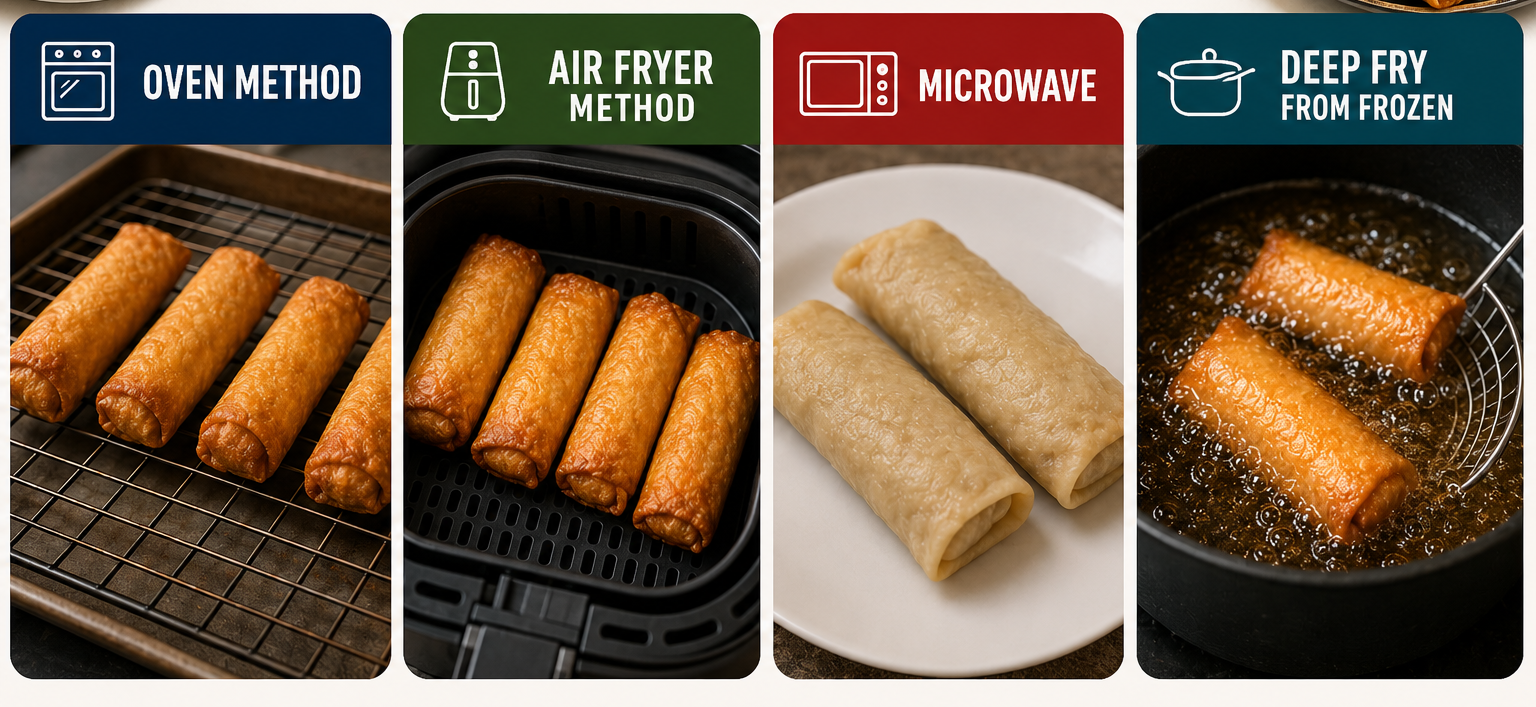
- Oven method (best results): Preheat to 200°C (400°F). Place frozen rolls on a wire rack over a baking sheet. Lightly spray with neutral oil. Bake 18–22 minutes, flipping once at the midpoint. This produces a genuinely crispy wrapper that the microwave method cannot replicate.
- Air fryer method (best for small batches): 190°C for 10–12 minutes, flipping once at the halfway mark. The circulating hot air produces browning very close to deep-frying without any added oil.
- Microwave: Not recommended. The wrapper softens to a leathery, steamed texture that removes the main reason to eat an egg roll in the first place.
- Deep fry from frozen: Possible, but oil temperature needs to drop to 165°C (rather than 175°C for fresh) to allow the frozen center to heat through before the outside over-browns. Add 90 seconds to standard cook time.
Lobster Egg Roll Calories: The Full Breakdown
Calorie counts vary depending on filling composition, wrapper size, frying oil absorption, and whether any dipping sauce is included. The following is based on a standard 8-egg-roll batch using the recipe in this article.
Per single egg roll (1/8 of the recipe):
Component |
Approximate Calories |
| Lobster meat (~31g per roll) | ~28 kcal |
| Shrimp (~12g per roll) | ~12 kcal |
| Cabbage, carrot, aromatics | ~15 kcal |
| Soy sauce, sesame oil, oyster sauce | ~12 kcal |
| Egg roll wrapper | ~65 kcal |
| Oil absorbed during frying (~1 tsp per roll) | ~40 kcal |
| Total per egg roll | ~172 kcal |
With dipping sauce:
- Sweet chili sauce (1 tbsp): +30 kcal → ~202 kcal
- Spicy ginger-soy (1 tbsp): +15 kcal → ~187 kcal
- Garlic aioli (1 tbsp): +60 kcal → ~232 kcal
A two-roll serving runs approximately 344–404 calories depending on sauce choice — a manageable appetizer portion with meaningful protein from the lobster-shrimp filling.
Frozen brand estimates: Commercial frozen lobster egg rolls typically run 180–230 calories per roll, but this varies significantly by brand and filling volume.
Nutrition Profile of Lobster Egg Rolls
Beyond the calorie count, the nutritional picture is more favorable than a fried appetizer typically looks:
- Protein: Approximately 8–11g per egg roll from the lobster and shrimp combination. Two rolls deliver 16–22g of protein — meaningful for an appetizer.
- Fat: 6–8g per roll, primarily from frying oil. The lobster and shrimp filling is inherently low in fat.
- Carbohydrates: 16–18g per roll, primarily from the egg roll wrapper (wheat-based).
- Sodium: 280–360mg per roll from soy sauce, oyster sauce, and wrapper ingredients. A two-roll serving provides 560–720mg — roughly 25–30% of the daily recommended ceiling for most adults. Choosing low-sodium soy sauce reduces this by approximately 40%.
- Selenium: Meaningful contribution from both lobster and shrimp — selenium supports thyroid and antioxidant function.
- Iodine: Shellfish is among the most reliable dietary iodine sources, and both lobster and shrimp are good contributors.
Healthy Version of Lobster Egg Roll
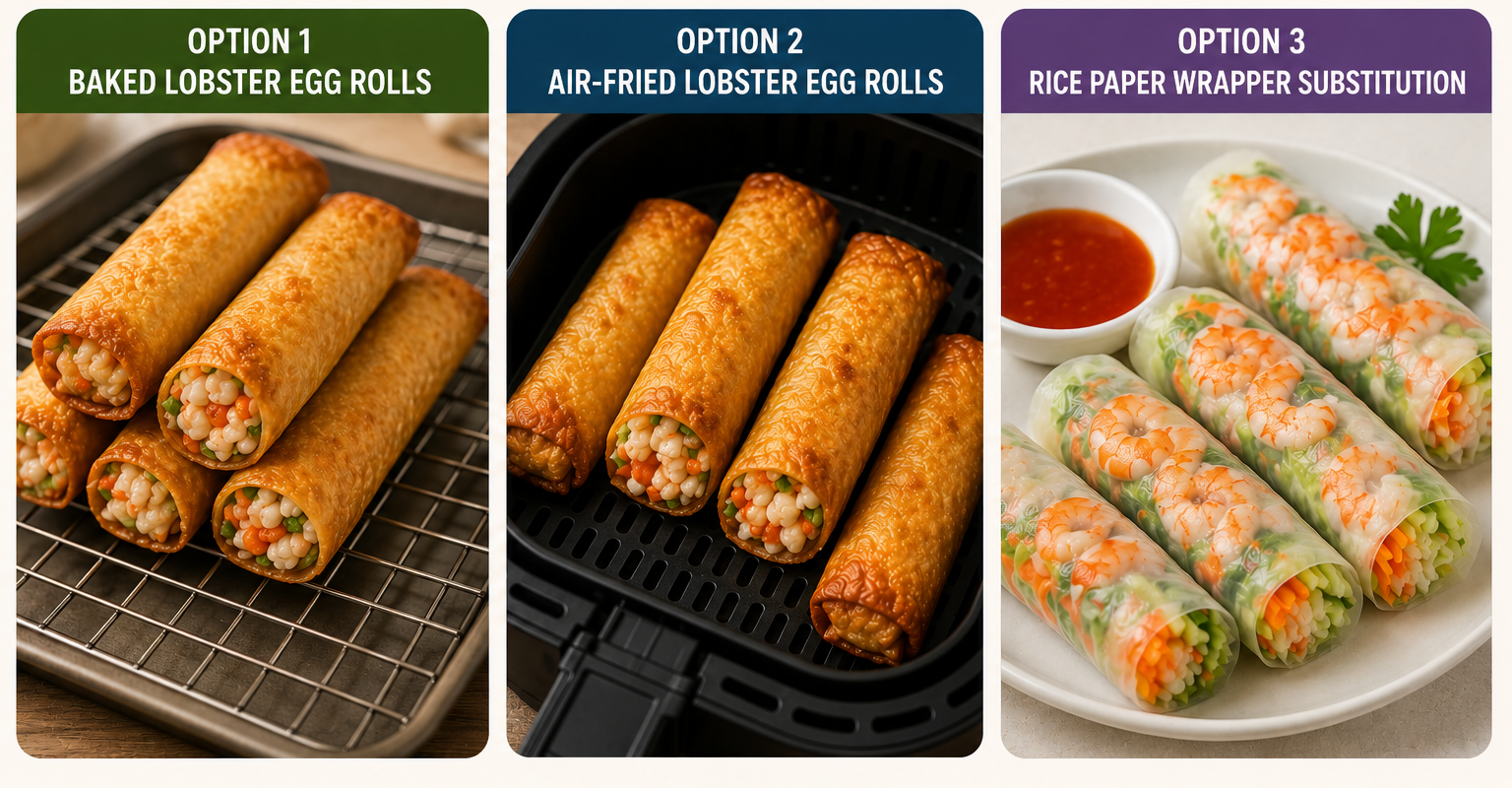
The core filling in this recipe is already nutritionally solid — the calories and fat come almost entirely from the frying process and the egg roll wrapper. Two practical modifications address both without fundamentally changing the dish.
Option 1 — Baked lobster egg rolls: Assemble the rolls exactly as described. Preheat the oven to 210°C (410°F). Place rolls seam-side down on a wire rack over a baking tray. Brush lightly with a neutral oil spray or a thin layer of beaten egg (for browning). Bake 18–22 minutes, turning once at the 10-minute mark. The wrapper won’t achieve the same deep caramel crunch as deep-frying, but the result is genuinely crispy — particularly at the edges and bottom — at roughly 60–70 fewer calories per roll.
Estimated baked calorie count: ~120–130 kcal per roll (no absorbed frying oil), vs. ~172 kcal fried.
Option 2 — Air-fried lobster egg rolls: Preheat the air fryer to 195°C (385°F). Lightly spray rolls with oil. Cook 8–10 minutes, flipping at the halfway point. The air fryer produces results noticeably closer to deep-frying than oven baking, with a properly blistered and golden wrapper at approximately 130–140 kcal per roll.
Option 3 — Rice paper wrapper substitution: Use rice paper wrappers instead of wheat-based egg roll wrappers, served as fresh (unfried) spring rolls. The same lobster-shrimp-vegetable filling works beautifully in rice paper. The resulting rolls are approximately 80–90 kcal each, gluten-free, and require no cooking after assembly. The eating experience is completely different — lighter, fresher, more delicate — but nutritionally far superior per serving.
Lower-sodium adjustment: Replace standard soy sauce with tamari (25% less sodium) or use coconut aminos (40–50% less sodium) without meaningfully affecting flavor. Skip the oyster sauce and add a small additional drop of sesame oil to compensate for the umami reduction.
Frequently Asked Questions
How do you make lobster egg rolls from scratch? The key steps are: shred and squeeze moisture from cabbage; sauté aromatics and vegetables; fold in pre-cooked, chopped lobster and shrimp; cool the filling completely; wrap in egg roll wrappers with an egg wash seal; deep fry at 175°C for 3–4 minutes until golden. The most important variable is filling moisture control — a wet filling produces soft, greasy wrappers regardless of frying technique.
Can I use frozen lobster for egg rolls? Yes. Frozen lobster tails or claw meat, fully thawed and patted dry before chopping, work well. The key is drying the meat thoroughly after thawing — frozen seafood holds more surface moisture than fresh, and that moisture transfers directly into the filling and wrapper. Pat with paper towels aggressively before adding to the pan.
What goes with lobster shrimp egg rolls? Asian slaw dressed with rice vinegar and sesame oil is the most complementary pairing — the acidity balances the richness. Other strong pairings include miso soup, edamame, pickled cucumber, a light citrus arugula salad, or steamed jasmine rice for a more substantial meal. For drinks, dry sparkling wine, crisp lager, or dry Riesling work well.
Are frozen lobster egg rolls good? Quality varies significantly by brand. The best frozen versions use real lobster as a primary ingredient and produce a satisfying result when baked in a wire rack oven or air-fried. Avoid microwaving — it destroys the wrapper texture. Check that “lobster” appears within the first three ingredients on the label.
How many calories in a lobster egg roll? A homemade fried egg roll using the recipe in this article runs approximately 172 calories each, with ~200 calories when including a tablespoon of sweet chili dipping sauce. Baked or air-fried versions run 120–140 calories per roll. Commercial frozen varieties typically range from 180–230 calories depending on size and filling composition.
Can I make lobster egg rolls ahead of time? Yes — in two ways. The filling can be made 24 hours ahead and refrigerated; the assembled, unfried rolls can be frozen for up to 2 months and cooked directly from frozen. Do not assemble and refrigerate finished rolls for longer than 30 minutes before frying — the wrapper will soften from filling moisture.
What is the best dipping sauce for lobster egg rolls? Sweet chili sauce is the most widely compatible and crowd-pleasing option. For something more complex, a spicy ginger-soy sauce (soy, rice vinegar, sesame oil, grated ginger, red pepper flakes) balances the lobster’s sweetness with acidity and heat. For a Western variation, lemon garlic aioli works well.
Can lobster egg rolls be made gluten-free? Yes — substitute rice paper wrappers for wheat-based egg roll wrappers and use tamari or coconut aminos in place of soy sauce. The rice paper version is served fresh (not fried) or can be lightly pan-seared for slight crisping. The wheat-free version is also lower in calories.
Conclusion
A well-made lobster egg roll is a significantly better dish than most people expect — one where the technique is as important as the ingredient quality. The filling logic, the moisture management, the oil temperature, and the resting time are not minor details.
For home cooks, the homemade version beats most restaurant versions simply because you control the lobster quantity — which in commercial preparations is invariably lower than the name suggests. Making a full batch of eight rolls costs roughly the same as ordering four at a mid-tier restaurant, delivers considerably more lobster per bite, and takes about 45 minutes including cooling time.
The healthy adaptations — baked, air-fried, or rice paper — are not consolation options. Baked egg rolls at 210°C with an oil spray produce a genuinely satisfying crunch at 30–35% fewer calories than frying. The rice paper spring roll version is a different dish but a nutritionally excellent one.