What Is Skate Seafood — Biology, Flavor, Cooking, and Everything You Need to Know
If you’ve spotted “skate wing” on a restaurant menu or at a fish counter and had absolutely no idea what you were looking at, you’re in a large and understandable majority. Skate is one of the most consistently underestimated seafood options available — eaten enthusiastically across France, Belgium, Portugal, and parts of coastal England, yet largely unfamiliar to most North American and Asian home cooks despite being caught in large numbers off both coasts of the United States.
Understanding what is skate seafood means engaging with a fish that operates by different biological rules than most, tastes like something between scallop and crab despite looking nothing like either, requires specific freshness management before cooking, and raises genuine sustainability questions that depend entirely on which species and which fishery you’re sourcing from. This guide covers all of it.
What Skate Is — The Biological Background
Skate is a member of the ray family, and its “wings” — actually the large pectoral fins — are the edible portion. Skates belong to the order Rajiformes and are part of Chondrichthyes — the class of cartilaginous fish that also includes sharks. Their entire skeleton is made of cartilage rather than true bone, which places them in an entirely different anatomical category from the finfish most people are familiar with.
Skates are bottom-dwellers with an arrow-like body and large flat pectoral fins. There are over two hundred skate species. They are found in cold and temperate oceans worldwide, from shallow coastal water as shallow as 30 meters to depths exceeding 1,000 meters depending on the species. Their flattened, diamond-shaped body allows them to rest on and move along the ocean floor, where they commonly feed on mollusks, crabs, and small fish — and their meat often takes on the flavor of the creatures they eat.
Skate vs. Ray — the naming confusion:
Skate and rays are really the same family and often exactly the same species. It’s just that the names have got confused and overlapped over the centuries. Fishmongers, chefs, and fish shops talk about “skate wings,” yet these are actually wings removed from thornback, homelyn and undulate rays. In truth, the correct term “skate” only really applies to the much bigger species of fish caught from deeper water.
The practical distinction for consumers: stingrays have a venomous barb on their tail; skates do not. Skates tend to have shorter and thicker tails than stingrays and they don’t have a stinger. From a culinary standpoint, the wings of both are prepared identically.
Common species in the US market:
East Coast skates include: Barndoor Skate, Clearnose Skate, Little Skate, Winter Skate, and Thorny Skate. Pacific Coast skates include: Big Skate, California Skate, and Longnose Skate. Of these, the winter skate is the primary species harvested for human consumption in the US market, sold mostly from Massachusetts and Rhode Island year-round according to NOAA Fisheries.
What Skate Tastes Like — And Why the Comparison to Scallop Holds Up
Skate wing has a mild, clean flavor with a noticeable sweetness. People who’ve tasted both consistently compare it to crab meat or well-cooked scallops. This isn’t marketing — there’s a structural reason behind the comparison.
Skate fish have a mildly pronounced flavor, firm flesh, and a high collagen content which gives it a unique texture when cooked. That collagen is the operative word. Skate wings have a high collagen content, which can give a nice, gelatinous texture when cooked. When prepared correctly, the flesh pulls away from the central cartilage in long, silky strands that resemble crab leg meat in both appearance and feel on the palate. This is why skate has historically been used — and occasionally misrepresented — as an imitation scallop in some markets.
The flesh is light beige to pinkish in color but becomes off-white when cooked. The flavor is genuinely mild — milder than most white fish — which makes it receptive to strong accompaniments like brown butter, capers, acidic reductions, and sharp herbs without the fish flavor competing with them.
The diet-flavor connection: Because skate feed primarily on crustaceans and mollusks along the ocean floor, their meat often takes on the flavor of the creatures they eat — which partially explains why the scallop and crab comparison holds up so consistently. The diet creates a base sweetness that most fish simply don’t have.
According to Barton Seaver, seafood author, skates are at the peak of their flavor in winter, when they are not spawning. This seasonal character — most notable from late autumn through early spring — is worth knowing for anyone sourcing skate from a quality fishmonger.
The Ammonia Smell — Why It Happens and When to Worry
This is the aspect of skate that confuses and puts off more first-time buyers than anything else, and it deserves a direct, science-backed explanation.
Skates, like sharks, use urea in their bloodstream to maintain water balance in saltwater. It’s an essential part of their biology. Once the fish dies, that urea begins breaking down into ammonia, which is why skate can develop a sharp, chemical-like smell in your fridge even a day after purchase.
The reason skate smells like this is because the urea in their flesh is an integral part of their survival. All sea fish have a battle with salt. The salt contained in seawater is continually trying to leach any moisture out of the fish. Bony fish solve the problem using special chloride cells in their gills, which get rid of excess salt. Cartilaginous fish don’t have the same gill structure, so instead they maintain a supply of urea in their bloodstream, which reverses the tendency to lose water to the salt, and enables them to keep a healthy osmotic balance.
The critical practical distinction:
A faint ammonia note in raw skate is normal and disappears completely during cooking. Strong ammonia smell, on the other hand, means the fish is past its prime.
Fresh skate fish should not have an ammonia odor; if it does then reject it — but this guidance is calibrated for restaurant receiving, where fish is expected to arrive very fresh. For home cooks buying from a counter, a faint note is acceptable and manageable. The smell fully disappears once heat is applied.
The counterintuitive aging principle:
Most dead fish get progressively worse for wear as every moment passes. But interestingly, not skate and rays. The opposite is true for these species. If you’re going to eat the wings from a skate, then it’s better to keep them for a couple of days before you introduce them to your hot skillet. Even at fisheries that pride themselves on serving the very freshest fish money can buy, they’ll make sure to keep ray wings a couple of days before showing them the hot floor of the frying pan.
This stands in direct contrast to every other fin fish. A 2-day-old skate wing from a quality source is better eating than a same-day one — the ammonia-producing urea breakdown has progressed enough to purge some compounds, but hasn’t gone far enough to damage the flesh quality. It’s one of the few fish where the traditional “freshest is best” rule doesn’t apply uniformly.
Managing the smell before cooking:
Some cooks soak the raw wing in milk or acidulated water (water with a squeeze of lemon) for 30 minutes before cooking to neutralize any lingering odor. If there is an odor of ammonia, soaking in milk or water that has been acidified with vinegar or lemon juice for four hours or more can remove any taste of ammonia.
How to Select, Clean, and Prep Skate Wing
At the fish counter:
Look for wings with firm, moist flesh that springs back slightly when pressed. The color should be consistent — pale beige to light pink. Avoid wings with browning at the edges, dried-out surfaces, or wet, slimy texture (different from the natural moisture of healthy fish). A faint smell is acceptable; anything approaching sharp or chemical at the counter means don’t buy it.
West Coast varieties average 3–5 lbs per wing while East Coast varieties average 1–3 pounds per wing. For home cooking, smaller East Coast wings are easier to manage in a home skillet and are the more common retail option.
Skinning:
If you’re buying a whole skate wing, you’ll need to remove the skin from both sides before cooking. The skin is tough and not pleasant to eat. You can peel it off by making a small incision at one edge, then gripping the skin with a dry towel or pliers and pulling it away in one sheet. Underneath, you’ll find the pale, striated meat.
Most fish counters sell skate wings already skinned, and sometimes already filleted off the cartilage, so you may be able to skip that step entirely. When buying from a quality fishmonger, ask whether the wings are already prepped — saving the skinning step is worth the asking.
The cartilage structure: Unlike fin fish, skate doesn’t have conventional bones running through the flesh. The central cartilage sheet acts as the structural frame, with meat layered on either side. To get boneless fillets, slide a knife between the meat and the central cartilage to separate each layer. This is easier than it sounds — the cartilage is smooth and the meat separates cleanly with minimal pressure.
How to Cook Skate — Methods and Techniques
Pan-Searing (The Benchmark Method)
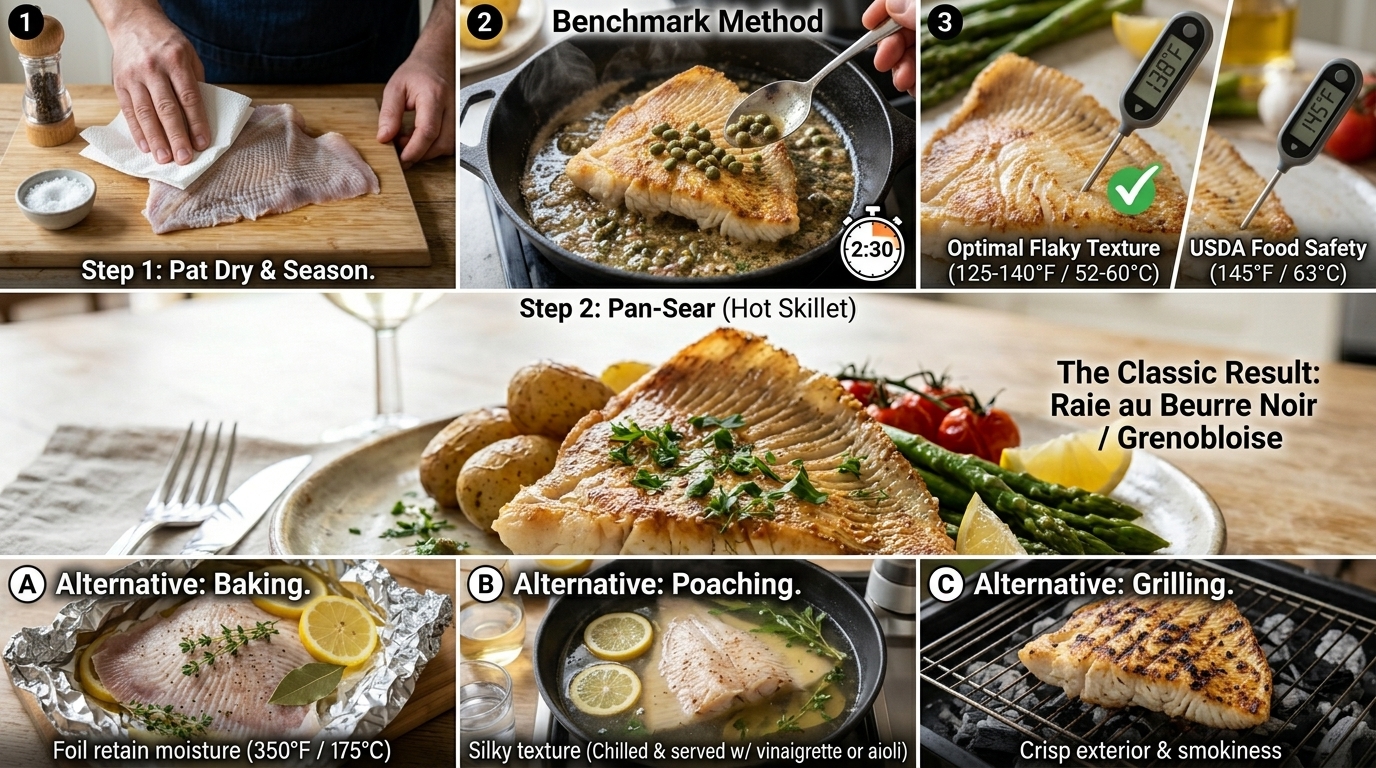
If you are new to working with skate, pan-searing is the easiest way to do so, which emphasizes its natural sweetness. Wipe the wing and dry it before searing; too low a heat or too much water in the pan kills the sear and results in an over-cooked, brown skate wing.
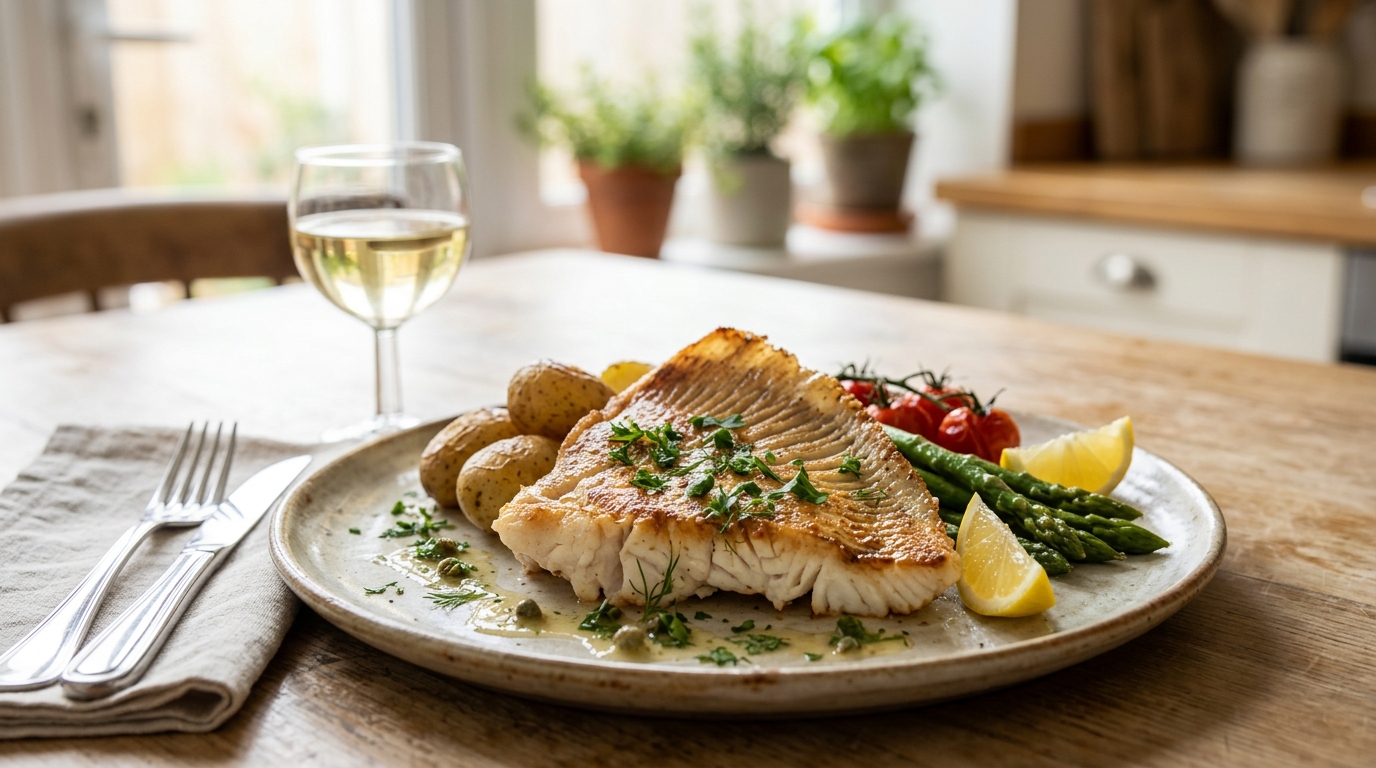
The classic French preparation — raie au beurre noir — is where skate built its culinary reputation. The classic French preparation is pan-searing in browned butter with capers and lemon, a dish called “raie au beurre noir.” The nutty butter complements the sweet, delicate meat perfectly. Pat the fillet dry, season it with salt and pepper, and cook it in a hot skillet with oil or butter for about two to three minutes per side until golden.
The à la grenobloise method, described by experienced cooks, adds a final sauce of shallots, pickled capers (with their brine), minced parsley, dry white wine, and lemon juice — spooned over the pan-seared wing before serving. The acid from the capers and wine cuts through the collagen richness effectively.
Recommended finished cooking temperatures for skate: 125–140°F (52–60°C) for flakier/firm texture in pan-frying, baking, or sous vide, resulting in a tender, crab-like texture that flakes easily. Avoid overcooking past this range, as the fish can become tough and chewy. 145°F (63°C) meets USDA food safety minimums for all cooked fish.
Baking:
Bake at 350°F for even heat penetration. Foil helps retain moisture if you need a softer finish. Baking works well for larger wings that are difficult to manage in a skillet. Add aromatics — lemon slices, fresh thyme, a bay leaf — to the foil packet to infuse flavor during cooking.
Poaching:
You might consider poaching your skate in a court-bouillon (wine, water, lemon, herbs) as an alternative to dry-heat methods. Poached skate develops a particularly silky texture from the collagen softening in moist heat. Chill the poached wing and serve with vinaigrette or aioli for a cold preparation that showcases the crab-like texture particularly well.
Grilling:
Lightly oil the wing and grill over medium heat to develop a crisp exterior while keeping the interior tender. Use a fish basket or grill mat to prevent the wing from sticking or falling through the grates. The slight smokiness from the grill complements skate’s sweetness well.
The one cooking mistake that ruins it:
Do not over cook skate or ray as the flesh will break along the separations. The collagen that makes skate texturally special degrades and causes the flesh to separate and crumble if pushed past 145°F for any extended period. Pull it slightly earlier than you think it needs — carryover heat will finish the job.
Flavor pairings:
Skate’s mild profile takes well to bright acids and simple aromatics. Lemon, capers, parsley, and thyme are reliable pairings. Brown butter adds richness without overpowering the meat. For Asian-leaning preparations, soy, ginger, and scallions provide a clean contrast. Keep the seasoning balanced — the goal is to support the natural flavor, not mask it.
Sustainability — The Species-Specific Picture
This is where the conversation around skate gets genuinely complicated, and where buying responsibly requires knowing which species you’re purchasing.
The common skate (Dipturus batis) was uplisted to critically endangered on the IUCN Red List in 2006 and is protected within the EU. It is prohibited to land both species of the common skate complex according to EU fishing regulations.
The winter skate (Leucoraja ocellata) is considered endangered by the IUCN, due to human and natural causes including fishing and predation. Their range has declined 99% from the 1980s to 2015 in the Southern Gulf of St. Lawrence sector.
However, the US picture is different from the European one:
U.S. wild-caught winter skate is a smart seafood choice because it is sustainably managed and responsibly harvested under U.S. regulations. According to the 2022 stock assessment, winter skate is not overfished and not subject to overfishing.
The divergence matters. The same species — winter skate — is endangered in Canadian Atlantic waters while sustainably managed in US federal waters. This is a fisheries management story, not simply a species-level one.
What this means for buyers:
- Ask your fishmonger or retailer whether the skate is US-caught and MSC-certified (Marine Stewardship Council) where available
- US-caught winter skate from the Northeast Skate Complex (Massachusetts, Rhode Island) is the most responsibly sourced option for North American buyers
- European-caught skate should be verified as species other than common skate (Dipturus batis) or flapper skate (Dipturus intermedius), both of which are prohibited from landing under EU regulations
- Avoid skate of unknown origin — the species-level conservation status varies so dramatically across the global skate family that origin and certification are the only meaningful guides
Nutrition — What Skate Seafood Delivers Per Serving
Skate is one of the leaner, lower-calorie seafood options available — nutritionally closer to cod and sole than to salmon or mackerel.
Per 100g (3.5 oz) serving of raw winter skate (NOAA Fisheries/USDA data):
Nutrient |
Amount |
Notes |
| Calories | 90 kcal | Very lean protein source |
| Protein | 20g | ~36% DV — high-quality complete protein |
| Total Fat | 1g | Near fat-free |
| Saturated Fat | 0g | No saturated fat |
| Carbohydrates | 0g | Zero carbohydrate |
| Cholesterol | Minimal | Lower than most shellfish |
| Sodium | Low | Minimal unless brined |
| Collagen | High | Unique structural protein — supports joint and skin health |
What skate’s nutrition profile means in context:
cAt 90 calories and 20g protein per 100g serving with virtually no fat, skate is one of the most calorie-efficient complete proteins in seafood. It compares favorably to cod (82 kcal, 18g protein) and beats chicken breast (165 kcal, 31g protein but with higher fat) on a pure calorie-to-protein efficiency basis.
The collagen advantage: Skate’s high collagen content is not just a textural characteristic — it’s a nutritional one. Collagen peptides support joint health, skin elasticity, and connective tissue integrity. While the collagen in cooked food is partially broken down during digestion, peer-reviewed research supports the benefit of dietary collagen peptides from animal-source foods. Skate’s naturally high collagen content makes it one of the richer food-source collagen options available.
Omega-3 content: Skate is a lean fish and therefore carries less omega-3 fatty acids per serving than fatty fish like salmon or mackerel. It should not be considered a primary omega-3 source. For that function, combine skate with supplemental fatty fish or algae-based DHA.
B12, selenium, and phosphorus are present in meaningful quantities, as they are in most seafood. Skate’s micronutrient density aligns with comparable white fish like halibut and cod.
Frequently Asked Questions About Skate Seafood
Q: What does skate seafood taste like? When cooked properly, skate offers a unique texture similar to lobster or crab meat, with a mild, sweet flavor that’s reminiscent of scallops. It’s significantly milder than most fin fish, which makes it very approachable for people who don’t typically enjoy strongly flavored seafood.
Q: Is skate the same as stingray? They are closely related — both are cartilaginous fish in the order Rajiformes — but they are different animals. Stingrays have a venomous barb on their tail; skates do not. Both are sold as “skate wing” in many markets. The culinary preparation is identical.
Q: Why does skate smell like ammonia? Skates use urea in their bloodstream to maintain water balance in saltwater. Once the fish dies, that urea begins breaking down into ammonia. A faint smell is normal and disappears completely during cooking. A strong smell indicates the fish is past its prime.
Q: Is skate seafood safe to eat? Yes — properly handled and cooked skate is safe. Cook to 145°F internal temperature per USDA guidelines. Soak in milk or acidulated water for 30 minutes to 4 hours before cooking if any ammonia note is present. Do not eat skate raw.
Q: Is skate a sustainable seafood choice? It depends entirely on origin. U.S. wild-caught winter skate is sustainably managed and responsibly harvested under U.S. regulations, with the stock not overfished according to the 2022 assessment. European common skate is critically endangered and prohibited from commercial landing under EU law. Always verify origin and look for MSC certification.
Q: Can you eat skate like scallops? The flavor and texture comparison is apt, and some historical fish processors did punch skate wing into rounds to sell as imitation scallops — a practice that has been documented and criticized. They are not the same food, but the textural similarity is real enough that skate adapts well to preparations designed for scallops: pan-searing in browned butter, poaching, and light grilling.
Q: How do I buy the best skate wing? Buy from a reputable fishmonger who can confirm species and origin. Look for firm, moist flesh with minimal odor. US-caught winter skate from the Northeast is the most reliably sustainable choice in North American markets. Ask if the wing has been pre-skinned — most retail wings are.
Q: What is the best sauce for skate wing? Brown butter with capers and lemon (beurre noisette) is the classic French answer and remains the most widely recommended pairing. The nutty richness of browned butter and the sharp acidity of lemon and capers complement the sweet, mild flesh perfectly without overpowering it.
Conclusion — Skate Seafood Deserves More Attention Than It Gets
What is skate seafood? It’s a cartilaginous bottom-feeding fish in the ray family whose large pectoral fin — the skate wing — offers a crab-textured, scallop-flavored eating experience that most people have never tried despite it being caught in large numbers off both US coasts.
The ammonia issue that puts people off is manageable: a brief soak in milk or acidulated water before cooking neutralizes any faint smell, and heat eliminates it completely. The aging principle — that 2-day-old skate cooks better than same-day — is counterintuitive but well-established among experienced cooks and fishers. The cooking window is narrow, so watch the temperature carefully and pull at 125–140°F for the best collagen-rich, meltingly tender texture.
Nutritionally, skate delivers 90 calories and 20g of protein per 100g serving — among the most efficient protein-to-calorie ratios in all of seafood — with near-zero fat and a meaningful collagen content that sets it apart from most white fish. It’s not a primary omega-3 source, but its lean protein profile and micronutrient density make it a genuinely valuable addition to a varied seafood diet.
The sustainability story requires care: US-caught winter skate from NOAA-managed Northeast fisheries is a responsible choice; European common skate is critically endangered and should be avoided. Knowing the species and origin when you buy is the only way to navigate this responsibly.
For home cooks willing to try something outside the usual salmon-and-shrimp rotation, a properly prepared skate wing with brown butter and capers is one of the more memorable seafood meals available — and at a price point well below the premium proteins it resembles on the plate.