How Long Does Sushi Last in the Fridge — Everything You Need to Know
The short answer to how long does sushi last in the fridge depends almost entirely on what’s inside the roll. Raw fish sushi is operating on a fundamentally different timeline than a cooked shrimp roll, a cucumber avocado maki, or a California roll made with imitation crab. Treating them all the same is where people get into trouble.
Most people know sushi doesn’t last long — but the specific numbers, the reasons behind them, and the signs that tell you something’s gone wrong are less understood. This guide covers the exact refrigerator shelf life for every sushi type, the bacteria and parasites that make the timeline non-negotiable, the critical role sushi rice plays that most storage guides overlook, how to store leftover sushi correctly, and when to throw it out with confidence.
The Core Shelf Life Numbers — By Sushi Type
The U.S. Department of Agriculture (USDA) provides the clearest official guidance: raw fish and shellfish can be safely refrigerated for 1–2 days, while cooked seafood can be refrigerated for 3–4 days. These figures form the backbone of all sushi storage guidelines, though the practical reality for sushi specifically is often shorter once you factor in rice and seaweed.
Shelf life by sushi type:
Type of Sushi |
Room Temperature |
In the Fridge |
| Raw fish sushi (nigiri, sashimi, spicy tuna rolls) | Max 2 hours | 1–2 days |
| Cooked seafood rolls (shrimp tempura, eel, cooked crab) | Max 2 hours | 3–4 days |
| Vegetable-only rolls (cucumber, avocado, sweet potato) | Max 2 hours | 3–5 days |
| Imitation crab (California rolls, kani) | Max 2 hours | 2–3 days |
| Sashimi (raw fish, no rice) | Max 2 hours | 1–2 days |
| Store-bought/grocery store sushi | Eat same day | 1 day maximum |
The honest practitioner’s version of this table: those “3–4 days” numbers for cooked rolls are technically safe, but the texture and flavor degrade significantly after day two. Nori (seaweed) goes soft and slightly slimy within 12–24 hours in the fridge. Sushi rice hardens and loses its seasoned softness. What you can safely eat on day three often doesn’t resemble what you ordered. The food safety window and the quality window are two different things.
Why the Clock Starts Before You Open the Fridge
Here’s the part most storage guides skip: when you pick up sushi from a restaurant or grocery store, the clock has already been ticking for some time. A restaurant dinner where raw fish sat at the table for 90 minutes, then rode in your car for 20 minutes, then sat on your counter while you unloaded groceries has already consumed most of its two-hour room temperature window before it ever reaches your refrigerator.
The FDA’s guidance is explicit: perishable foods should not remain in the “temperature danger zone” of 40–140°F (4–60°C) for more than 2 hours total — not 2 hours after you decide to put them away, but across the entire time from preparation to refrigeration. Outdoors above 90°F, that window drops to 1 hour.
This matters practically when evaluating how long your leftover sushi will actually last in the fridge. If a restaurant roll had significant table time and travel time before refrigeration, the 1–2 day window for raw fish sushi shrinks considerably. Store-bought grocery store sushi is especially unpredictable — you generally have no information about when it was made, how long it sat in the display case before you bought it, or how consistently it was kept cold during transport.
For store-bought sushi, the practical guidance is: eat it the same day. The labeled date tells you the last safe day, not the optimal day.
The Bacteria and Parasites That Make These Timelines Non-Negotiable
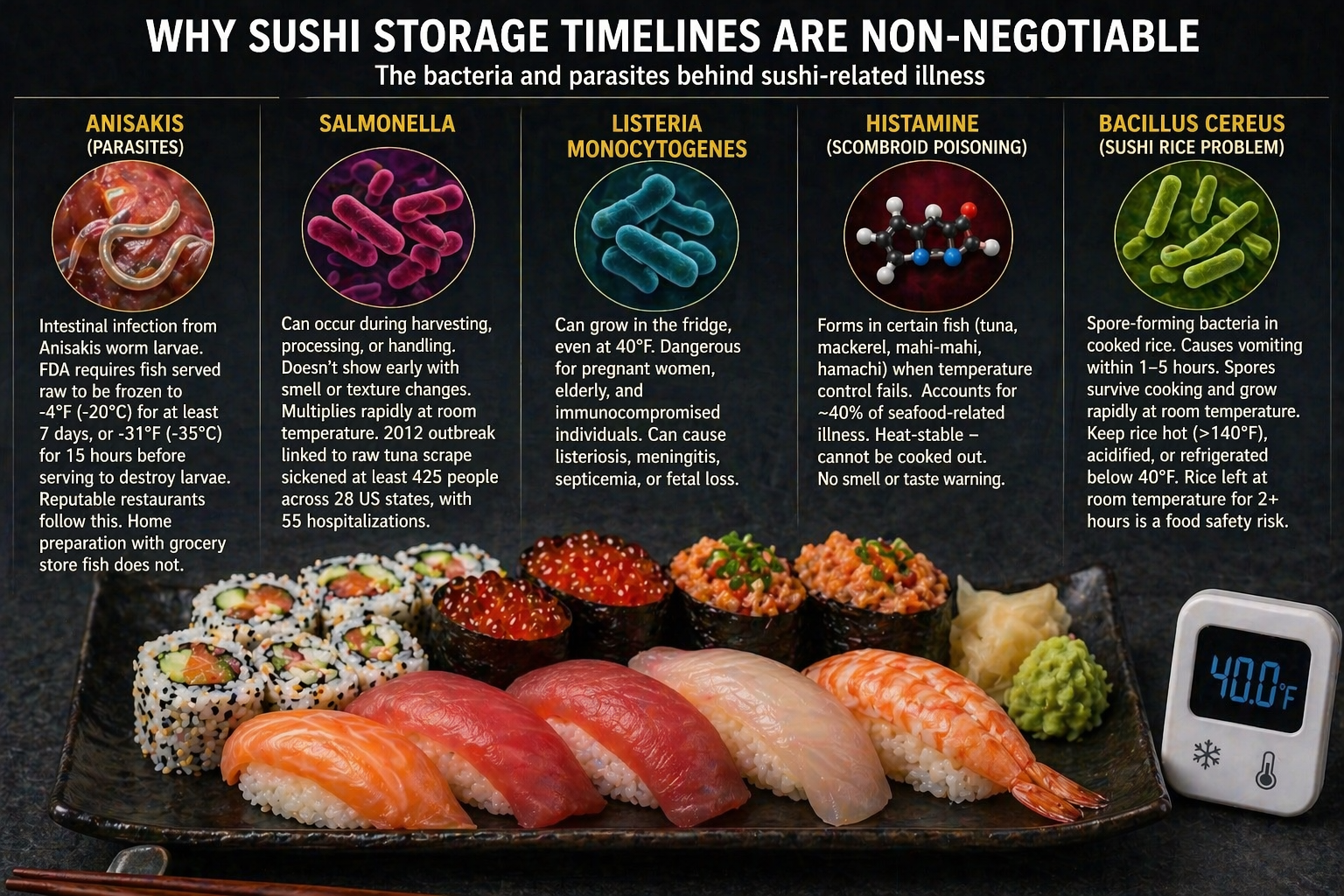
Understanding why these numbers exist makes them easier to follow and harder to rationalize away.
Anisakis (parasites): Anisakidosis — intestinal infection from Anisakis worm larvae — is one of the most common sushi-associated illnesses in Japan and an increasing concern in the US as raw fish consumption grows. The FDA requires fish served raw to be frozen to -4°F (-20°C) for at least 7 days, or -31°F (-35°C) for 15 hours before serving, specifically to destroy Anisakis larvae. Reputable sushi restaurants follow this. Home preparation with grocery store fish does not.
Salmonella: A 2012 outbreak linked to raw tuna scrape (Nakaochi scrape) sickened at least 425 people across 28 US states, with 55 hospitalizations. Salmonella contamination in raw fish can occur during harvesting, processing, or handling — and critically, Salmonella doesn’t announce itself with obvious smell or texture changes in early contamination stages. It multiplies rapidly at room temperature, and the 40°F refrigerator limit slows but does not stop growth.
Listeria monocytogenes: A 2019 recall by Fuji Food Products covered ready-to-eat sushi, salad, and spring roll products distributed along the East Coast and Upper Midwest after Listeria contamination was found in routine testing. Listeria is particularly concerning because it can grow — slowly — even in a properly calibrated refrigerator at 40°F. For healthy adults, Listeria infection is usually manageable. For pregnant women, elderly individuals, and immunocompromised people, it can cause meningitis, septicemia, or fetal loss.
Histamine (scombroid poisoning): Certain fish — tuna, mackerel, mahi-mahi, hamachi — can produce histamine when temperature control fails during storage or handling. Histamine poisoning accounts for approximately 40% of all seafood-related foodborne illness, according to Food Safety Magazine. Unlike bacterial contamination, histamine is heat-stable: you cannot cook it out. A piece of tuna that spent too long in the temperature danger zone before reaching your plate contains histamine regardless of how fresh it looks or smells. This is why sushi temperature control from catch to table matters, and why the storage timelines aren’t suggestions.
Bacillus cereus (sushi rice problem): This is the bacteria angle most people miss completely. Cooked rice is a known growth medium for Bacillus cereus — the spore-forming bacteria responsible for a characteristic rice-associated food poisoning that causes vomiting within 1–5 hours of eating. B. cereus spores survive cooking, and the bacteria grow rapidly in cooked rice held at room temperature. Sushi rice must be either kept hot (above 140°F), acidified (the rice vinegar seasoning does provide some protection), or refrigerated below 40°F. Rice sitting at room temperature on your counter for 2+ hours — separate from the fish concern — is already a food safety risk.
Proper Refrigerator Storage — What Actually Works
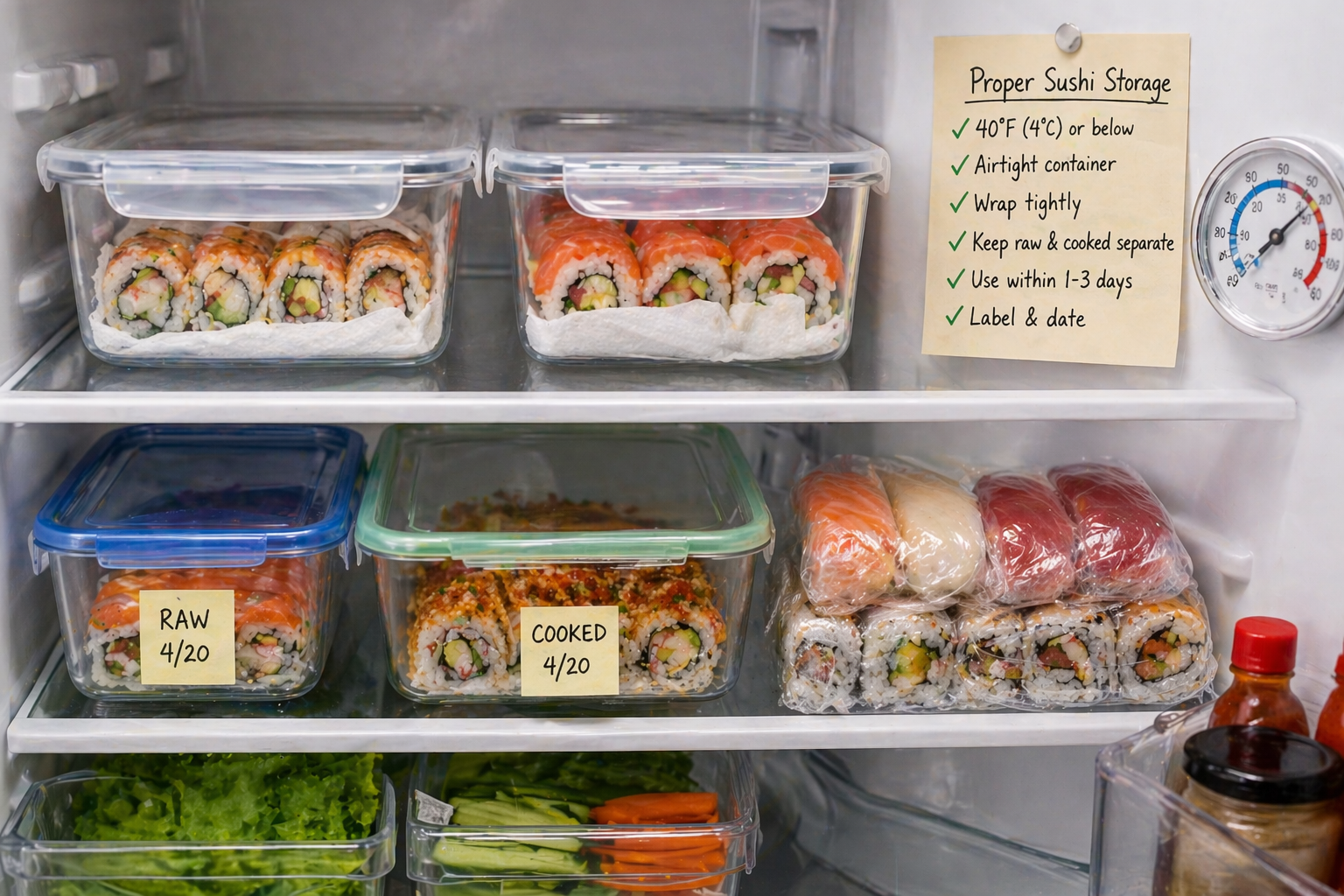
Knowing the shelf life numbers is step one. Knowing how to extend freshness to those limits is step two.
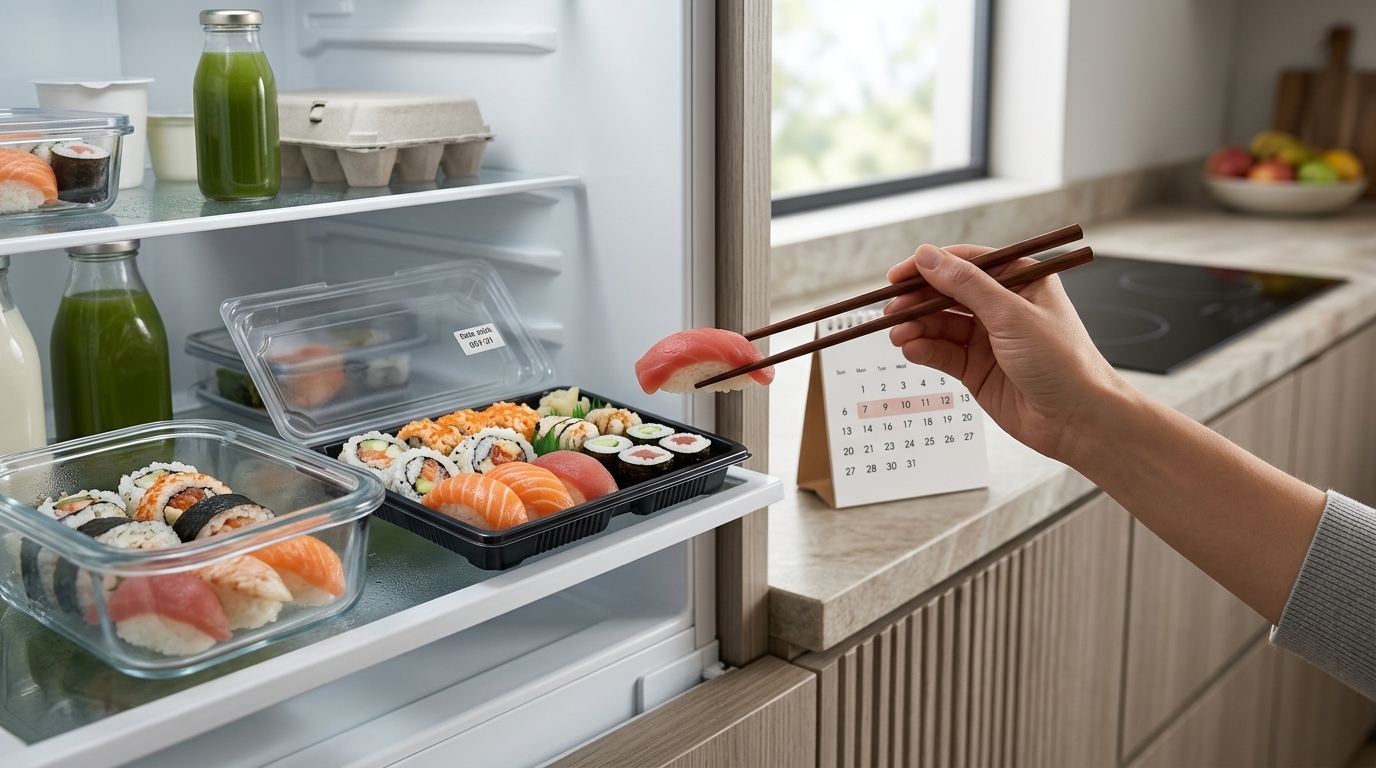
Temperature: Store sushi at 40°F (4°C) or below. Most home refrigerators run warmer than their dial suggests — the actual temperature varies by location within the fridge. The coldest consistent zone is typically the back of the middle shelf, away from the door. The fridge door is the warmest zone due to frequent opening; never store sushi there.
Wrapping method: If you have an airtight container: place sushi in a single layer if possible, press a sheet of plastic wrap directly against the sushi surface to minimize air contact, then seal the lid. If you only have plastic wrap: wrap each piece individually or the entire portion tightly, removing as much air as possible. Loose wrapping allows moisture loss from the rice and oxidation of the fish — both accelerate quality decline.
A useful technique for rice texture: Dampen a paper towel lightly and place it around the wrapped sushi before sealing it in a container. The slight humidity slows the rice from hardening. Don’t overwet — excess moisture promotes bacterial growth. This is a kitchen professional’s trick that works and is rarely mentioned in standard storage guides.
Keep raw and cooked sushi separate: Cross-contamination from raw fish onto cooked sushi or vegetable rolls shortens the safe storage window of the cooked items. Store them in different containers.
Do not refrigerate in the original restaurant container unless it seals airtight. Most restaurant takeout containers have loose-fitting lids that allow airflow, drying out the rice and exposing the fish to ambient fridge odors and bacteria.
Label and date everything. This sounds basic but matters enormously when you open the fridge two days later uncertain whether those rolls have been there one day or three.
Sushi Rice — The Hidden Spoilage Factor
Most sushi storage discussions focus on the fish. The rice deserves equal attention.
Traditional sushi rice (shari) is seasoned with a rice vinegar, sugar, and salt mixture (sushi-zu) that lowers the pH to approximately 4.0–4.5. This acidification is not just flavor — it’s a functional food safety measure that inhibits some bacterial growth and is why sushi rice can sit at room temperature longer than plain cooked rice. However, this acidification does not fully protect against Bacillus cereus or Salmonella at extended room temperature times, and it does not substitute for refrigeration.
In the refrigerator, the starch in sushi rice undergoes retrogradation — a physical process where gelatinized starch molecules re-crystallize, making the rice firm, dry, and less cohesive. This is why day-old refrigerated sushi rice has that characteristic hard, granular texture. The process is irreversible at refrigerator temperatures. The food safety aspects of refrigerated sushi may be fine; the eating experience often isn’t.
Can you soften hardened sushi rice? Partially. Placing sushi rolls in a sealed container with a slightly damp paper towel and leaving them at room temperature for 15–20 minutes before eating can restore some softness to the rice without entering the danger zone (the brief warming period is acceptable). Do not microwave raw fish sushi — it cooks the raw fish unevenly and creates hot spots that reduce quality dramatically.
For cooked rolls only, a very brief microwave session (10–15 seconds, covered with a damp paper towel) can restore some texture. But this is a compromise, not a restoration.
Freezing Sushi — When It Works and When It Doesn’t
Freezing is a legitimate option for some types of sushi, with important caveats.
What freezes acceptably: Cooked seafood rolls (shrimp, eel, imitation crab), vegetable rolls. These can be frozen for up to 1–2 months. Wrap each piece individually in plastic wrap before placing in a freezer bag to prevent sticking. Thaw overnight in the refrigerator, not at room temperature.
What doesn’t freeze well: Raw fish sushi. Freezing and thawing disrupts the cellular structure of raw fish, causing it to weep liquid and lose the firm, clean texture that defines quality sashimi and nigiri. The result is mushy, watery fish that bears little resemblance to what you started with. If you’re freezing raw fish sushi out of necessity, accept that you will be eating the ingredients separately — defrosted raw fish can be cooked rather than eaten raw after freezing.
Sushi rice after freezing: The starch retrogradation that happens in the fridge happens more severely during freezing. Frozen and thawed sushi rice typically has a dry, crumbly texture even after reheating. This is why most experienced sushi cooks consider freezing assembled sushi a last resort rather than a standard practice.
Signs Your Sushi Has Gone Bad — The Sensory Assessment
These are the indicators to check before eating any refrigerated sushi, in order of reliability:
Smell: The most reliable first signal. Fresh sushi has a clean, slightly oceanic scent. Sushi going bad develops an increasingly sharp, ammonia-like, or sour smell. If you detect anything beyond mild oceanic notes, discard it. Bacteria metabolizing fish proteins produce odorous compounds that are detectable before the fish is obviously dangerous. Trust your nose over the clock.
Texture: Slimy fish or slimy rice is a clear sign of bacterial growth. Fresh raw fish has a slightly firm, slightly moist surface. A sticky, mucus-like film on the fish surface indicates microbial activity. Similarly, sushi rice that has become excessively wet or slimy rather than just firm means discard.
Color: Raw tuna should be deep pink-red. Salmon should be bright orange-pink. Fish that has turned grey, brown, or dull has either oxidized or begun spoiling. Discoloration alone warrants discarding, though color can change from oxidation without bacterial spoilage — combine with the smell assessment before deciding.
Nori: Soft, slimy nori that has absorbed moisture and developed an off-taste is a quality issue more than a safety issue, but wet nori often accompanies the broader degradation of the sushi that signals it’s past its useful window.
The taste test: Do not use taste as a primary indicator. Several bacteria — including Salmonella and early-stage histamine-producing organisms — produce no obvious off-flavors at dangerous concentrations. By the time sushi tastes noticeably wrong, it may have already delivered a problematic dose.
Nutrition — What You’re Actually Eating in Sushi
Beyond storage, understanding sushi’s nutritional profile helps contextualize why this food is worth handling carefully.
Per typical sushi serving (6 pieces, approximately 140g):
Nutrient |
Amount |
| Calories | ~200–350 kcal (varies by filling) |
| Protein | 10–20g |
| Total Fat | 2–8g |
| Carbohydrates | 30–45g (primarily from sushi rice) |
| Omega-3 fatty acids | ~0.5–1.5g (in fish-based rolls) |
| Sodium | 400–900mg (from soy sauce dip and seasoning) |
| Iodine | Present (from nori seaweed) |
| Selenium | Present (from fish) |
| Vitamin B12 | Present (from seafood) |
Key nutritional highlights: Fatty fish varieties — salmon, mackerel, tuna — deliver EPA and DHA omega-3 fatty acids that support cardiovascular and brain health. Nori seaweed contributes iodine, which is essential for thyroid hormone production and often underrepresented in Western diets. White sushi rice is refined carbohydrate with a moderate-to-high glycemic index — a nutritional consideration for people managing blood sugar.
The soy sauce sodium problem: Most people underestimate how much soy sauce they dip through a meal. A single tablespoon of regular soy sauce contains approximately 900mg of sodium. For someone enjoying sushi regularly, this can push sodium intake well above daily recommended limits. Low-sodium soy sauce (tamari or reduced-sodium versions) cuts this roughly in half.
High-risk groups should not eat raw sushi: Pregnant women, young children, elderly adults, and immunocompromised individuals are specifically advised by the FDA to avoid raw or undercooked seafood due to elevated susceptibility to Listeria, Salmonella, and parasitic infections.
Frequently Asked Questions About Sushi Shelf Life
Q: Can I eat sushi that’s been in the fridge for 3 days? It depends entirely on the type. Cooked seafood rolls and vegetable rolls fall within the USDA’s 3–4 day guideline and are likely still safe, though quality will have declined. Raw fish sushi at 3 days is past the 1–2 day USDA safety window — discard it. When in doubt, use the smell and texture tests, but err toward discarding rather than risking foodborne illness.
Q: Can you eat sushi the next day? Yes, for most types. Raw fish sushi is best eaten same-day for optimal quality and is still safe the next day if refrigerated promptly and properly. Cooked rolls and vegetable sushi stored within 2 hours of preparation can safely be eaten the following day. Always smell-test and texture-check before eating.
Q: How long does grocery store sushi last in the fridge? Grocery store sushi should be treated as same-day food. You have no information about when it was prepared or how long it was displayed. Even if the sell-by date shows tomorrow, the quality and safety margins are already narrower than freshly made sushi. Eat it the day you buy it.
Q: Can you freeze leftover sushi? Cooked rolls and vegetable rolls can be frozen for 1–2 months, though quality declines. Raw fish sushi should not be frozen and thawed for raw consumption — the texture is destroyed. Freeze only if you plan to cook the fish afterward.
Q: Is it safe to eat sushi left out overnight? No. Any sushi left at room temperature for more than 2 hours (1 hour above 90°F) has exceeded food safety limits and should be discarded regardless of how it looks or smells.
Q: Why does sushi rice get hard in the fridge? Starch retrogradation — the gelatinized starch in cooked rice re-crystallizes at refrigerator temperatures. This is a physical change, not a sign of spoilage. It can be partially reversed by briefly bringing the rice to room temperature before eating, but the texture will never fully recover.
Q: What does bad sushi smell like? Fresh sushi smells clean and faintly oceanic. Bad sushi develops ammonia-like, sharp, or sour notes as bacteria metabolize the fish proteins. Any smell beyond mild ocean freshness is a reason to discard.
Q: Is raw sushi safe to eat after 2 days in the fridge? Technically it’s at the edge of the USDA’s 1–2 day guideline. Day 2 is the outer boundary — not the optimal point. Quality will have declined noticeably and safety margin is minimal. If the sushi smells clean and the fish texture is firm and not slimy, it may still be acceptable for healthy adults. For pregnant women, elderly individuals, or immunocompromised people — discard at 24 hours.
Conclusion — Freshness Is the Point of Sushi, Not an Option
Sushi is designed to be eaten immediately. The entire culinary tradition around it — the trained chef, the fresh-daily fish deliveries, the precise rice temperature, the moment-of-service timing — reflects a food that reaches its peak at the moment it’s made and declines from there.
That said, refrigerating sushi safely is entirely possible when the right type, the right timing, and the right storage method align. Raw fish sushi belongs in the fridge within 2 hours of preparation and on a plate within 1–2 days. Cooked rolls have 3–4 days under ideal conditions, though two days is more realistic for both quality and confidence. Vegetable sushi offers the most flexibility at 3–5 days.
The bacteria and parasites associated with sushi — Anisakis, Salmonella, Listeria, histamine-forming organisms, Bacillus cereus in the rice — are not theoretical concerns. They have caused real, documented outbreaks with hundreds of victims. The storage guidelines exist because the science of bacterial growth at various temperatures is well established, not because regulators are being conservative.
From a nutritional standpoint, sushi is genuinely worth eating — rich in omega-3s, selenium, iodine, and lean protein, particularly when the fish is fresh and prepared well. The health benefits are real. So are the risks of eating it past its window. Know your timelines, use your nose, and when the situation is ambiguous — buy more sushi fresh rather than eating stale sushi out of frugality.