Low Fat Cottage Cheese: Everything You Need to Know Before Your Next Spoonful
Low Fat Cottage Cheese: The Complete Nutrition, Benefits, and Usage Guide

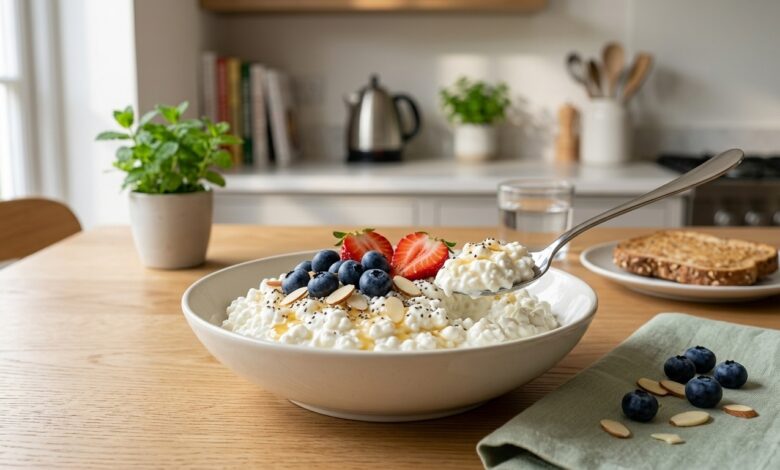
Most people pick up a tub of low fat cottage cheese because they’ve heard it’s “healthy.” That’s not wrong, but it’s also not the full story. Cottage cheese has a surprisingly complex nutritional profile, a wider range of practical uses than most people realize, and some genuine benefits that hold up under scientific scrutiny — alongside a few caveats that the health food marketing consistently glosses over.
What Is Low Fat Cottage Cheese and How Is It Made
Cottage cheese is made by curdling pasteurized cow’s milk with an acid — either a bacterial culture or direct acid addition — and then separating the resulting curds from the liquid whey. What you’re left with is loose, soft cheese curds suspended in a small amount of creamy dressing. “Low fat” refers specifically to varieties made with 1% or 2% milkfat, sitting between nonfat (fat-free) and full-fat (4%) versions.
The “dressing” — the creamy liquid that coats the curds — is where most brands diverge significantly. Many commercial producers use thickeners, stabilizers, and gums to bind the dressing to the curds and extend shelf life. Brands that use live cultures to develop the dressing naturally tend to produce a cleaner flavor, better texture, and a shorter ingredient list.
Step By Step Recipe Method: Homemade Low Fat Cottage Cheese
Making homemade low fat cottage cheese is surprisingly simple.
Ingredients
| Ingredient | Amount |
| Low-fat milk | 1 liter |
| White vinegar or lemon juice | 3 tbsp |
| Salt | ¼–½ tsp |
| Optional yogurt or milk | 2–4 tbsp |
Method
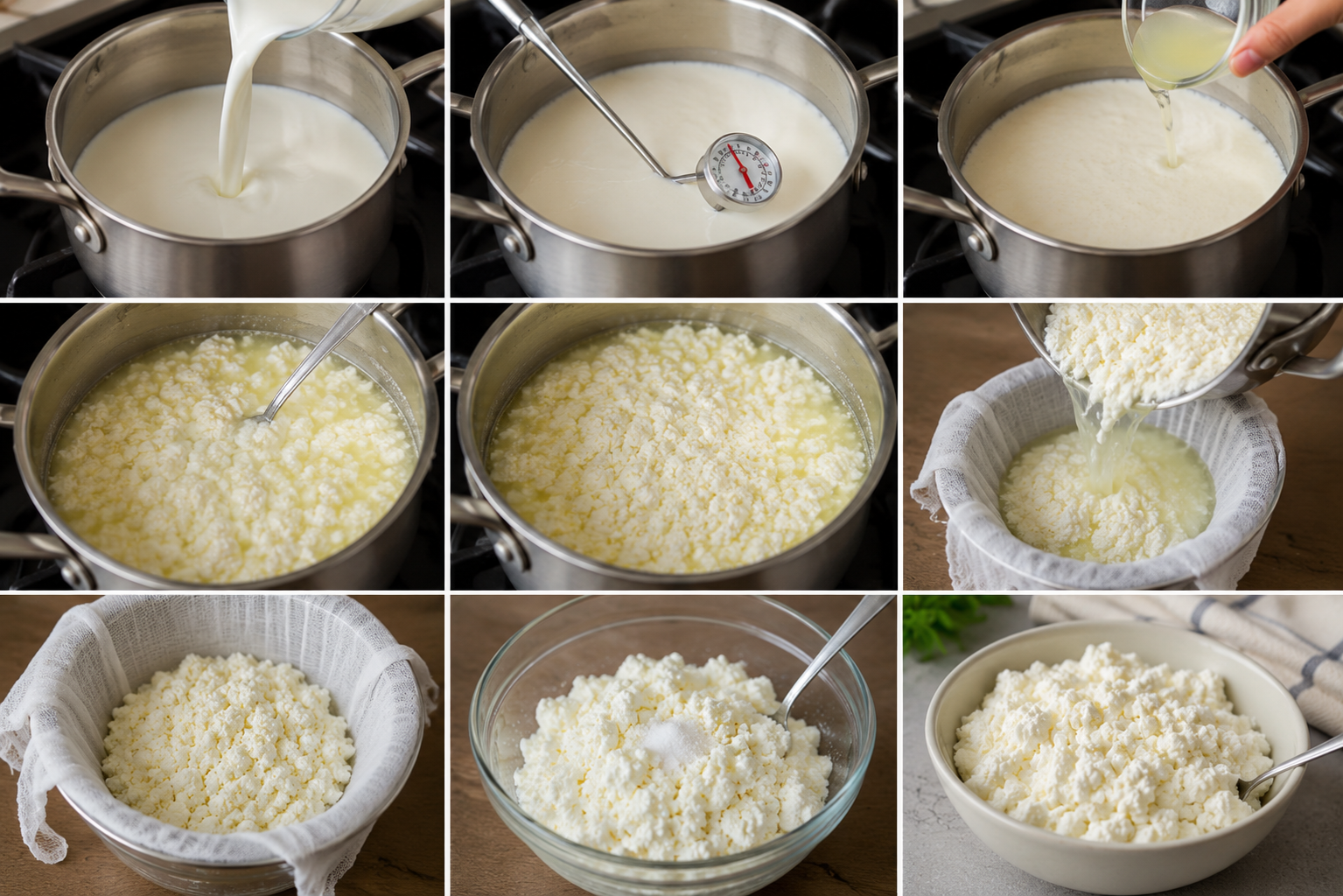
- Pour milk into a heavy saucepan.
- Heat slowly over medium heat until about 185°F / 85°C.
- Turn off heat.
- Add vinegar or lemon juice.
- Stir gently.
- Let sit 10 minutes while curds separate.
- Pour into cheesecloth-lined strainer.
- Drain 10–20 minutes.
- Rinse lightly if desired.
- Add salt.
- Stir in a little milk or yogurt for creaminess.
Homemade cottage cheese is best used within 3–4 days.
The homemade version gives you control over:
- Sodium
- Texture
- Thickness
- Creaminess
- Ingredient quality
Low Fat Cottage Cheese Nutrition: The Full Picture
Per ½ cup (113g) serving of standard 2% low fat cottage cheese, the typical nutritional profile is:
Nutrient |
Amount |
% Daily Value |
| Calories | 90–100 kcal | — |
| Protein | 12–13g | ~26% |
| Total Fat | 2.5g | ~3% |
| Saturated Fat | 1.5g | ~8% |
| Carbohydrates | 5–6g | ~2% |
| Sugars (natural lactose) | 3–4g | — |
| Calcium | 100–125mg | ~10–12% |
| Phosphorus | 150mg | ~12% |
| Sodium | 320–400mg | ~14–17% |
| Potassium | 120mg | ~3% |
| Selenium | ~14mcg | ~25–27% |
| Vitamin B12 | ~0.4mcg | ~17% |
| Vitamin A | ~70–90IU | ~2–3% |
A few things stand out in this table that most people skip over.
Selenium is the underappreciated number. At roughly 25–27% of the daily recommended intake per half-cup serving, low fat cottage cheese is one of the more consistent dietary selenium sources available. Selenium plays a central role in thyroid hormone metabolism, antioxidant defense, and immune function. People with Hashimoto’s thyroiditis or other thyroid conditions often have suboptimal selenium levels, and cottage cheese is a practical, low-calorie way to address that gap.
Phosphorus works synergistically with calcium for bone mineral density maintenance. The calcium-phosphorus ratio in dairy is close to what the body uses for bone tissue, which is why dairy calcium tends to be better utilized than plant-based calcium from sources where the ratio is less ideal.
Sodium is the number that deserves more attention than it gets. A half-cup of many standard cottage cheese brands delivers 14–17% of the daily recommended sodium intake — before anything else you eat that day. This isn’t a reason to avoid cottage cheese, but it is a reason to choose low-sodium varieties if you’re managing blood pressure or eating it multiple times per day.
Nutritional Value of Low Fat Cottage Cheese vs. Full Fat vs. Nonfat
Full-fat cottage cheese (4% milkfat) provides around 110 calories per half-cup and roughly 5g of fat, including about 3g of saturated fat. It’s more satiating per bite because fat slows gastric emptying — the stomach empties more slowly, so hunger signals are delayed. It also contains higher concentrations of fat-soluble vitamins (A, D, K) and conjugated linoleic acid (CLA), a fatty acid with some research support for metabolic benefits.
Nonfat cottage cheese strips the fat almost entirely, dropping calories to around 70–80 per serving. The problem is texture and satiety. Fat-free cottage cheese tends to be watery, less flavorful, and it doesn’t hold hunger back as effectively. Many nonfat versions compensate by adding thickeners, which isn’t a health concern but suggests the product is being engineered rather than naturally produced.
Low fat (1–2% milkfat) at 90–100 calories keeps most of the casein protein intact, retains enough fat for palatability and moderate satiety, and avoids the additives that often show up in nonfat formulations. For most practical purposes — cooking, snacking, or meal planning — this is the most functional version of the three.
Nutritional Information: Daisy Low Fat Cottage Cheese
Daisy is one of the most widely consumed cottage cheese brands in the United States, and their approach to production genuinely differs from most competitors. Their low fat version uses only three ingredients: cultured skim milk, cream, and salt (with Vitamin A Palmitate). No thickeners, no locust bean gum, no modified food starch.
Daisy uses live and active cultures to develop the creamy dressing rather than stabilizers or additives, which gives their product an industry-leading shelf life without preservatives.
Daisy Low Fat Cottage Cheese (2% Milkfat) — per ½ cup serving:
- Calories: 90 kcal
- Protein: 13g
- Fat: 2.5g
- Carbohydrates: ~5g
- Sodium: ~370mg
- Calcium: ~10% DV
Daisy’s low fat cottage cheese derives approximately 57% of its calories from protein, 18% from carbohydrates, and 25% from fat — a macronutrient distribution that nutritionally functions like a lean protein food with a small amount of fat for palatability.
Is Low Fat Cottage Cheese Healthy?
The short answer is yes — with one meaningful asterisk.
The affirmative case is strong on several fronts. It delivers high-quality casein protein at a low calorie cost. Casein is a slow-digesting protein that creates a sustained amino acid release into the bloodstream, unlike whey which peaks and drops quickly. The protein in cottage cheese is mostly casein, a type of protein that takes longer for the body to absorb and digest. This matters for muscle protein synthesis, satiety between meals, and overnight recovery.
Research suggests that people who eat protein-rich bedtime snacks like cottage cheese enjoy better muscle quality and higher metabolism, and consuming cottage cheese before sleep does not impair resting energy expenditure or negatively affect the following day’s appetite.
The asterisk is sodium. For people managing hypertension or who eat cottage cheese frequently throughout the day, the sodium load accumulates quickly. A full cup of standard low fat cottage cheese delivers 640–800mg of sodium — more than a third of the recommended daily ceiling for many adults. Choosing low-sodium varieties (brands like Hood No Salt Added or Friendship Dairies No Salt Added) removes this concern entirely if sodium management is a priority.
Low Fat Cottage Cheese for Weight Loss
This is where the evidence is more specific than the general “high protein = weight loss” claim that most food articles make.
An umbrella review found that dairy protein, especially casein, may improve appetite regulation, reduce fat mass, and support lean body mass during energy restriction.
Three factors make cottage cheese a great choice for weight management: high protein content, which research finds helps curb appetite and manage hormones associated with appetite and insulin release; lower fat content relative to most cheeses; and calcium, with studies showing that increasing calcium can support weight loss when combined with a calorie-restricted diet.
The practical application is straightforward. A half-cup serving of low fat cottage cheese at 90–100 calories delivers 13g of protein — more protein per calorie than Greek yogurt, more than eggs (6g per large egg at 78 calories), and more than most other whole food protein sources at equivalent calorie counts. For people tracking calories, this ratio is genuinely useful: high protein, low energy density, good satiety.
One underused strategy is eating cottage cheese as a late evening snack rather than a daytime food. Since casein is slow-digesting, consuming it before sleep provides a steady amino acid supply during the overnight fasting period — supporting muscle recovery without disrupting resting metabolic rate or morning hunger.
Low Fat Cottage Cheese for Diabetics
The diabetes-specific case for cottage cheese is built on two pillars: glycemic impact and protein-driven satiety.
The minimal carbohydrate content — approximately 3.4 grams per 100g — makes cottage cheese an ideal snack or meal component for maintaining stable blood glucose levels. The glycemic index of cottage cheese ranges from 0 to 40, placing it firmly in the low-GI category.
High-protein dairy foods, including cottage cheese, have been shown to reduce postprandial glucose levels and improve satiety in both healthy and diabetic individuals. Postprandial glucose control — managing blood sugar in the 1–2 hours after eating — is one of the most clinically meaningful targets for people with type 2 diabetes, and protein is one of the most reliable dietary tools for blunting post-meal glucose spikes.
For diabetics specifically, the sodium consideration is more pressing than for the general population because diabetes significantly elevates cardiovascular risk, and high sodium intake worsens hypertension — a common comorbidity. Fat and sodium levels vary widely between cottage cheese brands; checking labels and choosing low-fat or lower-sodium options is advisable for anyone watching heart health or blood pressure.
The practical recommendation for people managing blood sugar: pair cottage cheese with a small amount of fiber-rich vegetables (cucumber, celery, bell pepper) or a serving of fruit rather than eating it alone. Adding fiber to the eating occasion slows gastric emptying further and helps flatten glucose response.
Low Fat Cottage Cheese for Dogs
This comes up more than most people expect, and the answer is nuanced rather than a simple yes or no.
Dogs can have plain, unsweetened, low-fat cottage cheese in small amounts. Cottage cheese is high in protein but shouldn’t replace complete dog food. Too much cottage cheese can cause stomach upset, especially in lactose-sensitive dogs. Treats like cottage cheese should make up no more than 10% of a dog’s daily calories.
The low-fat variety is specifically preferable over full-fat for dogs because whole-milk cottage cheese has a high fat content that, if consumed in large quantities, could lead to excessive weight gain or pancreatitis (inflammation of the pancreas).
What to feed: Plain, unseasoned, low-sodium, low-fat cottage cheese only. No onion, no garlic, no chives, no flavored varieties. These common flavorings are toxic to dogs, even in small amounts.
How much: Offer 1 to 2 tablespoons at a time, depending on the dog’s size, to minimize the risk of gastrointestinal distress. For extra-small dogs under 10 lbs, start with a teaspoon or less.
When it’s useful: Low-fat cottage cheese paired with white or brown rice is a good choice for a dog with an upset stomach, as bland foods can nutritionally support a dog while allowing for gentle digestion. Cottage cheese’s soft texture also makes it useful for hiding medication, though check with your veterinarian first since dairy can interact with certain antibiotics.
When to avoid it: Dogs with confirmed lactose intolerance, pancreatitis, kidney disease, or hypertension should not eat cottage cheese without veterinary guidance. Sodium content in standard cottage cheese brands is high relative to a dog’s daily needs.
Low Fat Cottage Cheese Recipe: The Savory Herb Bowl
This is a practical, high-protein base recipe that works as a breakfast, a light lunch, or a post-workout meal. It uses low fat cottage cheese as the protein anchor rather than a topping, which changes the eating experience considerably.
Ingredients (1 serving)
- ½ cup (113g) low fat cottage cheese (2% milkfat)
- ½ cup cherry tomatoes, halved
- ¼ cucumber, finely diced
- 2 tbsp fresh chives or dill, chopped
- 1 tsp extra virgin olive oil
- 1 tsp lemon juice
- Cracked black pepper to taste
- Optional: pinch of za’atar or everything bagel seasoning
- Optional protein add-on: 1 soft-boiled egg or 30g smoked salmon
Step-by-Step Method
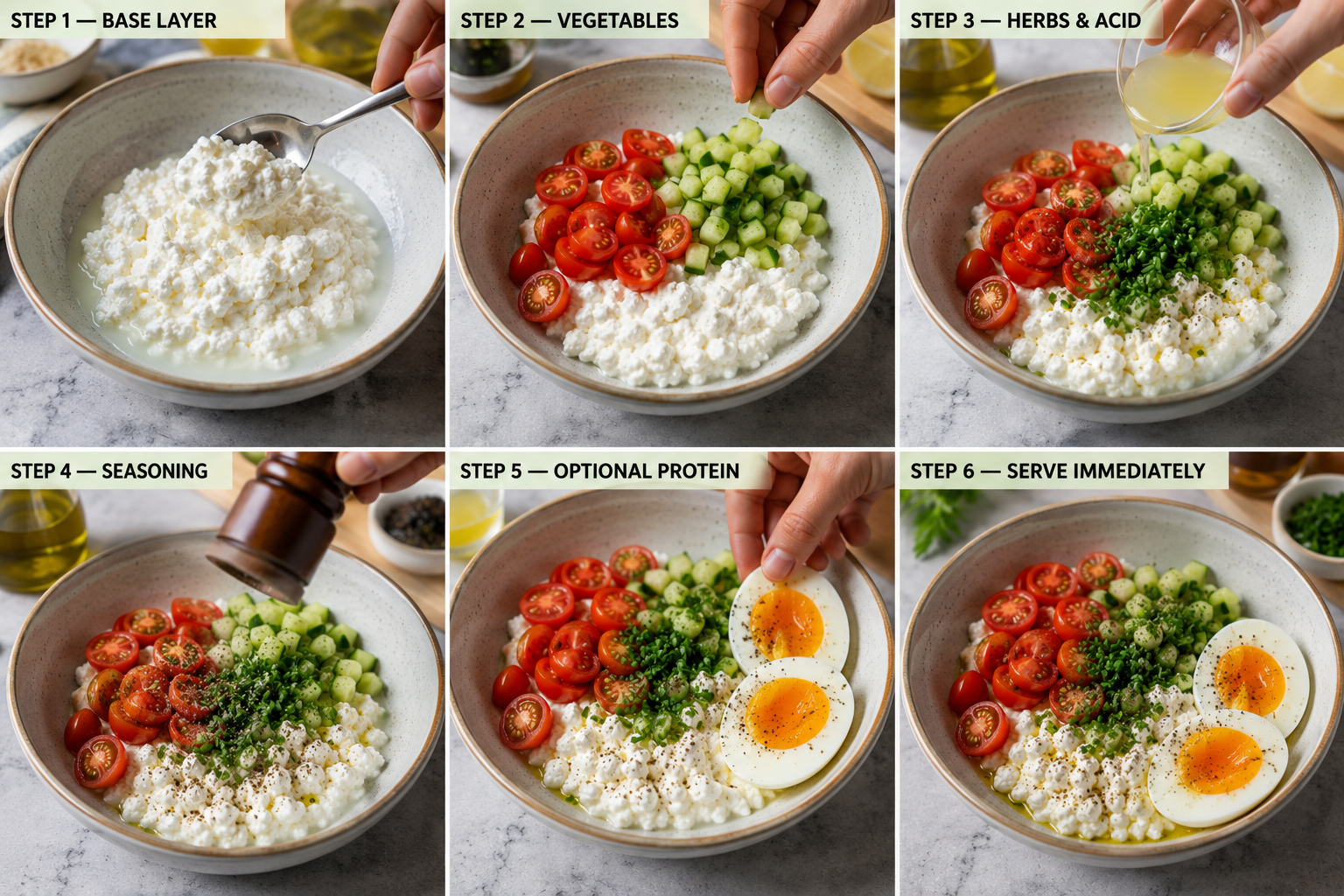
Step 1 — Base layer: Spoon the cottage cheese directly into a wide, shallow bowl. Don’t drain it — the whey liquid carries additional protein and flavor.
Step 2 — Vegetables: Add cherry tomatoes and diced cucumber directly over the cottage cheese. The goal is texture contrast — the creamy base against the fresh crunch.
Step 3 — Herbs and acid: Scatter the fresh chives or dill over the top. Drizzle with lemon juice first, then olive oil. The acid from the lemon cuts through the mild dairy richness and lifts the overall flavor significantly.
Step 4 — Seasoning: Add cracked black pepper generously. If using za’atar or everything bagel seasoning, add a light pinch now. Both spice blends complement cottage cheese without overwhelming it.
Step 5 — Optional protein: If adding a soft-boiled egg, halve it and place it beside the cottage cheese rather than on top. For smoked salmon, tear into small pieces and fold lightly through the bowl just before eating.
Step 6 — Serve immediately: Cottage cheese doesn’t hold well once dressed with acid — the tomatoes will weep and the texture softens if it sits more than 10–15 minutes. Prepare it fresh.
Recipe Tips
- If you prefer a smoother texture, blend the cottage cheese briefly with an immersion blender before building the bowl. This creates a consistency closer to ricotta or whipped cream cheese, which works better for spreading on toast or crackers.
- For meal prep: keep the cottage cheese base and the vegetables in separate containers. Combine only when eating.
- Avoid adding salt before tasting — most brands already carry significant sodium, and additional salt is rarely necessary.
- The olive oil is not optional. Even a teaspoon significantly improves flavor and helps fat-soluble nutrients absorb.
- Room temperature cottage cheese has more flavor than cold-from-the-fridge cottage cheese. If time allows, take it out 10 minutes before eating.
Calories for This Recipe
Ingredient |
Calories |
| ½ cup 2% low fat cottage cheese | 90 kcal |
| Cherry tomatoes + cucumber | 25 kcal |
| 1 tsp olive oil | 40 kcal |
| Fresh herbs, lemon juice | ~5 kcal |
| Total (base) | ~160 kcal |
| With soft-boiled egg | ~238 kcal |
| With smoked salmon (30g) | ~215 kcal |
Healthy Version and Low-Calorie Options
The base recipe above is already lower in calories than most protein snacks. But there are specific modifications worth knowing for people with stricter targets.
For maximum protein, minimum calories: Use 1% milkfat cottage cheese instead of 2%. The calorie difference is 10–15 kcal per serving, but the change adds up across multiple servings per day. Skip the olive oil and dress only with lemon juice, fresh herbs, and black pepper. Total: approximately 110–120 kcal for a generous portion with vegetables.
For the lowest possible calorie version: Use nonfat cottage cheese (70–80 kcal per half cup), load up on non-starchy vegetables (cucumber, celery, radish, bell pepper), and skip all added fats. The satiety won’t be as strong, but as a volume-eating strategy it delivers substantial food for under 120 calories.
For people who dislike the curded texture: Blend nonfat or 1% cottage cheese smooth and use it in place of cream cheese, sour cream, or ricotta in any recipe. Blended into pasta sauce it’s nearly undetectable, adds 13g of protein per half cup, and replaces significantly higher-calorie dairy alternatives. Blended cottage cheese as a dip base with roasted garlic and lemon is genuinely indistinguishable from a cream cheese dip to most people who try it.
For diabetics targeting carbohydrate control: Pair ½ cup of low fat cottage cheese with sliced bell pepper or cucumber for a snack that delivers protein, fiber, and water volume at well under 5g net carbohydrates total. This keeps postprandial glucose response minimal while providing meaningful satiety.
Frequently Asked Questions
Is low fat cottage cheese healthy every day? For most people, yes — with attention to sodium. Eating it daily means the sodium adds up quickly; choosing low-sodium brands or limiting to one serving per day keeps this manageable. The protein, calcium, selenium, and B12 benefits are consistent and meaningful over time.
How does low fat cottage cheese compare to Greek yogurt nutritionally? They’re close, but cottage cheese typically delivers slightly more protein per serving (12–13g vs. 10–12g in most Greek yogurts) with less sugar — yogurt’s fermentation process converts some lactose to lactic acid but still carries more natural sugars than cottage cheese. Greek yogurt generally has stronger probiotic content. Cottage cheese edges it on selenium and phosphorus; Greek yogurt edges it on active bacterial cultures.
Can I eat low fat cottage cheese before bed for muscle recovery? Yes — this is actually one of the stronger evidence-backed uses. Casein protein digests slowly and releases amino acids over 5–7 hours, providing a sustained supply during the overnight fasting window. Research supports that this supports muscle protein synthesis without disrupting sleep, appetite the next morning, or resting metabolism.
What is the difference between 1% and 2% low fat cottage cheese? Nutritionally, the difference is modest — approximately 10–15 calories per half-cup and about 1g of fat. The 2% version tastes noticeably richer and has a creamier texture, which makes it more satisfying as a standalone snack. The 1% version is marginally better for strict calorie management.
Is Daisy low fat cottage cheese better than other brands? Daisy’s ingredient list (cultured skim milk, cream, salt) is shorter than most competitors, and they use live cultures rather than gums and thickeners to develop the dressing. This doesn’t make it “better” in a nutritional science sense — the macros are similar across brands — but it does make it a cleaner product with fewer additives, which many people prefer.
How much low fat cottage cheese should a dog eat? Dogs should receive cottage cheese only as an occasional treat — no more than 10% of their daily calories. A general guideline is 1–2 tablespoons for medium to large dogs, 1 teaspoon or less for small breeds. Always choose plain, unseasoned, low-fat, and low-sodium varieties. Avoid flavored or herb-infused cottage cheese, which may contain ingredients toxic to dogs (garlic, chives, onion).
Does low fat cottage cheese spike blood sugar? No — its glycemic index is 0–40, firmly in the low-GI range. The minimal carbohydrate content (approximately 5g per half-cup serving, all from natural lactose) creates very little glucose response on its own. Pairing with fiber-rich foods reduces any glucose impact further.
Is low fat cottage cheese good for diabetics? Yes, with appropriate brand selection. Plain low fat cottage cheese with low sodium is well-suited to diabetic eating plans: high protein, minimal carbohydrates, low glycemic index, and evidence supporting improved postprandial glucose control. Avoid flavored varieties with added fruit or sweeteners, which add carbohydrates and sugar that matter for blood glucose management.
Conclusion
Low fat cottage cheese earns its reputation as a nutritionally efficient food, but the details matter more than the headline claims. The protein density is genuine — 13g per 90 calories from a slow-digesting casein source that sustains satiety and supports muscle recovery across a wide range of use cases. The selenium content is underappreciated. The sodium is the real watch point, not the fat content.
For weight loss, the high protein-to-calorie ratio makes it one of the more practical tools in a calorie-controlled eating pattern. For blood sugar management, its low glycemic profile and protein-driven glucose blunting make it a consistently useful food for people with type 2 diabetes or insulin resistance. For dogs, low fat, plain, low-sodium varieties in modest amounts are safe and can be genuinely useful — particularly as a bland diet component when a dog’s digestive system needs a reset.