How to Make Corn Syrup Recipe — Complete Guide With Methods, Science, and Smart Substitutes

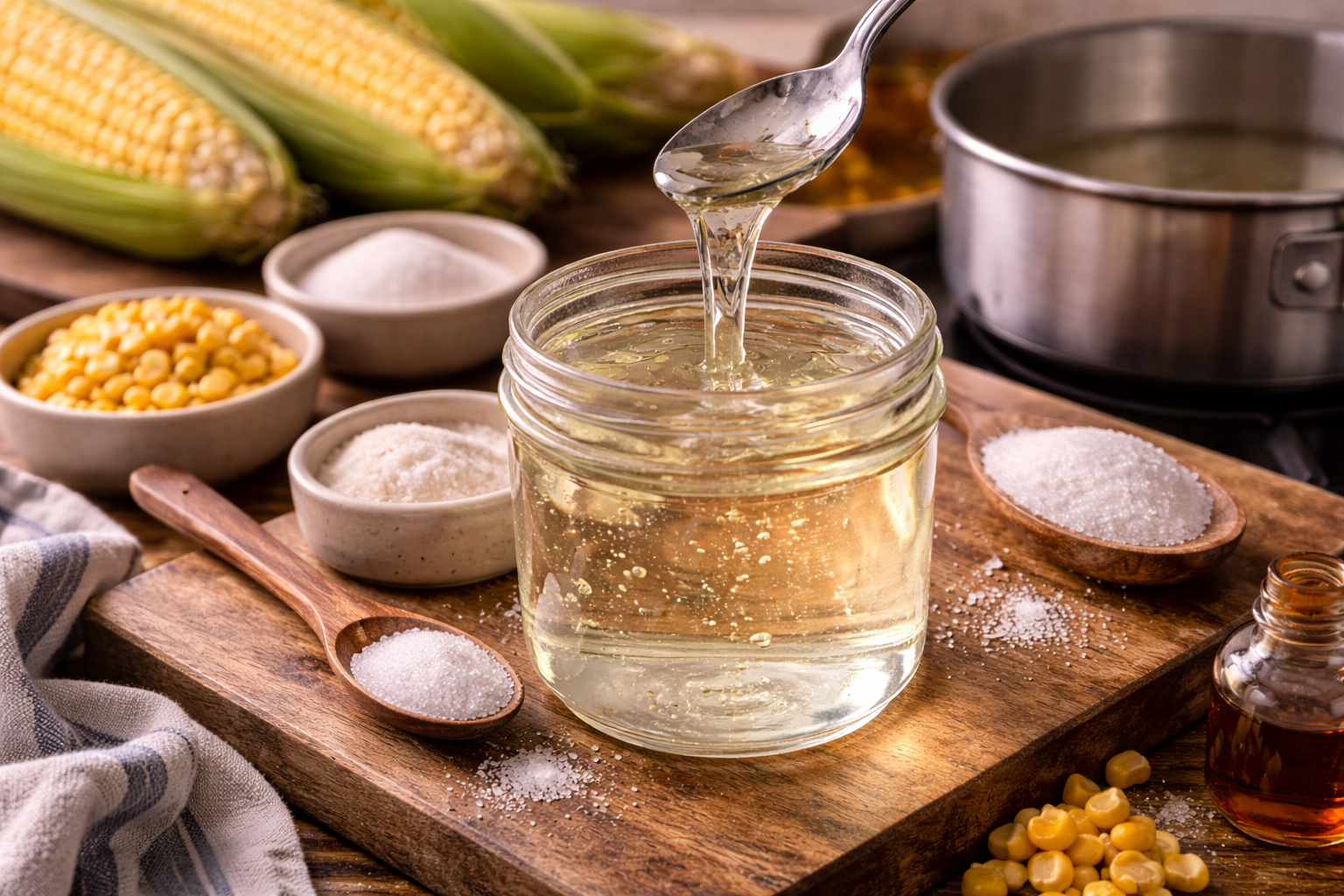
How to Make Corn Syrup Recipe at Home — The Full Practitioner’s Guide
The moment most people start looking up how to make corn syrup recipe at home, they’re mid-recipe and out of the commercial product. That urgency leads them to one of two mistakes: grabbing whatever syrup is in the pantry and hoping for the best, or making a watery sugar syrup that doesn’t actually replicate what corn syrup does in a recipe.
What corn syrup does — and why it can’t be replaced by just any sweetener — comes down to one specific chemical behavior: it prevents sucrose crystallization by introducing monosaccharides (glucose or a glucose-fructose mix) that physically interrupt the sucrose crystal lattice. That function is why it appears in pecan pie, caramel, marshmallows, fudge, and hard candy. Without it, the texture of those things breaks down.
The good news is that this exact function can be replicated at home, consistently, using three pantry staples and a candy thermometer. This guide covers the homemade invert sugar method, the older corn-stalk extraction approach, light versus dark versions, the science behind why it works, and the nutritional context you actually need — not the oversimplified version.
The Chemistry Behind Corn Syrup — Why Homemade Works
Commercial corn syrup is produced industrially through enzymatic hydrolysis of cornstarch — breaking long glucose polymer chains into free glucose molecules. The result is a solution that’s predominantly glucose, viscous, nearly flavorless, and highly effective at disrupting sucrose crystal formation.
When sucrose crystals form in a candy or sauce, they do so because sucrose molecules (disaccharides made of one glucose and one fructose unit) align into ordered lattice structures. Glucose and fructose molecules — both smaller monosaccharides — get in the way of that alignment. They don’t fit neatly into the sucrose crystal pattern, so they act as molecular interference agents, preventing the crystal chain reaction from building momentum.
This is why adding any glucose-dominant or glucose-fructose solution to a boiling sugar mixture keeps it smooth. Your homemade version works by converting sucrose into glucose and fructose via acid hydrolysis — the acid (cream of tartar or lemon juice) acts as a catalyst that breaks the bond between the glucose and fructose units in each sucrose molecule. This process is called sugar inversion, and the resulting product is invert sugar — functionally identical to corn syrup for all practical baking and confectionery purposes.
One important note from food science research: a 2022 study published in the Journal of Food Science tested 12 common corn syrup alternatives and found that only glucose syrup, homemade invert sugar, and golden syrup achieved 92%+ crystallization suppression at 24-hour storage. Honey, maple syrup, agave, and brown rice syrup all failed in the majority of trials due to volatile acids, enzymatic activity, or excessive fructose ratios that destabilized boiled sugar solutions. This matters practically: not every syrup is a legitimate corn syrup substitute, regardless of what recipe blogs suggest.
Method 1 — The Standard Homemade Invert Sugar (Most Reliable)
This is the version you want for pecan pie filling, caramel sauce, marshmallows, fudge, candy coating, and any recipe where crystallization control is the primary function of the corn syrup.
Ingredients (yields approximately 1½ cups):
Ingredient |
Amount |
Role |
| Granulated white sugar | 2 cups (400g) | Sucrose base being inverted |
| Water | ¾ cup (180ml) | Solvent and reaction medium |
| Cream of tartar | ¼ teaspoon | Acid catalyst for inversion |
| Fine salt | ⅛ teaspoon | Flavor enhancer |
| Lemon juice (optional) | 1 teaspoon | Backup acid, subtle brightness |
Step-by-step method:
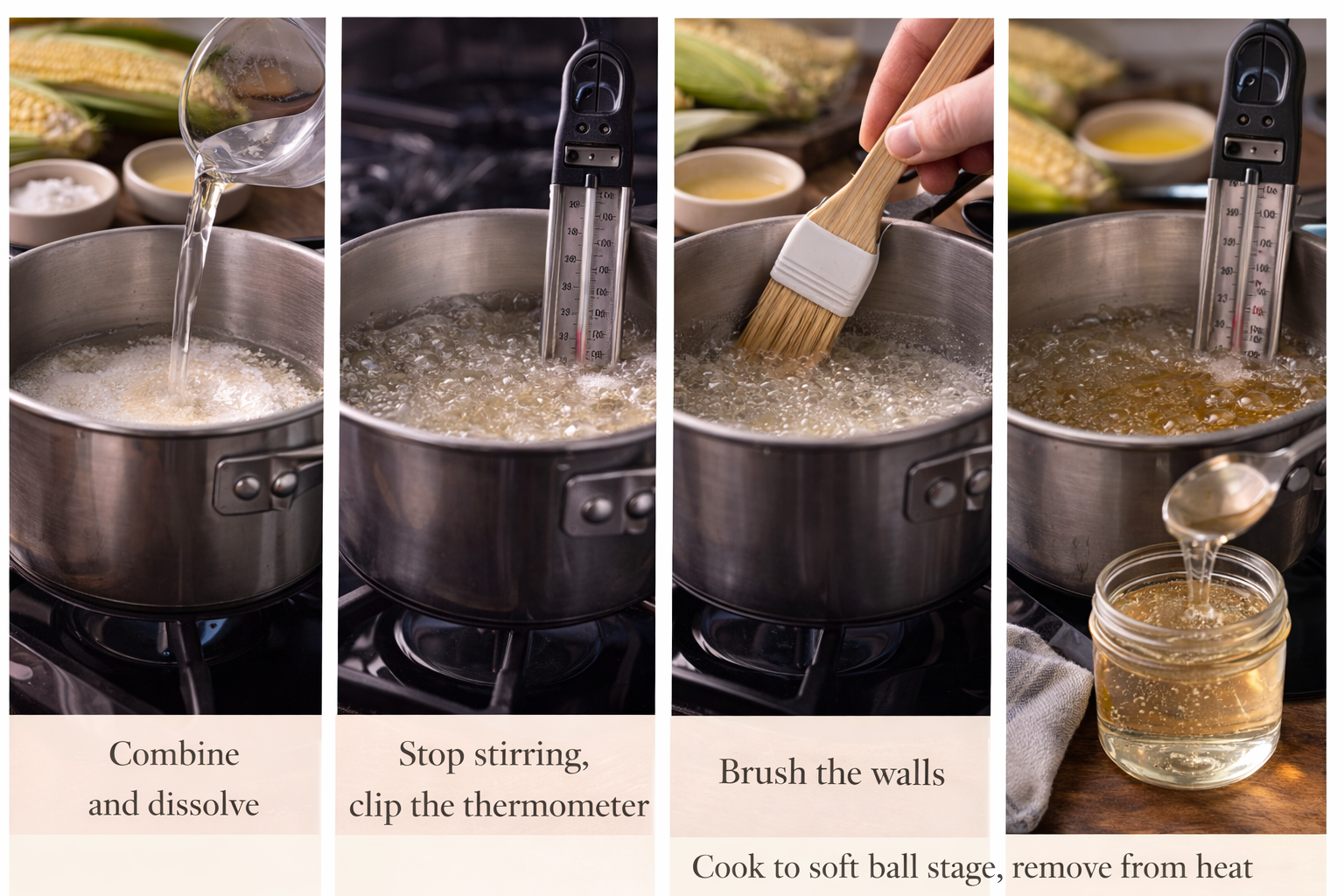
Step 1 — Combine and dissolve
Add sugar, water, cream of tartar, and salt to a heavy-bottomed saucepan — not thin stainless, which develops hot spots. Stir gently over medium heat until the sugar fully dissolves and the liquid turns completely clear. This is the only window where stirring is permitted.
Step 2 — Stop stirring, clip the thermometer
Once the mixture comes to a clear boil, stop stirring entirely. Any agitation at this point seeds crystallization — the very problem you’re trying to prevent. Clip your candy thermometer to the side of the pan, making sure the bulb doesn’t touch the bottom.
Step 3 — Brush the walls
Dip a clean pastry brush in cold water and sweep the inside walls of the saucepan above the syrup line every few minutes. Splashed sugar droplets above the liquid line evaporate and recrystallize on the wall. If a crystal falls back into the syrup, it triggers the cascade you’re working against. This step is frequently skipped — which is why batches fail.
Step 4 — Cook to soft ball stage (235–240°F / 112–115°C)
Keep the heat steady at medium. This temperature range takes 20–35 minutes depending on your stove, pan diameter, and altitude. At this stage, the syrup will be pale gold — not amber or caramel-colored. If it begins darkening before reaching temperature, your heat is too high. Lower it immediately.
Step 5 — Add lemon juice, remove from heat
If using lemon juice, add it now, swirl once, and pull the pan from the heat. Do not stir vigorously.
Step 6 — Cool completely before storing
Pour into a clean glass jar — don’t scrape the sides of the pan, as any crystallized edges will contaminate the batch. Allow the syrup to reach room temperature before sealing. Store at room temperature for up to 3 months, or refrigerate for up to 12 months.
Method 2 — Making Dark Corn Syrup at Home
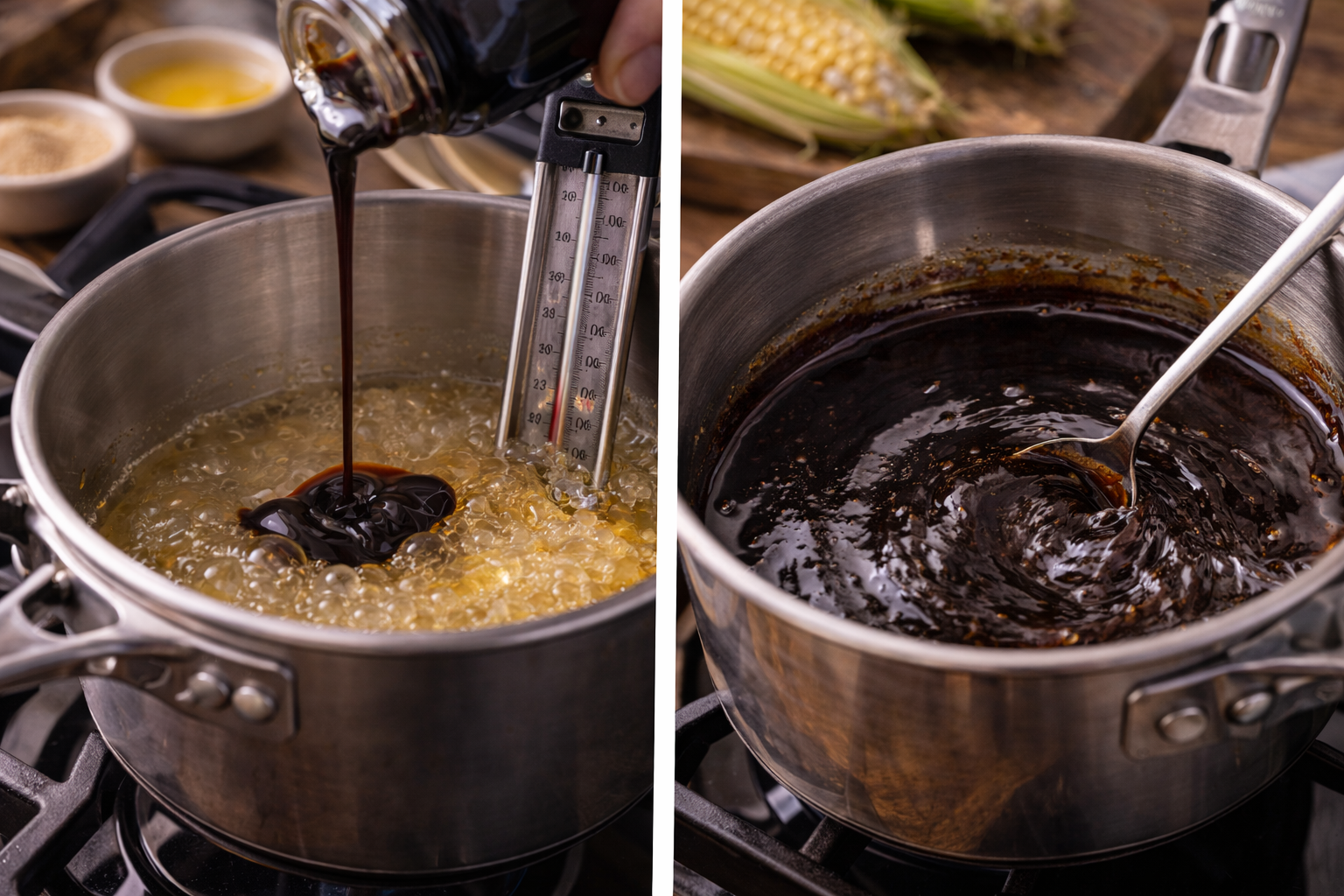
Dark corn syrup contains molasses, which adds a deeper color, richer flavor, and slightly more viscosity. It’s standard in recipes like pecan pie, certain barbecue glazes, and dark gingerbread.
To make the homemade dark version, follow Method 1 exactly with one modification:
- Reduce granulated sugar from 2 cups to 1½ cups
- Add ½ cup of unsulfured molasses after removing the pan from heat
Stir the molasses in off the heat, not during cooking. Molasses contains its own sugars and volatile compounds that behave unpredictably under sustained high heat — adding it hot into the finished syrup integrates it cleanly without risk of scorching.
The dark version is not interchangeable with light in most recipes. Pecan pie and molasses-forward recipes call for dark specifically because of the flavor depth. Caramels and candy coatings where a neutral flavor matters are better served by the light version.
Method 3 — The Traditional Corn Stalk Method (Old-Fashioned Authentic Version)
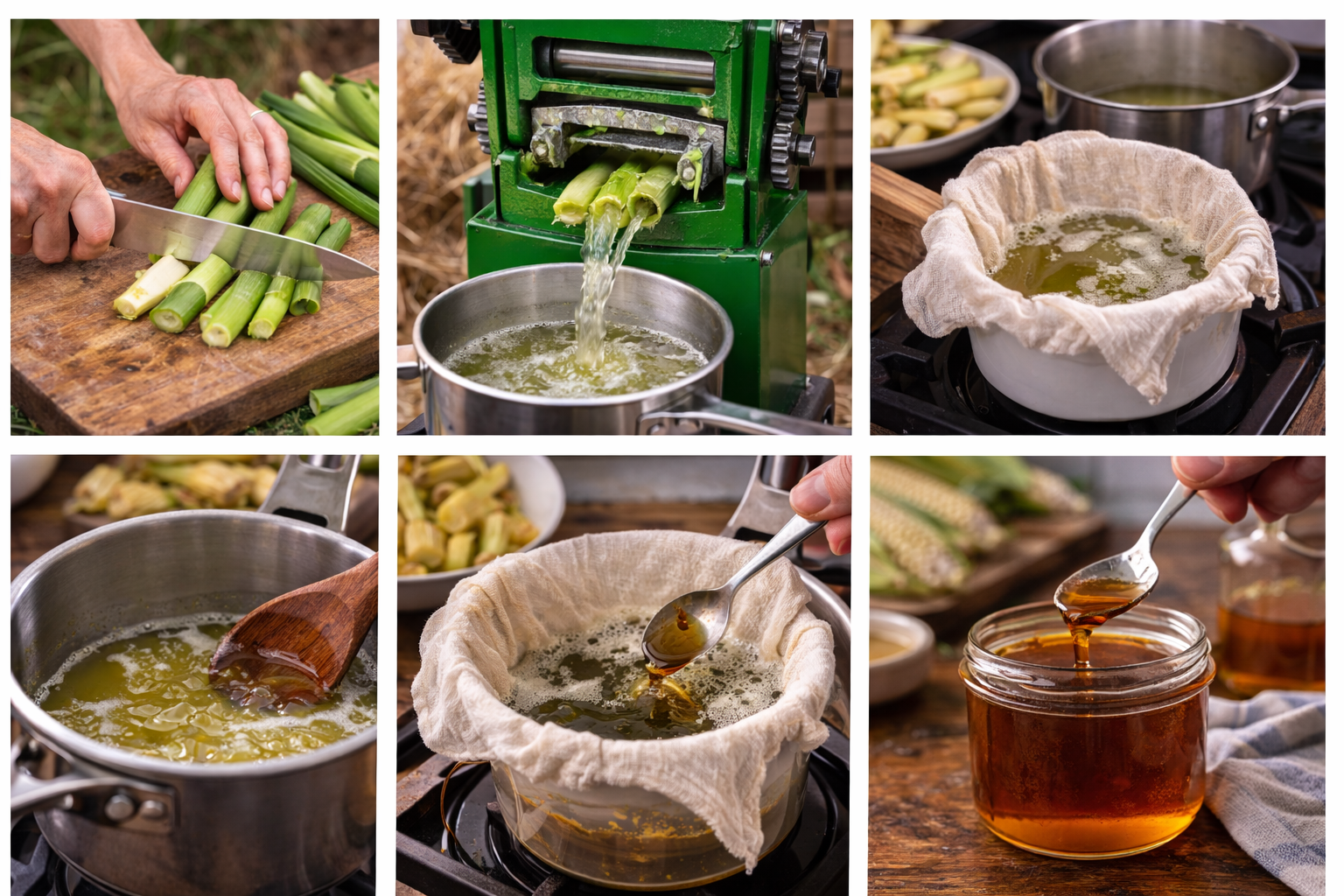
This is the approach that predates commercial production — closer to how farm families made corn syrup before the industrialization of starch hydrolysis. It extracts natural sugars directly from corn stalks, specifically from earless stalks where the plant’s sugar production has no ear to feed and concentrates in the stalk tissue.
The process:
- Identify earless corn stalks at the end of the growing season. Taste the wound at the base — if it reads sweet, the sugars are present and extractable.
- Remove the leaves and tassels. Cut the stalks into 3–4 inch segments.
- Low-tech crushing method: Use a mortar and pestle, a meat mallet, or a heavy rolling pin to crush the segments thoroughly and release the juice. Press through a fine mesh strainer lined with cheesecloth, collecting the liquid.
- Higher-efficiency method: Run stalks through a sugarcane press or a juicer — this extracts significantly more liquid per batch.
- Combine the extracted stalk liquid with water in a 1:1 ratio. Bring to a boil and simmer until reduced by half, skimming foam as it rises.
- Strain through cheesecloth again to remove any remaining solids.
- Return to low heat and continue reducing until the liquid thickens into a syrup consistency. This is a very long reduction — expect 3–4 hours for a meaningful batch.
The result is a genuinely corn-flavored syrup with a mild, grassy sweetness. In strongly flavored recipes — barbecue sauce, spiced cakes, pecan pie — the corn character is essentially undetectable. In neutral recipes like marshmallows or light caramel, it adds a faint, pleasant corn note.
Honest assessment: This method requires a functioning corn crop, significant time, and equipment most people don’t own. For practical baking purposes, Method 1 is what you should use. The stalk method is worth knowing for homesteaders, historical cooking enthusiasts, and anyone growing field corn who wants to utilize every part of the plant.
Altitude and Humidity Adjustments for Both Methods
These two environmental variables affect every boiled sugar recipe and corn syrup recipe is no exception.
Altitude: The boiling point of water drops approximately 2°F for every 1,000 feet above sea level. At 5,000 feet, water boils at approximately 202°F instead of 212°F. Since candy thermometer stages are calibrated to sea-level boiling points, you must lower your target temperature by the same margin. At 5,000 feet, soft ball stage is approximately 225–230°F rather than 235–240°F.
To calibrate for your exact location: boil plain water and note the thermometer reading. Whatever it reads below 212°F is the adjustment to apply to all subsequent temperature targets.
Humidity: Sugar is hygroscopic — it pulls moisture from the surrounding air. On humid days, your syrup may take longer to reach target temperature, may run slightly thinner than expected after cooling, and may re-absorb ambient moisture during storage more readily. Professional confectioners compensate by cooking 2–3°F higher than usual on high-humidity days. For home production, making your corn syrup on a drier day is the simplest solution.
Troubleshooting — What Went Wrong and Why
The syrup crystallized into a solid mass. Almost always caused by one of three things: sugar crystals splashing onto the walls and falling back in (use the pastry brush technique), stirring during the cooking phase, or cooling too rapidly in a cold container. To recover a crystallized batch, return it to a saucepan with a tablespoon of water per cup of syrup, heat gently on low while swirling (don’t stir), and bring back to temperature.
The syrup is too thin and watery. It didn’t reach the correct temperature before you pulled it off heat. Undercooked syrup won’t function as a crystallization inhibitor because the water content is still too high — the glucose-fructose solution is too dilute. Return to heat and cook until the thermometer reads 235°F minimum.
The syrup turned amber or dark before reaching temperature. Heat was too high. Caramelization begins at around 320°F in isolated conditions, but sucrose exposed to sustained high heat with residual moisture will brown earlier. The solution is lower heat and more patience — 20–30 minutes at medium is better than 10 minutes at medium-high.
The syrup has a faint sour taste. The acid catalyst (cream of tartar or lemon juice) was excessive, or the batch cooked too long past the target temperature. A slight tang is normal and undetectable in most recipes. If it’s pronounced, reduce cream of tartar to ⅛ teaspoon in the next batch.
The syrup is cloudy. Stirring during cooking caused nucleation. Cloudiness doesn’t affect the syrup’s function as a crystallization inhibitor — it’s an aesthetic issue, not a performance one. Use as normal; the texture of finished candy, caramel, or pie filling will be unaffected.
Nutrition — What You’re Actually Adding to Recipes
Understanding the nutritional profile of corn syrup and its homemade equivalent matters for context, not because these are health foods, but because knowing the science helps you make informed choices.
Per 1 tablespoon (approximately 21g) of light corn syrup or homemade invert sugar:
Nutrient |
Amount |
| Calories | ~60 kcal |
| Total Carbohydrates | 16g |
| Sugars | 16g |
| Total Fat | 0g |
| Protein | 0g |
| Sodium | Trace |
| Glycemic Index | ~65 (light corn syrup/glucose dominant) |
The HFCS vs. regular corn syrup distinction matters here. Commercial light corn syrup (like Karo) is 100% glucose. High-fructose corn syrup (HFCS), used in manufactured foods, has had a portion of that glucose enzymatically converted to fructose — typically 42–55% fructose. These are not the same product. Your homemade invert sugar syrup is approximately 50% glucose and 50% fructose — closer in composition to table sugar than to pure corn syrup.
What the research actually says about corn syrup vs. other sweeteners: Research published in The American Journal of Clinical Nutrition and confirmed in studies through the Journal of Nutrition found no meaningful metabolic difference between sucrose, honey, invert sugar, and HFCS when consumed in equivalent caloric amounts. The body processes fructose and glucose the same way regardless of whether they arrive as sucrose, honey, HFCS, or invert syrup. The health concern is total added sugar consumption — not which specific sugar format it arrives in.
Where homemade has a genuine edge: Store-bought corn syrup contains ethanol (ethyl alcohol) as a preservative and vanilla flavoring in the light version. Homemade contains neither. If you’re baking for someone with alcohol sensitivity or want a completely neutral-flavored product, homemade is the cleaner option. The functional difference in most recipes is zero.
Portion context: A tablespoon of corn syrup adds approximately 60 calories to a recipe. A typical pecan pie uses ¾ cup — about 720 calories from the syrup alone, spread across 8 slices (~90 calories per slice from the syrup). The glucose content in that portion is not alarming in context, but it is pure added sugar with no fiber, protein, vitamins, or minerals to offset it. Treat it as an ingredient with a specific culinary function, used in the right amount, rather than something to consume in volume.
Quick Conversion Reference Table
Commercial Corn Syrup Amount |
Homemade Invert Sugar |
Notes |
| ¼ cup (60ml) | ¼ cup homemade | Direct 1:1 swap |
| ½ cup (120ml) | ½ cup homemade | Direct 1:1 swap |
| 1 cup (240ml) | 1 cup homemade | Homemade is ~30% sweeter; reduce sugar in recipe by 2 tbsp |
| Dark corn syrup, ¼ cup | 3 tbsp light + 1 tbsp molasses | Mix off-heat after cooling |
| Karo for pecan pie | Same volume homemade | Flavor will be slightly more neutral |
Frequently Asked Questions
Q: Is homemade corn syrup the same as commercial Karo corn syrup?
No. Commercial Karo light corn syrup is predominantly glucose derived from cornstarch hydrolysis. Homemade invert sugar is roughly 50% glucose and 50% fructose from sucrose inversion. Both prevent crystallization and function identically in most recipes, but the composition differs slightly.
Q: Can I substitute honey for corn syrup in recipes?
Honey crystallizes at temperatures and conditions that differ from invert sugar, and it contains enzymes (particularly invertase) that can destabilize some candy applications. Research from the Journal of Food Science found honey failed crystallization suppression in over 78% of hard candy trials. It works in forgiving applications like sauces and marinades, but is unreliable in precision candy work.
Q: How long does homemade corn syrup last?
Stored at room temperature in a sealed glass jar: up to 3 months. Refrigerated: up to 12 months. The low water activity (aw ~0.81) inhibits microbial growth, but contamination from damp utensils can introduce moisture that shortens shelf life significantly.
Q: Why did my syrup crystallize during storage?
The most common cause is vibration or temperature fluctuation. Syrups stored near a refrigerator motor, dishwasher, or on a vibrating surface receive micro-agitation that triggers nucleation over time. Store in a still, room-temperature cabinet away from heat sources. If it crystallizes, reheat gently with a tablespoon of water to dissolve.
Q: Is cream of tartar essential or can I use lemon juice only?
Either works. Cream of tartar (potassium bitartrate) is the more reliable catalyst because its acidity is consistent and measured. Lemon juice acidity varies between citrus varieties and freshness. For best results, use cream of tartar as the primary acid and lemon juice optionally as a secondary flavor note.
Q: Can I make corn syrup without a candy thermometer?
You can use the cold water test (soft ball stage: syrup dropped into cold water forms a pliable ball you can flatten). But a candy thermometer is significantly more reliable — temperature windows for proper inversion are narrow, and missing the 235–240°F range by even 5–10 degrees changes the final texture and function meaningfully.
Q: Is homemade corn syrup safe for people who avoid high-fructose corn syrup?
Yes. Homemade invert sugar contains no corn products and no enzymatically-converted HFCS. It’s sucrose-derived. People avoiding HFCS specifically can use homemade invert sugar freely; those avoiding all added sugars should limit it as they would any syrup.
Q: Can I use this recipe for hard candy and lollipops?
The invert sugar method works well for hard candy but only if the syrup is used as a supporting ingredient alongside additional sucrose — not as the sole sugar base. For professional hard candy, a purpose-made glucose syrup at the correct viscosity performs more consistently than homemade invert sugar.
Conclusion — The One Formula That Handles Every Corn Syrup Need
Knowing how to make corn syrup recipe at home reduces to one central skill: controlling sucrose inversion through careful acid use, temperature management, and wall-brushing discipline. The three-ingredient invert sugar method (sugar, water, cream of tartar) covers the vast majority of baking and confectionery applications where corn syrup appears, performs at the same functional level, and stores reliably for months.
The science is on the side of homemade: glucose and fructose monosaccharides prevent crystallization whether they come from an industrial cornstarch process or from your stovetop acid hydrolysis. The molecular interference mechanism is identical. What changes is the corn origin, the preservatives, and your control over sweetness intensity.
From a nutrition standpoint, corn syrup and its homemade equivalent are concentrated sugar sources — functionally equivalent to each other, and equivalent in metabolic effect to table sugar and honey when consumed in the same caloric amounts. The health variable is total added sugar intake, not syrup format. Use the right amount for the recipe, understand what it’s doing structurally, and your baked goods will thank you for the precision.