
Do Vegans Eat Seafood — Everything From the Definition to the Bivalve Debate
The answer to whether vegans eat seafood is both straightforward and genuinely complicated, depending on how far you follow the question. At the most basic level: no, vegans do not eat seafood. Veganism excludes all animal products — fish, shellfish, crustaceans, and every other marine animal fall firmly in that category.
But the question almost never ends there. The debate around bivalves — oysters, mussels, clams, and scallops — has been ongoing in vegan and ethical philosophy circles for over a decade. A small but growing movement of plant-based eaters now includes bivalves in their diet on the grounds that these animals have no central nervous system and are incapable of conscious suffering. Whether this constitutes veganism, a modification of it, or something adjacent to it depends entirely on which definition of veganism you apply.
This guide covers the definitive answer, the ethical framework behind it, the specific bivalve controversy with the science that drives it, the difference between veganism and related diets that do include seafood, the nutritional gaps that make seafood appealing to some plant-based eaters, and the vegan seafood alternatives that have made significant strides in recent years.
What Veganism Actually Is — The Definition That Settles the Core Question
The Vegan Society, which coined the word “vegan” in 1944 when Donald Watson and others broke from the Vegetarian Society specifically over the question of dairy, defines veganism as:
“A philosophy and way of living which seeks to exclude — as far as is possible and practicable — all forms of exploitation of, and cruelty to, animals for food, clothing or any other purpose.”
This definition has two notable features. First, it applies to animals as a category — not just land animals, not just mammals, not just sentient animals as defined by any particular threshold, but animals. Fish, shrimp, crab, lobster, clams, and oysters are all animals by biological classification. Second, the phrase “as far as is possible and practicable” introduces a pragmatic qualifier that some bivalve-eating plant-based people cite when defending their position.
In practical terms, veganism excludes:
- All fish (salmon, tuna, cod, tilapia, sardines, mackerel, and every other species)
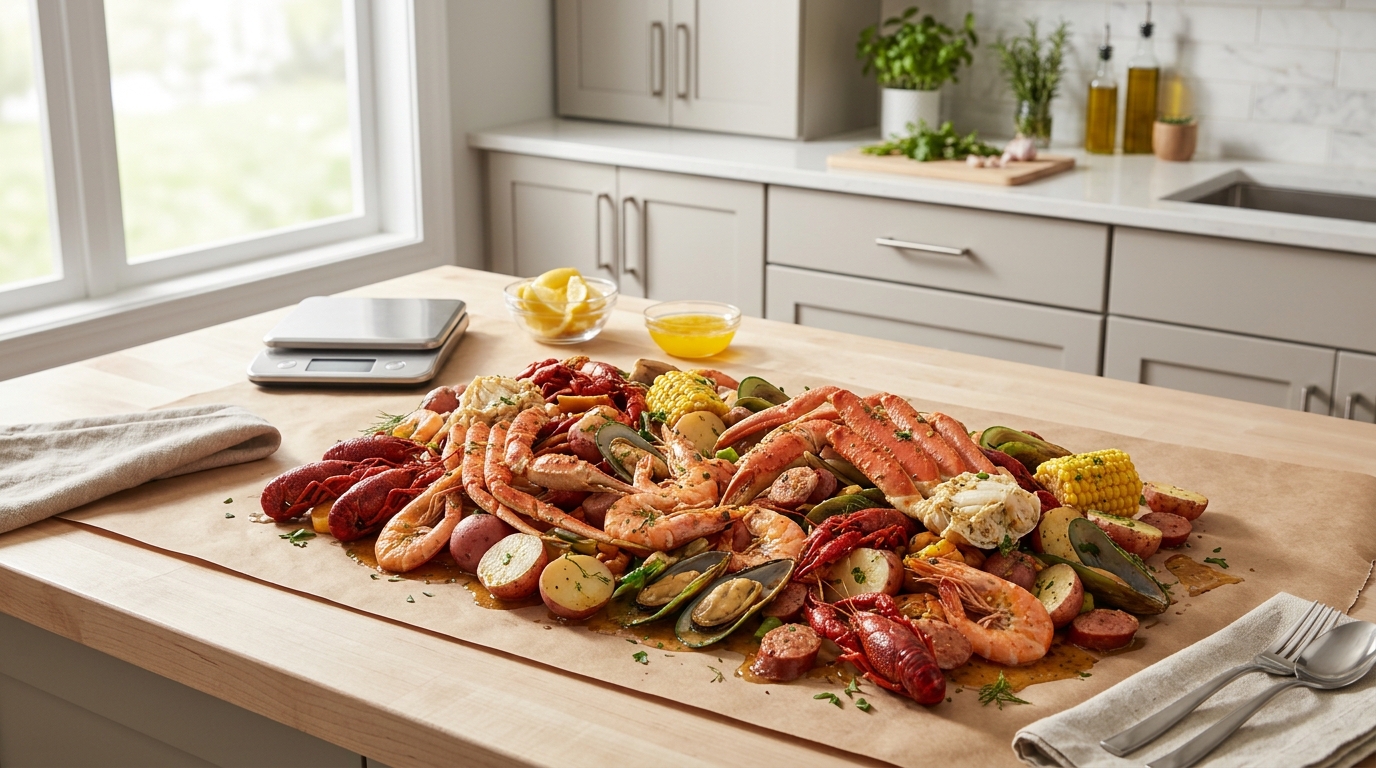
- All shellfish (shrimp, crab, lobster, crawfish)
- All mollusks (squid, octopus, clams, mussels, oysters, scallops)
- All other marine animals (sea urchin, sea cucumber, whale, seal)
- All products derived from marine animals used as food ingredients (fish sauce, worcestershire sauce containing anchovies, gelatin derived from fish bones)
This is non-contested within the vegan community on the core question. What becomes contested is the specific case of bivalves — and that’s a different conversation.
Veganism vs. Pescatarianism — The Diet That Actually Includes Seafood
The confusion around whether vegans eat seafood often comes from conflating veganism with pescatarianism. These are distinct dietary patterns that share some overlap but are categorically different.
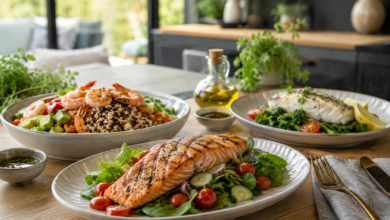
Pescatarianism is a dietary practice in which seafood is the only animal-flesh source in an otherwise plant-heavy diet. Pescatarians avoid red meat and poultry — beef, pork, chicken, turkey — but consume fish, shellfish, and often eggs and dairy. According to research from 2017–2018, approximately 3% of adults worldwide identify as pescatarian.
The word comes from the Latin piscis meaning fish, combined with the suffix of vegetarian — making it literally “fish-vegetarian,” though this is technically a misnomer since fish is meat.
Key distinctions:
Feature |
Vegan |
Vegetarian |
Pescatarian |
| Red meat | ❌ Excluded | ❌ Excluded | ❌ Excluded |
| Poultry | ❌ Excluded | ❌ Excluded | ❌ Excluded |
| Fish and seafood | ❌ Excluded | ❌ Excluded | ✅ Included |
| Dairy | ❌ Excluded | ✅ Often included | ✅ Often included |
| Eggs | ❌ Excluded | ✅ Often included | ✅ Often included |
| Honey | ❌ Excluded | Varies | Varies |
| Non-food animal products | ❌ Excluded | Varies | Varies |
Pescatarianism is sometimes described as a “stepping stone” diet — a way to reduce animal product consumption and environmental impact without fully eliminating animal-derived food. Research generally shows pescatarian diets produce lower greenhouse gas emissions than omnivorous diets, though higher than purely plant-based diets.
The important clarification for anyone searching whether vegans eat seafood: if someone includes seafood in their diet, they are not vegan. They may be pescatarian, flexitarian, or simply someone who reduces land animal consumption while maintaining seafood intake — but veganism by any accepted definition excludes seafood.
The Ethics Behind Why Vegans Don’t Eat Seafood
Understanding why vegans exclude seafood — rather than just that they do — provides the ethical architecture that makes the subsequent bivalve debate more intelligible.
Sentience as the moral foundation: The core ethical argument in veganism is that causing unnecessary suffering to sentient beings is morally wrong. Sentience — the capacity to consciously experience pain, pleasure, and suffering — is the threshold that ethically-motivated vegans use to determine which beings deserve moral consideration. Fish are now established as sentient by mainstream scientific consensus. A landmark 2003 paper by Sneddon et al. in the Proceedings of the Royal Society B demonstrated that trout have nociceptors (pain receptors), display physiological stress responses to painful stimuli, and alter behavioral patterns in response to painful experiences in ways consistent with conscious pain rather than mere reflexive response.
This research, and the considerable body of evidence that has followed it, shifted the scientific consensus decisively toward fish sentience. The argument that “fish don’t feel pain” — once widely used to rationalize pescatarian diets — is no longer tenable in light of the accumulated evidence.
The scale problem: Approximately 1 to 2.3 trillion wild fish are caught commercially each year (estimates vary significantly due to the difficulty of measuring), making fish the most numerically significant vertebrate population killed for human consumption. Even small reductions in individual fish consumption translate to large-scale impact at population level. For environmentally-motivated vegans, this scale consideration compounds the ethical argument.
Environmental harm beyond sentience: Even setting aside individual fish suffering, industrial fishing causes significant ecological damage — bycatch (unintended species caught and killed alongside target fish), habitat destruction from bottom trawling, plastic pollution, and the contribution to ocean ecosystem collapse through overfishing. These environmental harms extend the ethical case against seafood beyond animal rights alone.
The justice argument: Some vegan ethicists extend the argument to include labor justice — the global fishing industry relies in part on exploitative labor practices in certain supply chains, including documented cases of forced labor on fishing vessels.
The Bivalve Debate — Ostroveganism and the Sentience Threshold
This is the most philosophically interesting aspect of the seafood-and-veganism question, and it’s worth engaging with seriously rather than dismissing.
A small but vocal subset of otherwise plant-based people — called ostrovegans or bivalvegans — include oysters, mussels, clams, and sometimes scallops in their diet. Their argument rests on a specific biological claim: that bivalves have no central nervous system and therefore no capacity for conscious suffering.
The biological case for bivalve non-sentience:
Oysters and mussels are sessile organisms — they cannot move from place to place and are physically anchored throughout their adult lives. They have extremely rudimentary nervous systems with no brain, no cerebral cortex, and no neurological architecture associated with conscious experience in any other animal. Philosopher Cheryl Abbate, writing in Dialogues on Ethical Vegetarianism, argues that vegans who oppose bivalve consumption are guilty of “kingdomism” — valuing an organism based solely on its membership in the animal kingdom rather than its actual capacity to suffer.
Diana Fleischman, writing in 2013 and among the first in effective altruism circles to articulate this position, argues that sessile bivalves “cannot escape pain and thus there really isn’t any adaptive reason for them to feel pain” — meaning natural selection would not have produced pain consciousness in organisms for whom escape is physically impossible.
The environmental case for bivalve farming:
Farmed oysters and mussels are arguably the most environmentally sustainable animal protein on earth. They require no feed inputs — they filter phytoplankton naturally from the surrounding water — and actually improve water quality by filtering particulates and nutrients. Oyster farming extracts carbon from the atmosphere, sequestering it in shells. Some researchers and environmental advocates argue that bivalve aquaculture is not only neutral but actively beneficial to marine ecosystems.
The counterargument:
The mainstream vegan position is that the absence of a central nervous system does not definitively prove absence of suffering. Mussels exposed to the scent of a predatory crayfish have been shown to keep their shells closed longer — suggesting some form of environmental awareness. VeganFTA and similar organizations argue that applying the “benefit of the doubt” principle — erring toward assuming sentience when uncertainty exists — is the more ethically responsible position.
The honest assessment: the sentience status of bivalves is genuinely uncertain in ways that the sentience of fish, octopus, and shrimp is not. Whether that uncertainty justifies their inclusion in an otherwise vegan diet is a philosophical question rather than a settled empirical one. The Vegan Society does not endorse ostroveganism as compatible with veganism. Individual plant-based eaters reach their own conclusions.
What About Imitation Seafood — Is That Vegan?
Yes — the rapidly expanding category of plant-based seafood alternatives is fully vegan and has become one of the fastest-growing segments of the plant-based food market.
Vegan seafood products now widely available:
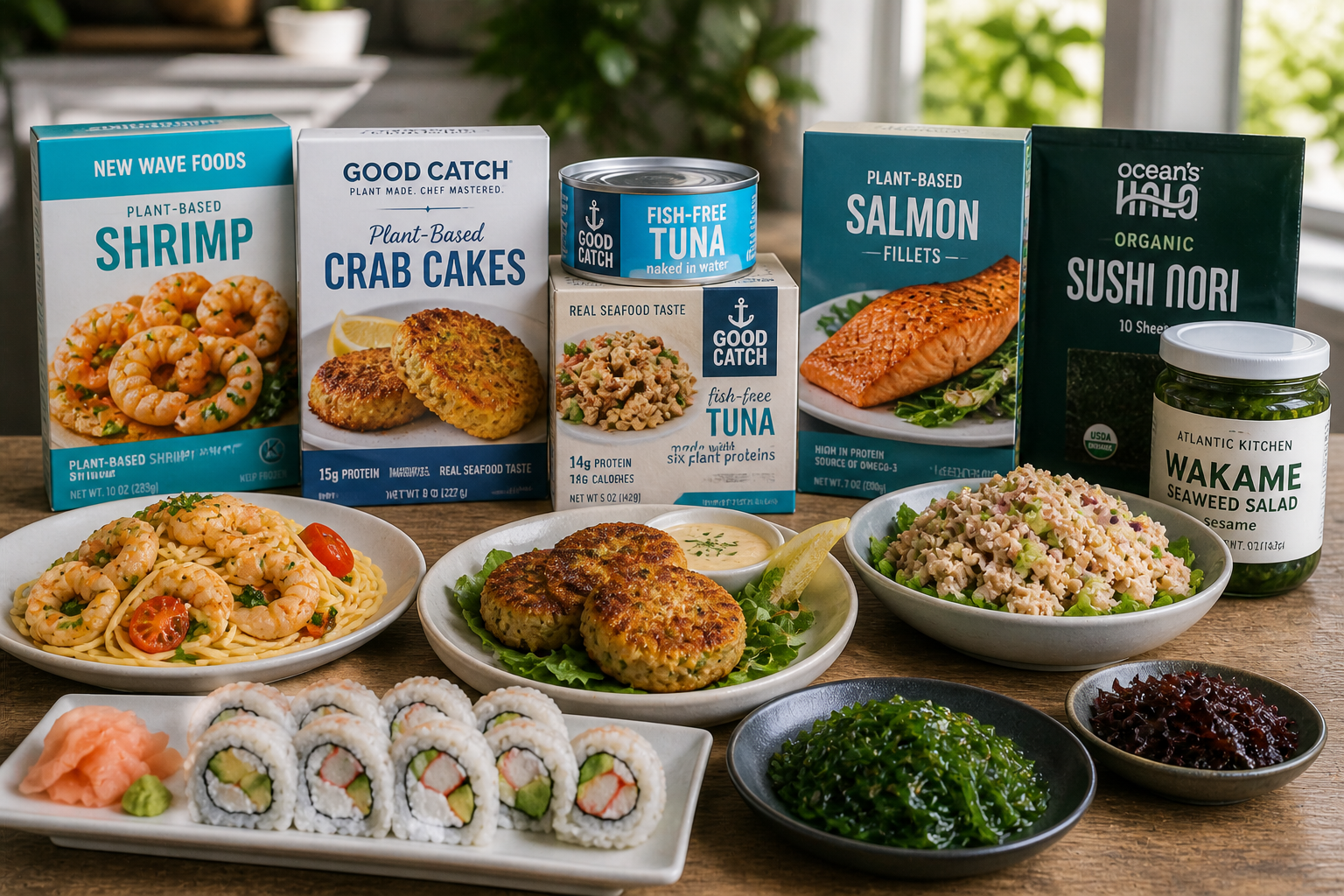
- Plant-based shrimp: Made from konjac (a starchy root), pea protein, or mung bean protein — the leading products from brands like New Wave Foods and Good Catch replicate the texture of shrimp remarkably well when sautéed or used in pasta and stir-fry.
- Vegan crab cakes and imitation crab: Hearts of palm, jackfruit, and artichoke hearts all have a fibrous, flake-able texture that functions as crab meat in cakes, rolls, and salads.
- Vegan tuna: Good Catch Fish-Free Tuna (made from a blend of six legumes) is the market leader — it replicates the color, texture, and flakiness of canned tuna closely enough for use in sandwiches, poke bowls, and pasta dishes.
- Vegan salmon: Several brands now produce plant-based salmon fillets from ingredients including soy protein, carrot-derived color, and seaweed for the omega-3 and oceanic flavor profile.
- Seaweed-based products: Nori sheets, wakame, dulse, and kelp are all marine organisms that are plants (or technically algae), making them fully vegan. They’re also among the few vegan sources of iodine and provide some omega-3 fatty acids.
What “imitation crab” actually is: Standard imitation crab (kani, as used in California rolls) is surimi — processed pollock fish shaped and colored to look like crab meat. It is not vegan. This is one of the most common hidden seafood ingredients in restaurant and packaged foods.
The Nutritional Gap — Why Seafood Is Tempting for Some Plant-Based Eaters
Understanding why some plant-based eaters consider seafood or bivalves requires acknowledging the genuine nutritional challenge of a fully plant-based diet.
Nutrients concentrated in seafood that require planning on a vegan diet:
DHA and EPA (omega-3 fatty acids): Fish and shellfish are the richest dietary sources of DHA and EPA — the forms of omega-3 that directly support brain function, cardiovascular health, and fetal development. Plants contain ALA (alpha-linolenic acid), which the body converts to DHA and EPA — but this conversion is inefficient, with conversion rates estimated at 5–15% for EPA and under 1% for DHA in most individuals.
Vegan solution: algae-based omega-3 supplements. Algae is the original source of DHA and EPA that fish accumulate by eating it — going directly to the algae source bypasses the fish entirely. Algal DHA supplements deliver comparable DHA concentrations to fish oil in clinical studies.
Vitamin B12: Seafood is an excellent source of B12. Vegans require supplementation or B12-fortified foods — there is no reliable whole-food plant source of B12. This is the most critical nutrient consideration in any fully plant-based diet and requires active management through supplements or fortified foods.
Iodine: Seaweed and iodized salt are the primary vegan iodine sources. Many fortified plant milks now include iodine. This is one area where including seaweed in a vegan diet provides meaningful benefit.
Zinc: Shellfish (oysters especially) are extremely high in zinc. Plant sources of zinc are less bioavailable due to phytate content in legumes and grains. Soaking and sprouting legumes reduces phytate and improves zinc absorption.
Per 3.5 oz (100g) serving comparison — vegan alternatives vs. seafood:
Nutrient |
Wild Salmon |
Algae Supplement |
Tofu |
Lentils |
| Protein | 22g | 0g | 8g | 9g |
| DHA | ~1,200mg | ~250mg (supplement) | 0 | 0 |
| B12 | 2.8mcg (117% DV) | 0 | 0 (unless fortified) | 0 |
| Iron | 0.7mg | 0 | 1.5mg | 3.3mg |
| Zinc | 0.6mg | 0 | 1mg | 1.3mg |
| Iodine | ~35mcg | Varies | Varies | Low |
This table illustrates why DHA and B12 are the two most important nutrients for vegans to actively manage through supplementation. Both are now widely available in vegan supplement form that does not require animal products.
Vegan Seafood Alternatives That Close the Nutritional Gap
The “but what about omega-3s” argument for eating fish has weakened considerably as algae-based supplements have become mainstream. Several other strategies close the gap:
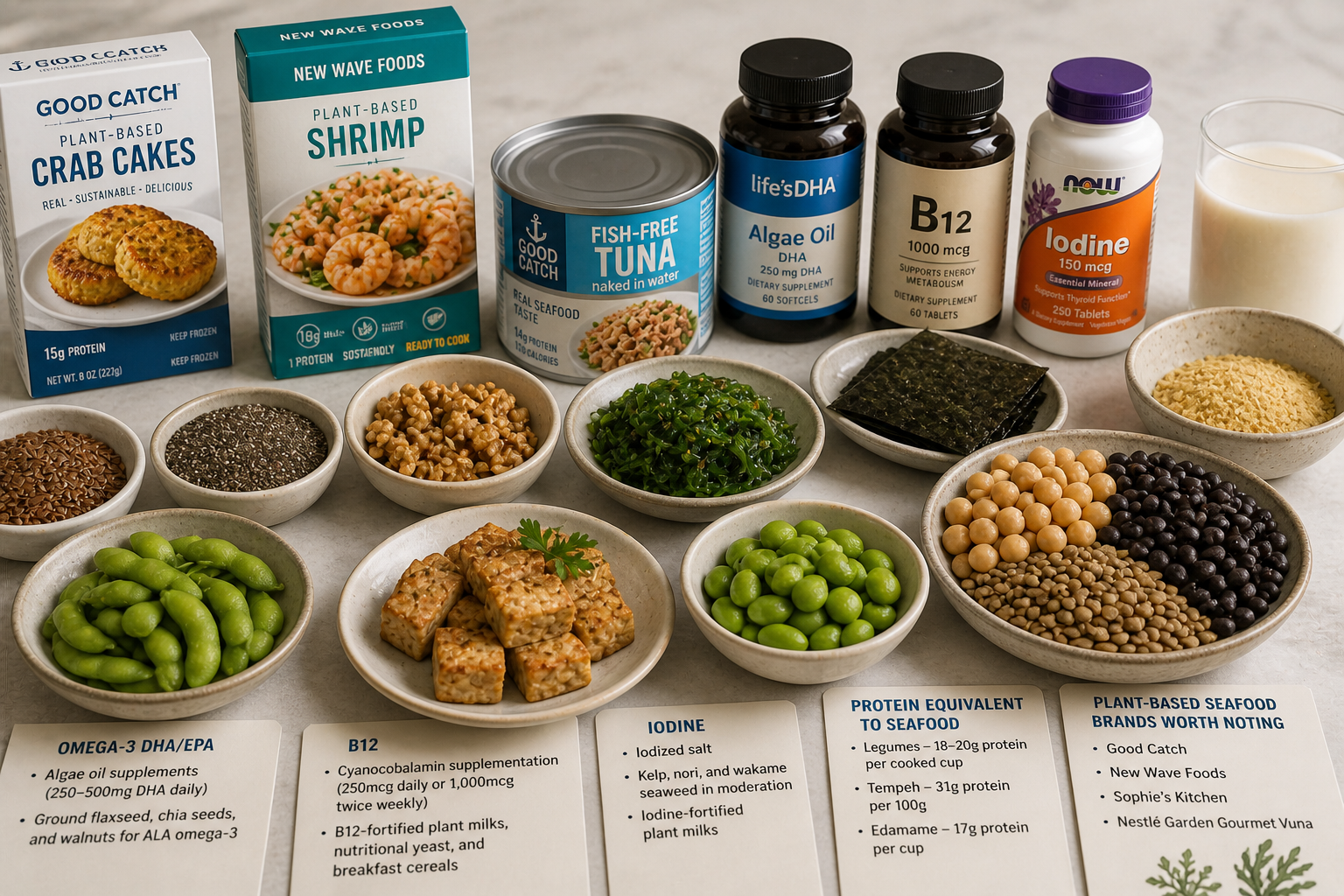
For omega-3 DHA/EPA:
- Algae oil supplements (250–500mg DHA daily) — clinically shown to raise blood DHA levels comparably to fish oil
- Ground flaxseed, chia seeds, and walnuts for ALA omega-3 (conversion is inefficient but contributes)
For B12:
- Cyanocobalamin supplementation (most studied form) — 250mcg daily or 1,000mcg twice weekly
- B12-fortified plant milks, nutritional yeast, and breakfast cereals
For iodine:
- Iodized salt (check label — not all salt is iodized)
- Kelp, nori, and wakame seaweed in moderation (note: seaweed iodine is highly variable — kelp can be excessively high)
- Iodine-fortified plant milks
For protein equivalent to seafood:
- Legumes (lentils, chickpeas, black beans) — 18–20g protein per cooked cup
- Tempeh — 31g protein per 100g, with the highest protein density of common plant foods
- Edamame — 17g protein per cup, with a complete amino acid profile close to animal protein
Plant-based seafood brands worth noting: Good Catch, New Wave Foods, Sophie’s Kitchen, and Nestlé’s Garden Gourmet Vuna are producing vegan seafood that has genuinely improved in quality. The texture gap that made early vegan seafood products unsatisfying has narrowed significantly with newer formulations using konjac, mycoprotein, and legume blends.
Frequently Asked Questions — Do Vegans Eat Seafood
Q: Do vegans eat fish? No. Fish are animals, and veganism excludes all animal products. The ethical case against eating fish is supported by scientific consensus on fish sentience — fish have pain receptors and exhibit behavioral pain responses. Eating fish is incompatible with veganism by any accepted definition.
Q: Can vegans eat shrimp? No. Shrimp are crustaceans — animals with nervous systems capable of nociception (pain detection). They are not plants and not vegan.
Q: What is the difference between a vegan and a pescatarian? A pescatarian eats plant foods plus fish and seafood, and often includes dairy and eggs. A vegan excludes all animal products including fish, dairy, and eggs. The dietary overlap is that both avoid red meat and poultry, but they diverge entirely on seafood.
Q: Do vegans eat oysters? Most vegans do not eat oysters. A small subset — called ostrovegans or bivalvegans — do, on the grounds that oysters have no central nervous system and likely cannot experience conscious suffering. The Vegan Society does not recognize this as compatible with veganism. It is an ongoing philosophical debate within the plant-based community.
Q: Is imitation crab vegan? Standard imitation crab (surimi/kani) is made from processed pollock fish and is not vegan. True plant-based crab alternatives made from hearts of palm, jackfruit, or konjac are vegan. Always check the ingredient label.
Q: How do vegans get omega-3 fatty acids without seafood? Through algae-based DHA/EPA supplements — the same omega-3 source that fish obtain by eating algae in the first place. Algal DHA supplements have been shown in clinical studies to raise blood DHA levels comparably to fish oil. Ground flaxseed, chia, and walnuts provide ALA omega-3, which the body partially converts.
Q: What about vegans eating seaweed? Seaweed (nori, kelp, wakame, dulse) is a marine plant/algae — not an animal — and is fully vegan. It’s also one of the most nutritionally valuable additions to a vegan diet, providing iodine, some omega-3 ALA, and a variety of minerals. Seaweed is a staple in many plant-based diets.
Q: Can you be vegan and eat sushi? Traditional sushi with raw fish is not vegan. Vegan sushi options exist — cucumber rolls, avocado rolls, pickled vegetable rolls, tofu inari sushi — and are widely available at sushi restaurants when requested. Nori (seaweed) used in sushi rolls is vegan.
Conclusion — Clear Answer, Complex Edges
Do vegans eat seafood? No — not by any accepted definition of veganism. Seafood includes fish, shellfish, and crustaceans, all of which are animals, and veganism excludes all animal products on ethical, environmental, and health-principle grounds.
The edges of this question are where things get genuinely interesting. The bivalve debate is not a frivolous one — it engages serious questions about where sentience begins, what the moral basis of veganism actually is, and whether an organism’s membership in the animal kingdom is sufficient to grant it full moral protection regardless of its neurological capacity for suffering. Philosophers, ethicists, and scientists have not reached consensus, and individual plant-based eaters reach different conclusions.
What is clear from a nutritional standpoint is that a well-planned vegan diet can meet all the nutritional needs that seafood addresses — DHA and EPA through algae supplementation, B12 through cyanocobalamin, iodine through iodized salt and seaweed, zinc through legumes and seeds. The argument that vegans “need” seafood for nutritional completeness is no longer supportable in 2026 given the quality of supplementation and fortified foods available.
If you eat fish or shellfish of any kind, you are not vegan — you may be pescatarian, flexitarian, or any number of other things, but not vegan. If you eat only bivalves and otherwise avoid all animal products, you are somewhere in a gray zone that the plant-based community is still actively debating.