How to Add Sourdough Discard to Any Recipe
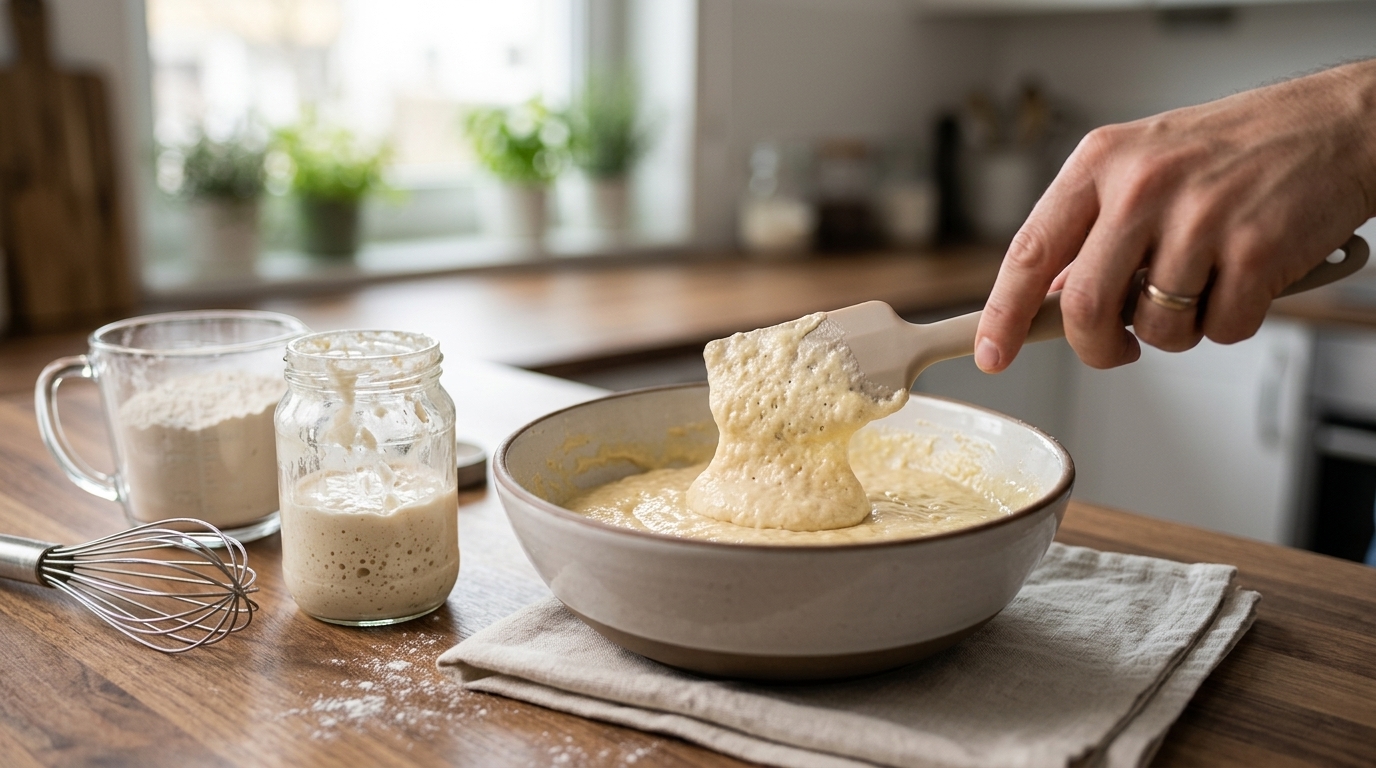
Anyone who keeps a sourdough starter long enough ends up with a secondary problem: what to do with all the discard. Feeding a starter means removing a portion of it each time — and that removed portion is discard. It still contains flour, water, wild yeast remnants, lactic acid bacteria, and fermentation byproducts. Throwing it away every day is wasteful when there’s a reliable, repeatable way to fold it into almost anything you’re already baking.
Knowing how to add sourdough discard to any recipe isn’t a trick — it’s applied baker’s math built on one straightforward principle: discard is roughly half flour and half water by weight. Once that’s understood, the substitution process becomes logical rather than guesswork.
This guide covers the calculation method, the limits of where substitution works, the hydration management that prevents disasters, the specific adjustments needed by recipe type, and the nutritional picture for why using discard is genuinely worth the extra step — not just an eco-conscious gesture.
What Sourdough Discard Actually Is — And What It Isn’t
Discard is the portion of your sourdough starter removed before feeding. It sits at a lower activity level than a fully fed, peak starter — fewer live yeast cells, higher acidity, and reduced leavening power. That’s what makes it “discard” rather than active starter.
What it still contains:
- Flour and water in roughly equal parts by weight (assuming a 100% hydration starter, which is standard for most home bakers)
- Lactic acid bacteria (LAB) — primarily Lactobacillus strains — that have been fermenting the flour
- Organic acids: lactic acid (milder, creamy tang) and acetic acid (sharper, vinegar-like tang) in varying ratios depending on temperature and feeding schedule
- Enzymatic activity — proteases and amylases produced during fermentation that continue to break down gluten and starch even in discard form
- Wild yeast at reduced but non-zero levels
The older the discard, the more acidic it becomes and the more pronounced the tang in finished baked goods. Discard fed within the last 24–36 hours behaves closest to active starter in flavor and mildness. Discard that’s been sitting in the fridge for a week will be noticeably more sour and will interact differently with gluten structure.
One important clarification: discard is not a leavening agent for most recipes you add it to. It will contribute flavor, moisture, and minor textural changes — but if you’re adding discard to a muffin recipe that relies on baking powder for lift, the discard doesn’t replace the baking powder. Treat it as a fermented ingredient that improves flavor and texture, not a standalone leavener (unless you’re specifically building recipes around long fermentation times).
The Core Calculation — Baker’s Math Made Simple
This is the method that works consistently across recipe types, and it comes from a single fact: standard sourdough starter at 100% hydration is 50% flour and 50% water by weight.
That means when you add 100g of discard to a recipe, you are also adding 50g of flour and 50g of water. To keep the recipe balanced, you must remove those same amounts from the original ingredient list.
The formula:
Amount of discard to use ÷ 2 = grams of flour AND grams of liquid to remove
Worked example — blueberry muffins:
Original recipe:
- 200g all-purpose flour
- 125g milk
- 50g vegetable oil
- 1 egg
- 100g sugar
- 12g baking powder
You want to add 100g discard.
- Divide 100g ÷ 2 = 50g
- Subtract 50g from flour: 200g → 150g flour
- Subtract 50g from liquid (milk): 125g → 75g milk
- Add 100g discard to the batter
- Everything else stays the same
The batter should behave almost identically to the original. The finished muffin will have a slightly more complex flavor with mild tang from the fermented flour.
Key rules for this method:
- Use a kitchen scale. Volume measurements (cups, tablespoons) are too imprecise for this substitution to work reliably. Baker’s percentages require weight.
- Maximum 200g of discard per standard recipe batch. Beyond that, the acidity becomes significant enough to affect gluten structure, leavening behavior, and finished flavor noticeably.
- Recommended range: 100–150g per recipe for most baking applications. This hits the sweet spot of flavor contribution without disrupting texture.
- Do not substitute more than ⅓ of the total flour weight with discard. If a recipe calls for 300g flour, keep discard-derived flour below 100g (meaning your discard cap is ~200g).
- Do not replace fats, sugars, or eggs with discard. Only water-type liquids (milk, water, juice, coffee) and flour can be displaced.
Hydration Management — The Variable Most Guides Skip
The 100% hydration assumption (equal parts flour and water) applies to most home sourdough starters. But if your starter is maintained at a different hydration — say 75% (stiffer, like some traditional Italian or French starters) or 125% (wetter, more pourable) — the math shifts.
For starters that aren’t 100% hydration:
- 75% hydration starter: For every 100g, there’s approximately 57g flour and 43g water. Adjust your subtraction accordingly.
- 125% hydration starter: For every 100g, there’s approximately 44g flour and 56g water.
Most bakers who are unsure of their hydration can simplify by feeding their starter at 1:1:1 (starter:flour:water by weight) for a week or two before using discard in calculations. This normalizes it to 100% and makes the math consistent.
Age of discard matters for hydration, too. Older discard tends to become slightly more watery as the bacteria continue to produce acids and break down the flour’s structure. If you’re working with discard that’s been in the fridge for a week or more, it may run slightly thinner than fresh discard. You might need to reduce the liquid substitution by a few grams or add a teaspoon more flour to the finished batter if it looks too loose.
Recipes with minimal liquid are trickier. Cookie dough, certain pie crusts, and shortbread have very little free liquid — meaning there’s not much to subtract when you add discard. In these cases, the “Marty Method” (named from a popular sourdough blog approach) works better: mix all your original ingredients first, then add ¼ to ½ cup of discard directly and refrigerate the dough for at least 6 hours overnight. The long cold rest allows the discard’s acidity and enzymatic activity to integrate without the batter becoming unbalanced. This works particularly well for cookies, shortbread, and crackers.
Recipe-Type Breakdown — Where Discard Works Best and Where It Doesn’t
Quick breads, muffins, and snacking cakes — Best fit
These are the most forgiving applications and the best starting point for anyone new to discard substitution. Quick breads (banana bread, zucchini bread, pumpkin loaves) and muffins typically contain enough liquid and flour to absorb 100–150g of discard cleanly. The discard adds a subtle tang that reads as depth of flavor, not sourness. The baking powder or baking soda handles all the leavening; the discard is simply replacing equivalent flour and liquid.
Pancakes and waffles — Simplest fit
These batters are inherently wet and loose, making them the most tolerant of addition. Many experienced discard bakers skip the formal calculation entirely with pancakes and simply add 50–75g of discard on top of the original recipe without adjusting anything. The extra liquid absorbs into the batter without much consequence. The resulting pancakes have a slightly tangy flavor and notably tender crumb due to the enzymatic action on the gluten.
Cakes — Works well with adjustments
Layer cakes, snacking cakes, and spice cakes all handle discard well when the calculation is applied accurately. One nuance: when replacing milk with discard, you lose the milk fat and milk solids that contribute to tenderness and color. For a cake where those matter, compensate by adding a teaspoon of extra butter or a tablespoon of whole milk fat back to the batter. The trade-off is usually worth it — discard improves chocolate cake flavor in particular, because the acidity amplifies cocoa compounds.
Bread with commercial yeast — Works, requires timing awareness
Adding discard to a commercially yeasted bread recipe introduces more acidity, which slightly strengthens the gluten structure but also extends fermentation time. The discard’s residual yeast activity is unpredictable — treat it as flavor contribution only, not leavening contribution. Don’t reduce the commercial yeast quantity when adding discard; simply substitute the flour and water as usual and monitor rise time. Expect it may take 15–30 minutes longer than usual.
Sourdough bread — Specialized territory
Replacing active starter with discard in a true sourdough loaf is possible but requires patience. Discard lacks the peak yeast activity of a freshly fed starter. Adding commercial yeast alongside discard is the practical workaround — use the discard for flavor and the commercial yeast for reliable rise. If working without added yeast, discard-only sourdough needs extended bulk fermentation (often 12–16 hours at room temperature or 24+ hours cold) to achieve adequate gluten development and rise.
Savory applications — Underused but effective
Discard’s acidic, fermented character makes it genuinely useful outside sweet baking. It thickens soups, gravies, and sauces the same way a flour slurry does — add a spoonful or two to a simmering liquid and stir. The fermented flavor blends into the background in brothy or richly seasoned dishes. Discard also works as a coating base for fried items (tempura batter, cracker dough, flatbreads) and as a tenderizing marinade for proteins — the lactic acid helps break down surface proteins on chicken, pork, or tofu before cooking.
Discard Age — Fresh vs. Old and When It Matters
This is the variable that most introductory discard guides understate.
Fresh discard (fed within 24–36 hours):
- Milder tang, closer to active starter in flavor
- More active enzymatic behavior
- Better for recipes where discard flavor should be subtle — vanilla cakes, light muffins, delicate pancakes
Medium discard (2–5 days refrigerated):
- Moderate tang, balanced lactic and acetic acid
- Works in most applications; the “everyday discard” most home bakers have
- Excellent for crackers, flatbreads, pizza crusts, banana bread, and scones where some tang is welcome
Older discard (1–3 weeks refrigerated):
- Sharper, more pronounced tang
- Thinner in consistency as proteins and starches continue breaking down
- Best used in strongly flavored recipes where the acidity either enhances the result (rye crackers, chocolate cake, cornbread) or disappears into bolder flavors (heavily spiced loaves, savory flatbreads, soups)
- Not ideal for neutral-flavored or sweet-forward recipes like shortbread or vanilla layer cake
Very old discard (more than 3–4 weeks):
- Extremely acidic; can make baked goods dense by over-activating leavening agents too quickly or by over-tenderizing gluten
- Use sparingly (50g maximum) or revive it by feeding once and waiting 8–12 hours before using
One practical approach: keep a dedicated discard jar in the fridge and label each addition with the date. Using the oldest portion first before adding fresh discard keeps flavor consistent and prevents the jar from developing excessively sour batches.
Nutrition — What Sourdough Discard Actually Adds to Your Food
The health picture of sourdough discard requires some nuance — the claims circulating online range from accurate to overstated, and it’s worth separating what the science actually supports.
What discard genuinely contributes:
Phytate reduction and improved mineral bioavailability. Research published in peer-reviewed food science journals consistently shows that sourdough fermentation reduces phytic acid content in grain flour by up to 62% — significantly more than standard yeast fermentation (~38%). Phytic acid binds to minerals including iron, calcium, zinc, and magnesium in the gut, blocking absorption. When lactic acid bacteria break down phytic acid during fermentation, those minerals become far more available to the body. Discard retains this benefit from its fermentation history, meaning the flour you replace in a recipe with discard is nutritionally superior to the raw flour it displaces.
Lower glycemic response. Multiple peer-reviewed studies, including research published in Cell Metabolism, show that sourdough fermentation lowers the glycemic index of grain-based foods compared to conventionally yeasted equivalents. The organic acids (lactic and acetic) produced during fermentation slow starch digestion and reduce the rate of blood glucose rise after eating. Baked goods that incorporate discard inherit some of this benefit, though the degree depends on the proportion of discard used and how long the batter or dough is allowed to ferment before baking.
B vitamins and amino acids. Fermentation by LAB produces additional B vitamins (thiamine, riboflavin, niacin, folate) and generates free amino acids through protease activity on gluten. These compounds remain present in discard and transfer to the finished baked good, improving its nutritional density relative to the same recipe made without discard.
The probiotic question — honest answer. Live lactic acid bacteria in discard do not survive oven temperatures. Most baking occurs at 325–450°F; beneficial bacteria die at temperatures above 120°F. The probiotic benefit most associated with fermented foods is not present in baked discard applications. However, the postbiotic compounds — organic acids, bioactive peptides, enzymes — remain structurally present in the food even after baking and carry their own digestive and metabolic benefits that are increasingly recognized in nutrition research.
Per 100g of sourdough discard (approximate, 100% hydration):
Nutrient |
Amount |
| Calories | ~185 kcal |
| Carbohydrates | 38g |
| Protein | 6g |
| Total Fat | 0.5g |
| Fiber | 1–2g |
| Iron | ~2mg (varies by flour type) |
| B vitamins | Present (B1, B2, B3, folate) |
| Sodium | Trace (if no salt was added to starter) |
The nutritional values above apply to the discard itself before any recipe additions. The contribution per serving of a finished baked good is smaller in proportion to the total batch.
Storage and Handling — Practical Rules
Refrigerator storage: Discard keeps well in a sealed jar in the refrigerator for 2–4 weeks. The jar can be added to after each feeding — layer fresh discard on top of older, use from the bottom. Always check for pink or orange streaks (contamination) or visible mold before use. A healthy discard jar smells tangy and fermented — not putrid or cheesy-rotten.
Do not put discard down the drain. It contains live cultures that, while harmless to humans, can contribute to plumbing buildup over time and are better composted if not used.
Freezing: Discard can be frozen flat in a sealed bag or in measured portions in an ice cube tray (roughly 50g per cube is useful for small-batch recipes). Thaw overnight in the refrigerator. Frozen discard loses some enzymatic activity but retains its flavor profile and can still be used in most baking applications.
Starting a new starter from discard: Discard is an effective base for building a new sourdough starter. Feed 50g of discard with 50g flour and 50g warm water, let it sit at room temperature, and repeat for several days. This works because discard still contains the wild yeast and LAB colonies that define your starter’s unique microbial community.
Quick Reference — Discard Substitution at a Glance
Recipe Type |
Discard Amount |
Calculation Needed? |
Notes |
| Pancakes / waffles | 50–100g | No (forgiving batter) | Add directly, minimal adjustment |
| Muffins / quick breads | 100–150g | Yes (standard method) | Subtract equal flour + liquid |
| Cakes | 100–150g | Yes | Consider replacing milk fat |
| Cookies / shortbread | 50–100g | Marty Method preferred | Refrigerate dough 6–12 hrs |
| Bread (commercial yeast) | 100–150g | Yes | Don’t reduce yeast quantity |
| Crackers / flatbreads | 100–200g | Yes | Old discard works well here |
| Soups / sauces (thickener) | 1–3 tablespoons | No | Stir in near end of cooking |
| Savory marinades | 50–100g | No | Use alongside other acids |
Conclusion — One Formula, Endless Applications
Learning how to add sourdough discard to any recipe comes down to mastering one calculation and understanding three variables: hydration, age, and recipe type. The formula — discard weight ÷ 2 = grams of flour and liquid to remove — is the same whether you’re adjusting a muffin batter, a yeast bread, or a cracker dough. What changes is how much discard you use, how old it is, and whether the recipe structure can absorb the substitution cleanly.
From a nutritional standpoint, the science is clear on what discard genuinely delivers: improved mineral bioavailability through phytate reduction, lower glycemic response from fermentation-derived organic acids, and measurable increases in available B vitamins compared to unfermented flour. These aren’t marginal gains — they represent a meaningful nutritional upgrade to everyday baked goods that requires no additional cost or effort beyond the calculation step.
The practical outcome of using discard regularly is that you waste less, bake more intuitively, and produce food with more flavor complexity than standard recipes achieve on their own. A jar of discard in the refrigerator stops being a problem to manage and becomes an ingredient you look forward to using.