How Long Can Salmon Stay in the Fridge — The Complete Storage and Safety Guide

How Long Can Salmon Stay in the Fridge — Everything From Purchase to Plate
If you’ve ever bought salmon and then started second-guessing whether it’s still good two days later, you’re not alone. The question of how long salmon can stay in the fridge is one of the most practically important seafood questions a home cook faces — and the answer shifts significantly depending on whether the salmon is raw, cooked, vacuum-sealed, smoked, or thawed from frozen.
The short answer: raw fresh salmon lasts 1–2 days in the fridge; cooked salmon lasts 3–4 days. But that summary hides important nuances — the fridge temperature you’re actually running (not the temperature you assume), how the salmon was handled before you bought it, what bacterial and enzymatic activity begins the moment a fish leaves cold water, and the meaningful difference between vacuum-sealed and unwrapped storage.
This guide covers every scenario clearly, backed by USDA and FDA guidance, with the storage and spoilage angles that most food safety guides miss.
The Official Numbers — What USDA and FDA Say
Both the USDA and the FDA have clear, documented guidelines for fish storage that form the foundation for every reliable answer on this topic.
Per USDA food safety guidelines:
- Raw fish and shellfish: refrigerate for 1–2 days at or below 40°F (4°C)
- Cooked fish: refrigerate for 3–4 days at or below 40°F (4°C)
Per FDA seafood handling guidance:
- Fresh salmon purchased for use within 2 days: store in a clean refrigerator at 40°F or below
- Beyond 2 days before planned use: wrap tightly in plastic, foil, or moisture-proof paper and freeze immediately
- Raw or undercooked salmon: carry elevated risk of Listeria, Salmonella, and parasites; people in high-risk groups (pregnant women, elderly, immunocompromised) should avoid raw consumption entirely
Complete shelf life reference by salmon type:
Salmon Type |
In the Fridge |
In the Freezer |
| Raw fresh salmon | 1–2 days | 2–3 months (best quality) |
| Raw vacuum-sealed salmon | Up to 5 days (unopened) | Up to 6 months |
| Cooked salmon (any method) | 3–4 days | 2–3 months |
| Thawed from frozen | 1–2 days (do not refreeze) | N/A |
| Smoked salmon (refrigerated) | 5–7 days | Up to 3 months |
| Canned salmon (opened) | 3–4 days | Not recommended |
| Marinated raw salmon | 1–2 days | Not recommended while marinating |
The vacuum-sealed distinction is important and frequently overlooked. Commercial vacuum packaging removes oxygen, which is one of the primary drivers of bacterial proliferation on fish surfaces. An unopened, properly refrigerated vacuum-sealed salmon fillet can safely last up to 5 days — significantly longer than an unwrapped or loosely packaged fillet at the same temperature.
Why Salmon Spoils So Quickly — The Biology Behind the Timeline
Understanding why raw salmon has a 1–2 day window helps you respect that window rather than push against it.
High moisture content: Fish tissue contains 70–80% water by weight — a significantly higher proportion than red meat. This moisture creates an environment where bacteria thrive and multiply rapidly at temperatures above 40°F. The USDA’s temperature danger zone (40–140°F) is where bacterial populations can double in as little as 20 minutes. Salmon sitting at 45°F instead of 38°F isn’t a minor difference — it meaningfully accelerates spoilage.
Natural enzymatic breakdown: From the moment salmon is caught, its own digestive enzymes begin breaking down the flesh. These proteases and lipases work regardless of bacterial presence — they’re the reason fish softens and loses texture over time even under good refrigeration. This enzymatic activity is one reason fresh salmon has a shorter window than, say, a chicken breast of similar weight.
Surface bacterial load: The outside of a fish fillet carries bacteria — from the water, from handling, from the retail environment. Refrigeration slows bacterial growth but doesn’t stop it. Listeria monocytogenes, in particular, can continue growing (slowly) even at proper refrigerator temperatures, which is why the 1–2 day window exists rather than a more generous limit.
Fat oxidation in fatty fish: Salmon is one of the fattiest fish available, with significant omega-3 polyunsaturated fatty acids. These beneficial fats oxidize when exposed to air and light — a process called rancidity. Rancid fish develops that characteristic unpleasant fishy-gone-off smell and contributes to the quality decline even before serious bacterial spoilage sets in. This is unique to oily fish like salmon and mackerel — leaner fish like cod or tilapia have longer tolerance for air exposure because there’s less fat to oxidize.
The “previously frozen” problem: Much of the “fresh” salmon sold at grocery store counters was previously frozen at sea, thawed at the distribution center, and then placed in the display case. Salmon labeled “previously frozen” or “never frozen” behaves differently from a storage standpoint. The 1–2 day window applies from the moment it reached your refrigerator, but if previously-frozen salmon spent two days in the display case before you bought it, your practical window at home is significantly compressed.
Your Fridge Temperature — The Variable Nobody Checks
This is the variable most food safety discussions gloss over: home refrigerators are often warmer than their dial settings suggest.
A University of Minnesota Extension study found that a significant percentage of household refrigerators run above 40°F — with some running at 45–50°F, particularly in the door compartments and the front of shelves. The back of the bottom shelf is consistently the coldest zone because it’s farthest from the door and closest to the refrigeration coils.
The practical implication for salmon storage:
- At 32–38°F: salmon achieves its maximum safety window (2 days raw, 4 days cooked)
- At 40°F: the USDA’s standard safe limit — salmon is at its edge
- At 42–45°F: bacterial growth accelerates meaningfully; the effective safe window for raw salmon compresses to closer to 24 hours
- Above 50°F: approaching the danger zone — treat salmon as perishable within hours, not days
What you should actually do: Place a refrigerator thermometer (inexpensive, available everywhere) in the back of your fridge’s middle shelf and note the actual temperature. If you’re running at 42–45°F, you’re storing food as if you have a generous safety buffer when you actually don’t. Adjusting your fridge thermostat down and confirming the actual temperature with a thermometer is one of the most impactful food safety changes a household can make.
The ice method for extended raw salmon storage: Professional fish markets and serious home cooks store fresh salmon on a bed of ice inside the refrigerator, keeping the immediate temperature around the fish at 32°F rather than the ambient fridge temperature. Place ice in a shallow container, set the salmon (in its packaging or wrapped) on top, and store in the coldest section. This method is particularly effective for fish you plan to cook the next day that you want in peak condition.
How to Store Salmon Correctly — Method by Method
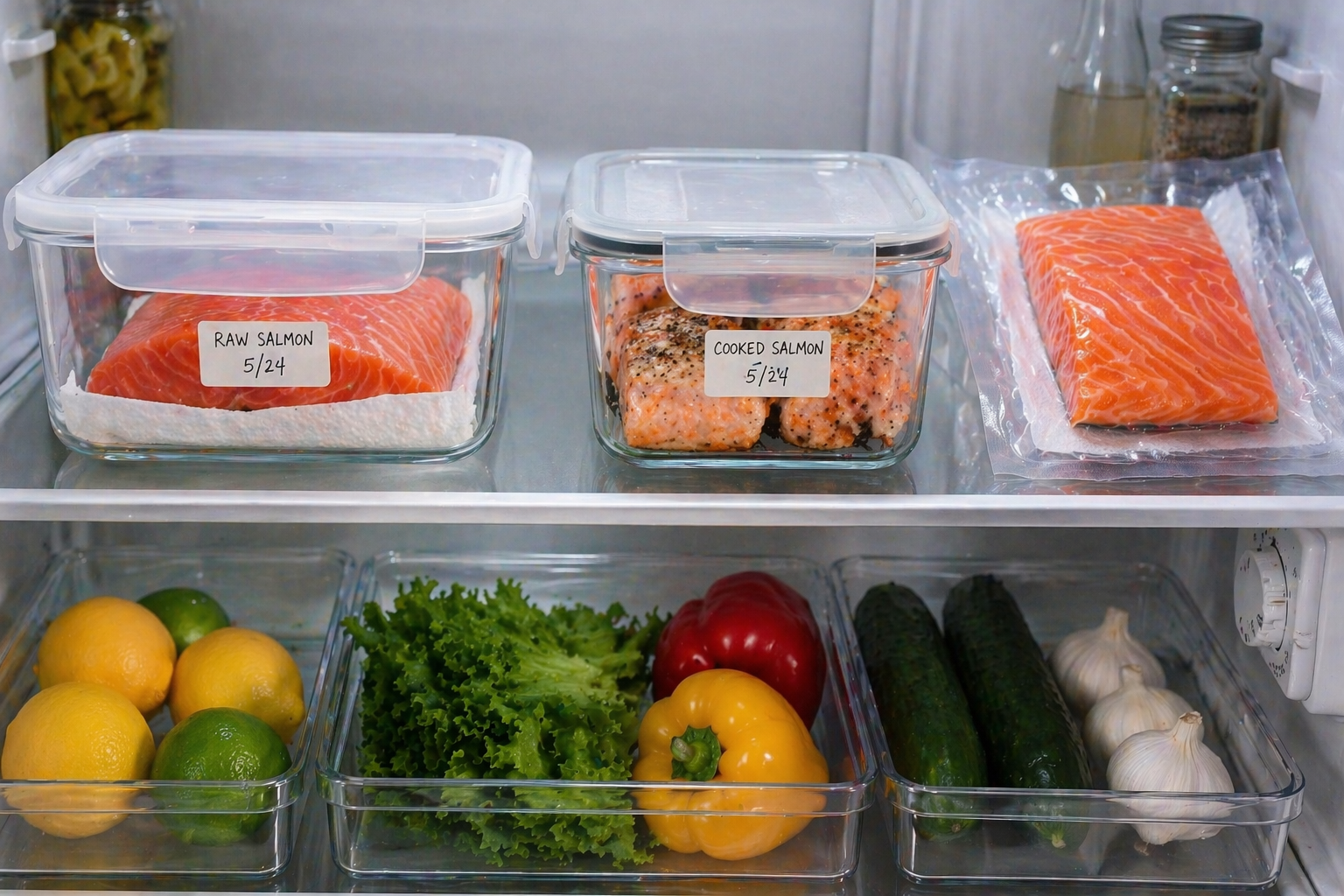
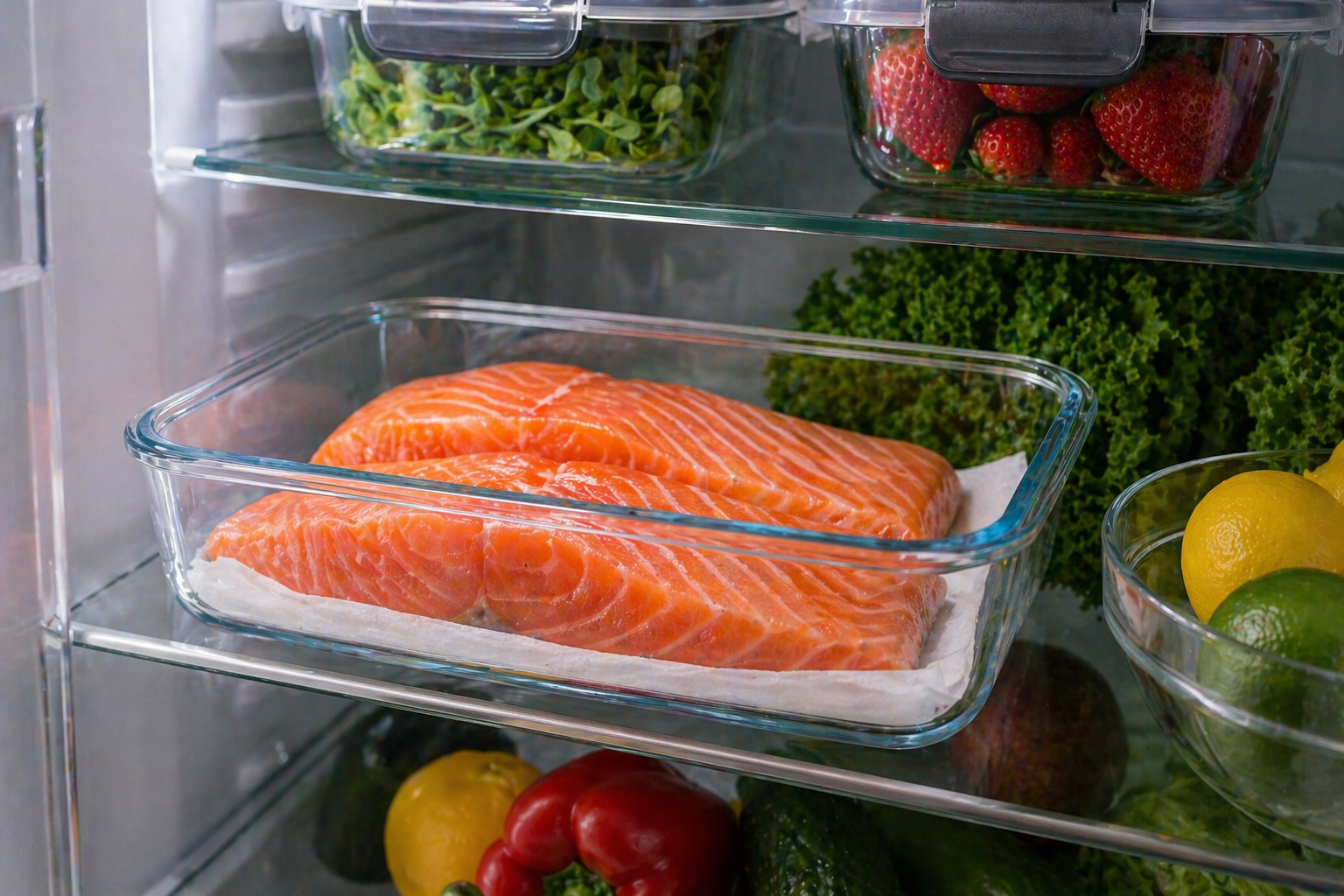
Raw salmon (store-bought, unwrapped or repackaged):
- Pat the fillet dry with paper towels — excess surface moisture accelerates bacterial growth
- Place a fresh paper towel in the bottom of an airtight container to absorb any liquid that drains from the fish
- Lay the salmon on top, skin-side down
- Cover tightly with a lid or wrap firmly in plastic wrap, then foil
- Store in the coldest part of your fridge — back of the bottom shelf, not the door
- Label with the purchase date
Do not store raw salmon in its original supermarket tray if it’s the type with absorbent pads and loose plastic film. These containers are designed for display, not extended storage — they don’t seal well and allow air circulation.
Do not rinse raw salmon before storing it. This is a common instinct but counterproductive. Rinsing raw fish spreads bacteria from the fish surface to your sink, countertop, and any surrounding surfaces. The FDA explicitly advises against rinsing raw fish before storage. Any surface bacteria will be eliminated during cooking.
Cooked salmon storage:
Allow cooked salmon to cool to room temperature — but not longer than 2 hours from cooking. Transfer to an airtight container. Refrigerate immediately. Cooked salmon stored in a sealed container retains both moisture and safety better than loosely covered or exposed leftovers.
For cooked salmon you plan to use in cold preparations (salads, grain bowls, salmon cakes), let it cool completely in the fridge rather than at room temperature — this takes slightly longer but keeps the quality higher.
Vacuum-sealed raw salmon:
Do not open until ready to use. Once the seal is broken, the 5-day window drops to the standard 1–2 day raw fish window immediately. If you notice the package is bloated or the seal is broken before purchase, do not buy it — bloated vacuum packaging indicates microbial activity producing gas inside the package.
Freezing Salmon — When and How to Do It Right
If you won’t cook raw salmon within 1–2 days, freeze it. This is not a quality compromise — it’s the correct decision, and properly frozen salmon retains its nutrition and most of its texture.
Freezing raw salmon:
- Rinse the fillet quickly (yes, you can rinse before freezing — you’re not spreading bacteria to counter surfaces, as the fish goes directly into packaging)
- Pat completely dry — moisture causes freezer burn
- Wrap tightly in plastic wrap, pressing out all air against the flesh
- Place in a heavy-duty freezer bag, press out additional air, and seal
- Label with the date
- Freeze immediately — do not let it sit in the fridge first
How long raw salmon lasts frozen: 2–3 months for best quality; safe indefinitely below 0°F, but texture and flavor degrade beyond 3 months. The fat content in salmon makes it more susceptible to freezer oxidation than leaner fish — beyond 3 months, you’ll notice the quality difference even if safety is fine.
Refreezing thawed salmon: You can refreeze raw salmon that was thawed in the refrigerator, according to USDA guidelines — as long as it maintained refrigerator temperatures throughout thawing (meaning it stayed cold to the touch and was never left at room temperature). You cannot safely refreeze salmon that was quick-thawed in a bowl of cold water or thawed in the microwave, as those methods expose the fish to temperature fluctuations that allow bacterial growth.
Freezing cooked salmon: Allow to cool completely (or even chill in the fridge first), then freeze in an airtight container or freezer bag. Cooked salmon keeps well frozen for 2–3 months. Freezing cooked salmon that has been sauced is generally fine; the sauce helps protect the fish from drying out during freezing.
Thawing properly: The safest thawing method is overnight in the refrigerator. Place frozen salmon in the fridge 12–24 hours before you plan to cook it. Once thawed, cook within 1–2 days. If you need to thaw faster: seal the salmon in a plastic bag and submerge in cold water, changing the water every 30 minutes. This takes 1–2 hours for most fillets and is safe as long as the water stays cold. Cook immediately after cold-water thawing — do not return to the fridge for storage. Never thaw salmon at room temperature.
How to Tell If Salmon Has Gone Bad — The Four-Point Check
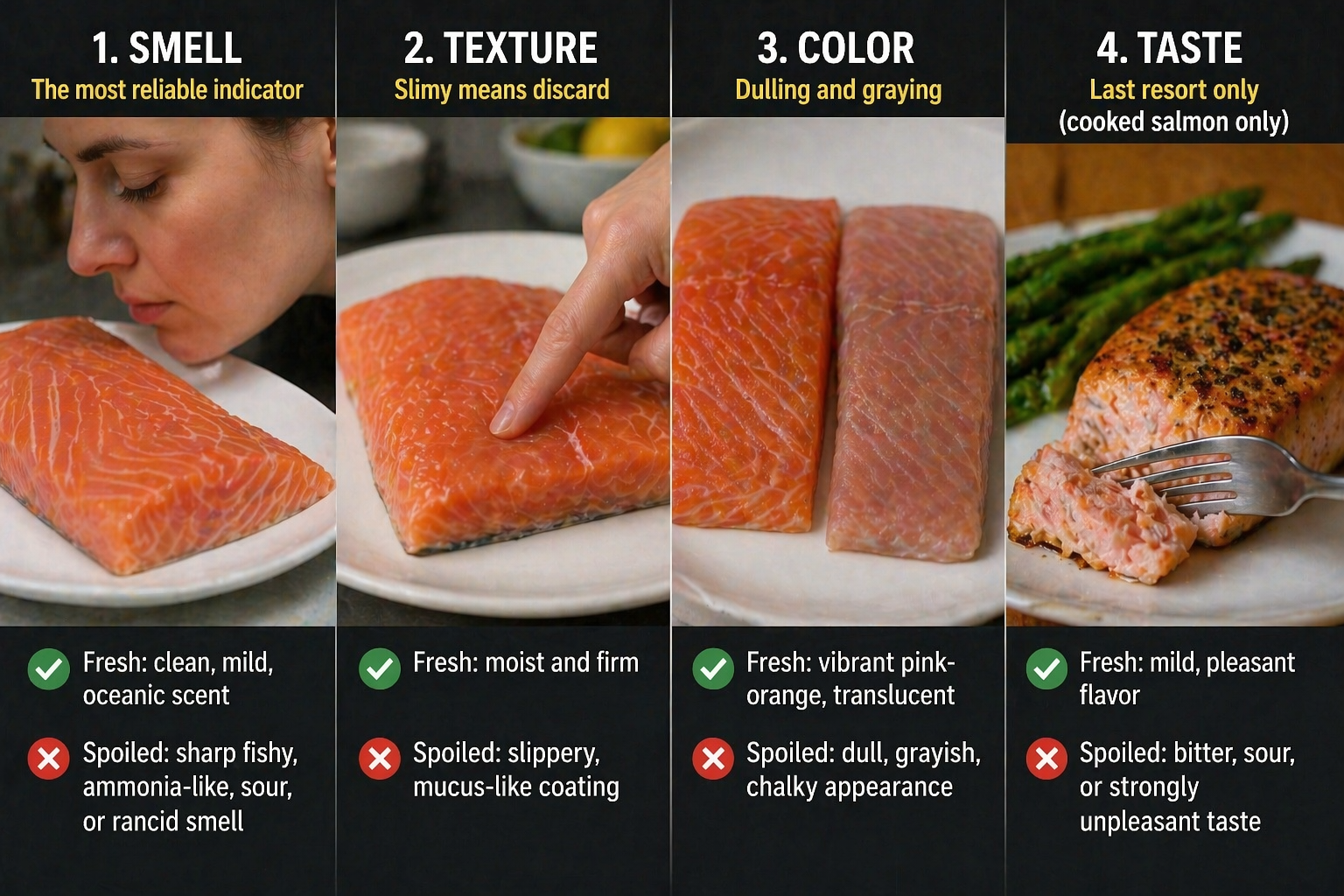
These are the four indicators to check before cooking or eating any refrigerated salmon, in order of reliability:
-
Smell — the most reliable indicator
Fresh salmon has a clean, mild, oceanic scent. As salmon begins to spoil, it develops a sharper, more pronounced fishy smell, then progresses to ammonia-like, sour, or rancid notes. The FDA notes that uncooked spoiled seafood develops these odors, which become stronger and more obvious after cooking.
Important: a slightly stronger smell doesn’t automatically mean discard — the natural fishy character of salmon intensifies during refrigeration. What you’re smelling for is a qualitative shift from pleasant ocean-fish to sharp-unpleasant-chemical. Trust your nose. If you’re uncertain, the safe call is to cook it promptly and smell it again during cooking — a bad piece of salmon becomes unmistakable once heat is applied.
-
Texture — slimy means discard
Fresh salmon feels slightly moist and firm. Spoiled salmon develops a slippery, mucus-like coating on the surface — a sign of bacterial growth on the protein surface. Run a clean finger across the flesh. If it feels slick rather than moist-firm, the salmon has turned.
Cooked salmon should be flaky and moist. Cooked salmon that has become slimy or excessively soft in a wet way (not just flaky) is past its window.
-
Color — dulling and graying
Fresh raw salmon ranges from deep pink-orange (sockeye, king) to lighter orange-pink (Atlantic farmed) to pale pink (coho). As salmon ages, the flesh lightens and dulls — it loses that vibrant translucency and develops a chalky, grayish appearance along the edges and surface. Minor color change from refrigeration is expected. Pronounced graying or browning indicates advanced age or improper storage.
-
The taste test — last resort only
Unlike the sushi context where tasting can be dangerous before you detect a problem, with salmon that has been cooked the taste-test is more acceptable as a final confirmation. Rancid or spoiled cooked salmon tastes distinctly off — bitter, sour, or strongly unpleasant. But do not rely on taste as a primary indicator, and never taste raw salmon that you’re uncertain about.
Salmon Nutrition — Why This Fish Is Worth Storing Carefully
Understanding what’s at stake nutritionally reinforces why proper salmon storage matters beyond just avoiding illness.
Per 3.5 oz (100g) cooked salmon (USDA/UPMC data):
Nutrient |
Amount |
% Daily Value |
| Calories | ~206 kcal | — |
| Protein | 22g | ~40% DV |
| Total Fat | 13g | — |
| Omega-3 (EPA + DHA) | ~2.2g | Well above daily recommendation (250–500mg) |
| Vitamin B12 | 2.8 mcg | 117% DV |
| Selenium | 41.4 mcg | 75% DV |
| Vitamin D | 13.1 mcg | 66% DV |
| Vitamin B6 | 0.65 mg | 38% DV |
| Choline | 91 mg | 16% DV |
| Potassium | ~490 mg | 10–13% DV |
What these numbers mean practically:
A single 3.5 oz serving of salmon provides more vitamin B12 than any daily requirement, nearly three-quarters of the selenium you need, and two-thirds of your vitamin D — a nutrient that most people are chronically deficient in, especially in northern latitudes and during winter. Salmon is one of the very few natural dietary sources of vitamin D3 in significant quantities.
The omega-3 content is what gets the most attention, and rightly so: one serving delivers multiple times the minimum recommended daily intake of EPA and DHA combined (250–500mg), supporting cardiovascular health, brain function, and inflammation regulation. The American Heart Association recommends eating fatty fish like salmon at least twice weekly specifically for this reason.
Wild vs. farmed for storage: Nutritionally, wild and farmed salmon are comparable. Wild salmon tends to be leaner, with slightly higher protein and lower fat; farmed Atlantic salmon has higher fat content and thus higher omega-3 absolute values per serving. For storage purposes, the higher fat content in farmed salmon makes it slightly more susceptible to oxidation during extended refrigeration — another reason to respect the 1–2 day raw window rather than pushing to day three.
Frequently Asked Questions About Salmon Storage
Q: Can I eat salmon that’s been in the fridge for 3 days raw? No — 3 days exceeds the USDA’s 1–2 day guideline for raw fish. Even if it smells acceptable, the bacterial load on raw salmon stored for 3 days is likely at or past a safe threshold. Discard it.
Q: Can I eat cooked salmon after 4 days in the fridge? The USDA’s guideline is 3–4 days for cooked fish. Day 4 is the outer edge — perform the smell and texture checks before eating. If it passes both, it’s likely safe for a healthy adult. For pregnant women, elderly individuals, or immunocompromised people, consume cooked salmon within 2 days.
Q: How long can salmon stay in the fridge after being frozen and thawed? Once thawed in the refrigerator, cook raw salmon within 1–2 days. Once cooked from frozen-and-thawed, consume within 3–4 days as you would normally cooked salmon.
Q: Is it safe to eat salmon left in the fridge overnight? Yes, absolutely — this is normal and safe. The 1–2 day window means overnight storage is well within limits for both raw and cooked salmon.
Q: Does it matter where in the fridge you store salmon? Yes, significantly. The back of the bottom shelf is consistently the coldest spot. The fridge door fluctuates in temperature every time it opens and is the worst location for salmon. Store salmon in the coldest consistent zone of your fridge.
Q: How long does smoked salmon last in the fridge? Unopened commercially smoked salmon keeps 5–7 days refrigerated. Once opened, consume within 3–5 days. The curing and smoking process gives smoked salmon a longer window than fresh salmon, but once the package is open, it’s exposed to air and moisture that begin degrading quality.
Q: Can you refreeze salmon after thawing it? Yes, if it was thawed in the refrigerator and maintained cold temperatures throughout. You cannot refreeze salmon that was thawed in cold water, at room temperature, or in the microwave. Refrozen salmon will have some texture degradation but is safe.
Q: What’s the best way to freeze salmon to prevent freezer burn? Pat completely dry, wrap tightly in plastic wrap with no air pockets, place in a heavy-duty freezer bag and press out all remaining air before sealing. Some cooks use the water-immersion freezing method: place salmon in a freezer bag, fill with water, freeze — the water forms a protective ice coating that prevents oxidation. This works well but makes thawing require an extra step.
Conclusion — Simple Rules, Consistently Applied
The answer to how long can salmon stay in the fridge comes down to two numbers you should commit to memory: 1–2 days for raw, 3–4 days for cooked. Everything else in this guide is detail that helps you understand why those numbers exist, how to maximize freshness within those windows, and what to look for when you’re not sure.
The most common salmon storage mistakes are predictable: buying it without a plan to cook it within 48 hours, storing it at too warm a temperature, not wrapping it properly, and pushing the raw fish window based on smell alone. Fixing those habits costs nothing and eliminates most of the food safety risk around salmon at home.
From a nutrition standpoint, salmon rewards careful handling — one properly stored and cooked fillet delivers over 100% of your daily vitamin B12, nearly 75% of your selenium, two-thirds of your vitamin D, and more EPA/DHA omega-3s than your body needs in a single day. That nutritional profile is worth the extra 60 seconds it takes to wrap it correctly and label it with a date.
When in doubt, freeze it the day you buy it rather than hoping the 1–2 day window stretches. Frozen salmon, properly thawed, tastes close enough to fresh that the quality difference rarely matters — and you’ll never waste a fillet or gamble on a questionable piece.