How to Make Canadian Bacon Recipes — Complete Homemade Guide With Curing, Smoking, and Cooking Methods

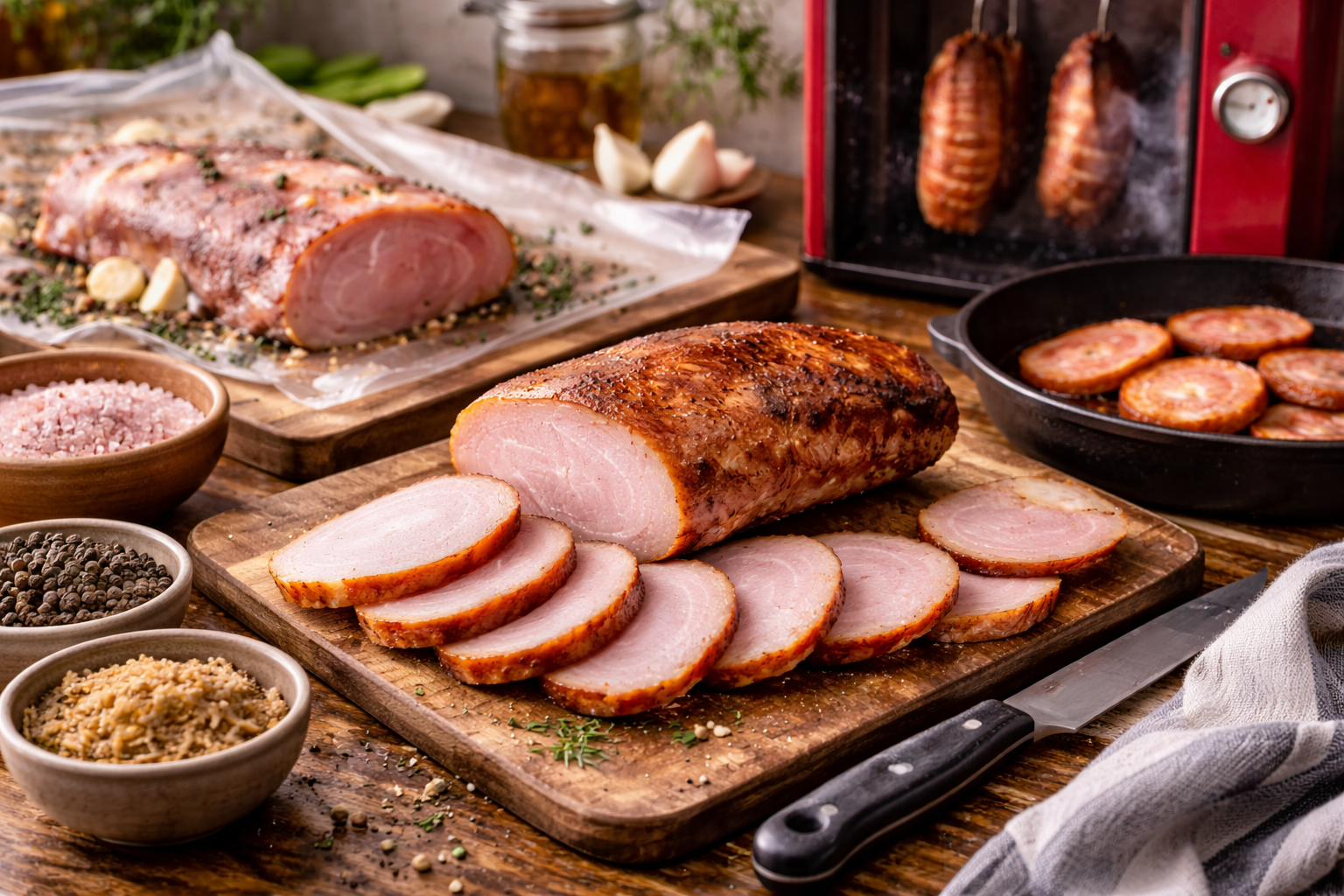
How to Make Canadian Bacon Recipes
Most people who decide to make Canadian bacon at home are initially intimidated by the curing step. That hesitation is understandable but largely unwarranted. If you’ve ever brined a roast or marinated meat for more than a day, you’ve already done the most cognitively demanding part of the process. The rest is time and temperature management.
What you get at the end is a lean, mildly sweet, smoke-kissed pork loin that bears no resemblance to the rubbery, overly salty rounds sold in vacuum packaging at most grocery stores. Learning how to make Canadian bacon recipes from scratch gives you complete control over salt levels, smoke intensity, and flavor additions — and the result is genuinely worth the five-day wait.
This guide covers the history and cut distinction, the full wet brine method, dry cure option, smoking vs. oven finishing, three practical recipes that use your homemade Canadian bacon, the nutritional comparison to regular bacon, and a full FAQ section.
What Canadian Bacon Actually Is — The Cut, the Name, and the Confusion
The name is misleading on multiple levels. In the United States, “Canadian bacon” refers to a brined and smoked pork loin — lean, cylindrical, pre-cooked, and nothing like the streaky belly bacon most Americans think of when they hear the word bacon. In Canada, the same preparation is called back bacon. What Canadians call peameal bacon is a brined but unsmoked pork loin rolled in yellow cornmeal — its own distinct product.
The naming history is surprisingly coherent: in the mid-19th century, Britain faced pork shortages and began importing cured back bacon from Canada. British curers took that imported product, added smoking to it, and continued calling it “Canadian.” That smoking tradition traveled to America, where the name stuck even as the product diverged from its Canadian origin.
From a butchering standpoint, the difference matters: regular American bacon comes from pork belly, a fatty cut with significant marbling and a high fat-to-protein ratio. Canadian bacon comes from the pork loin, which runs along the spine, is far leaner, and has a texture closer to ham than to belly bacon when cooked. This anatomical difference — belly versus loin — is the single most important fact when buying the right cut for this recipe.
Buy a center-cut, boneless pork loin (not pork tenderloin, which is a different, narrower muscle). A 3–5 lb loin is the standard working size for most home recipes. Larger loins are fine but require longer curing times to ensure the brine penetrates the center fully.
Ingredients for the Wet Brine — What Each One Does
The wet brine is the foundation of homemade Canadian bacon. Every ingredient in it has a specific role; substituting or skipping components changes the result in predictable ways.
Standard wet brine (for a 3–4 lb pork loin):
Ingredient |
Amount |
Function |
| Water | 4 cups (1 quart) | Brine carrier; dilutes and delivers all other components |
| Kosher salt | ¼ cup (60g) | Primary curing agent; draws moisture out and flavors inward |
| Brown sugar | ¼ cup packed | Balances salt; contributes mild caramel notes |
| Pure maple syrup | 3 tablespoons | Classic flavor note; adds depth the sugar alone can’t replicate |
| Prague Powder #1 (pink curing salt) | 1 teaspoon | Safety and color; inhibits botulism-causing bacteria, preserves pink color |
| Garlic cloves, smashed | 3–4 cloves | Aromatic complexity in the finished meat |
| Bay leaves | 2 | Background herbaceous note |
| Black peppercorns | 1 tablespoon | Gentle heat that develops during cure |
| Optional: star anise, fennel seed | ½ tsp each | Toasted first for more complex brine |
Critical safety note on Prague Powder #1:
This is sodium nitrite-based curing salt dyed pink to prevent accidental use as table salt. It is not Himalayan pink salt and cannot be substituted with it. Himalayan salt has no curing properties whatsoever. The pink curing salt serves two non-negotiable purposes: inhibiting Clostridium botulinum growth during the curing period, and producing the characteristic pink color and cured flavor of the finished product. If you choose to omit it, what you’ll produce is smoke-roasted pork — still delicious, more perishable, and not technically Canadian bacon.
Use Prague Powder #1 (sodium nitrite) for this recipe, not Prague Powder #2 (sodium nitrate). The #2 is for long-duration dry-cured, uncooked products like prosciutto or salami. For Canadian bacon that will be cooked, #1 is correct.
How to Make Canadian Bacon — The Wet Brine Method Step by Step
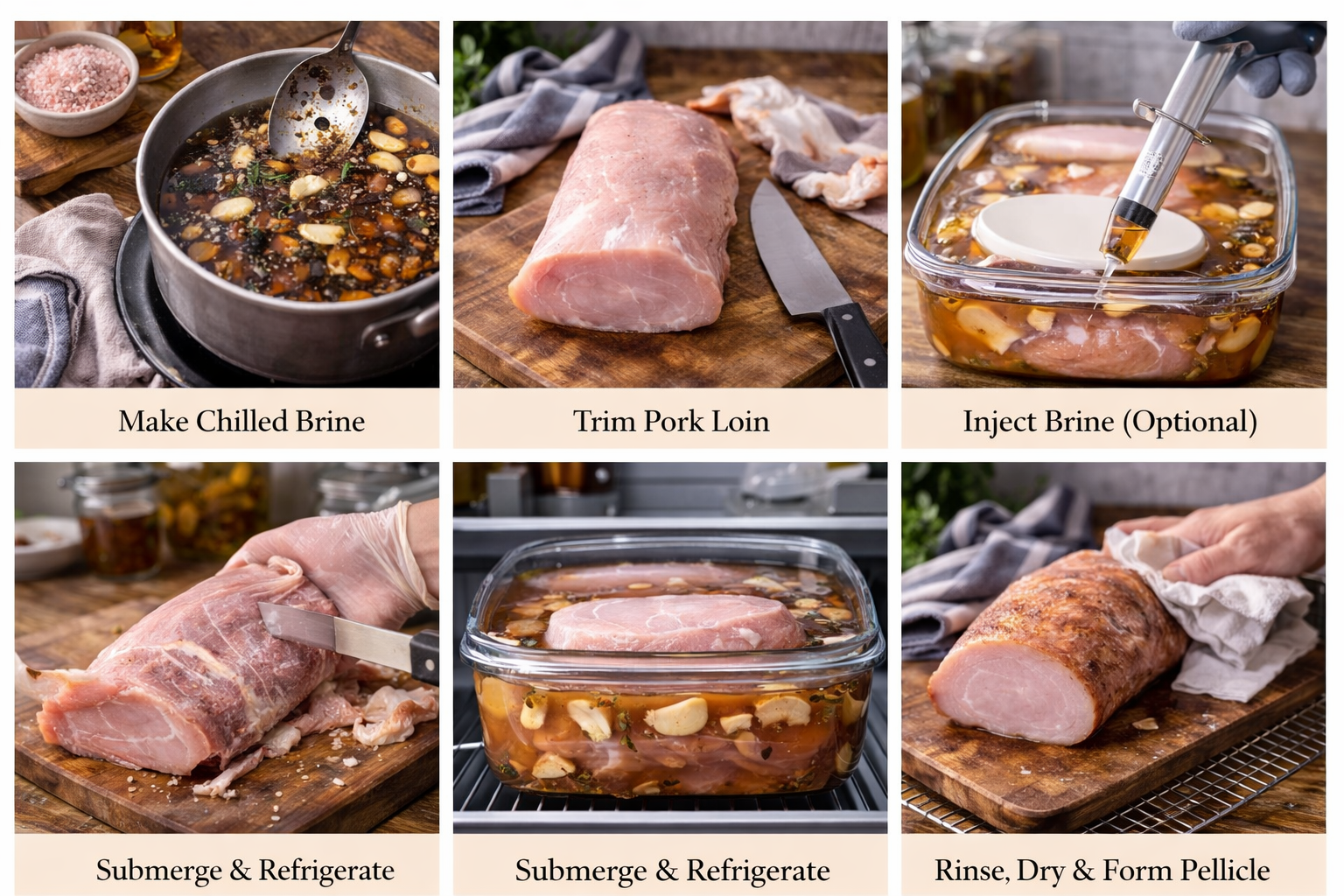
Step 1 — Make and chill the brine
Combine water, kosher salt, brown sugar, maple syrup, garlic, bay leaves, and peppercorns in a saucepan. If using star anise or fennel, toast them in the dry pan first for 2 minutes until fragrant, then add the liquids. Bring to a simmer and stir until all solids are fully dissolved — about 3 minutes. Remove from heat.
Add the Prague Powder #1 and stir until dissolved. Cool the brine to room temperature, then refrigerate until it reaches below 40°F (4°C) before using. Never pour warm or hot brine over raw meat — it begins to cook the exterior and disrupts the curing process.
Step 2 — Trim and prepare the pork loin
Remove the loin from packaging and trim surface fat to roughly ⅛ inch — thin enough that brine penetrates but thick enough to protect the meat during smoking. A fully trimmed loin can dry out during longer smoke sessions.
Step 3 — Inject the brine (recommended)
For loins thicker than 3 inches in diameter, a meat injector speeds penetration dramatically and ensures the center cures properly without requiring a 10–14 day wait. Inject brine every 1–1.5 inches across the top surface, pushing the needle about halfway down. You’ll see brine track slightly through the meat.
Step 4 — Submerge and refrigerate
Place the injected loin in a non-reactive container — glass, food-grade plastic, or stainless steel. Pour remaining brine over the top until the loin is fully submerged. Weight it down with a plate or sealed zip-lock bag filled with water if it floats.
Refrigerate at 36–40°F for 4–7 days, flipping the loin every day or two to ensure even brine contact. Without injection: 7–10 days minimum for reliable center penetration.
Step 5 — Rinse, dry, and form the pellicle
After curing, remove the loin from brine and rinse thoroughly under cold running water. Pat completely dry with paper towels. Set it on a wire rack uncovered in the refrigerator for 2–4 hours (or overnight). This drying period forms a pellicle — a tacky, slightly dry surface layer that smoke adheres to. Skip this step and smoke flavor will be surface-only, not integrated into the meat.
Smoking the Canadian Bacon — Temperatures and Wood Choice
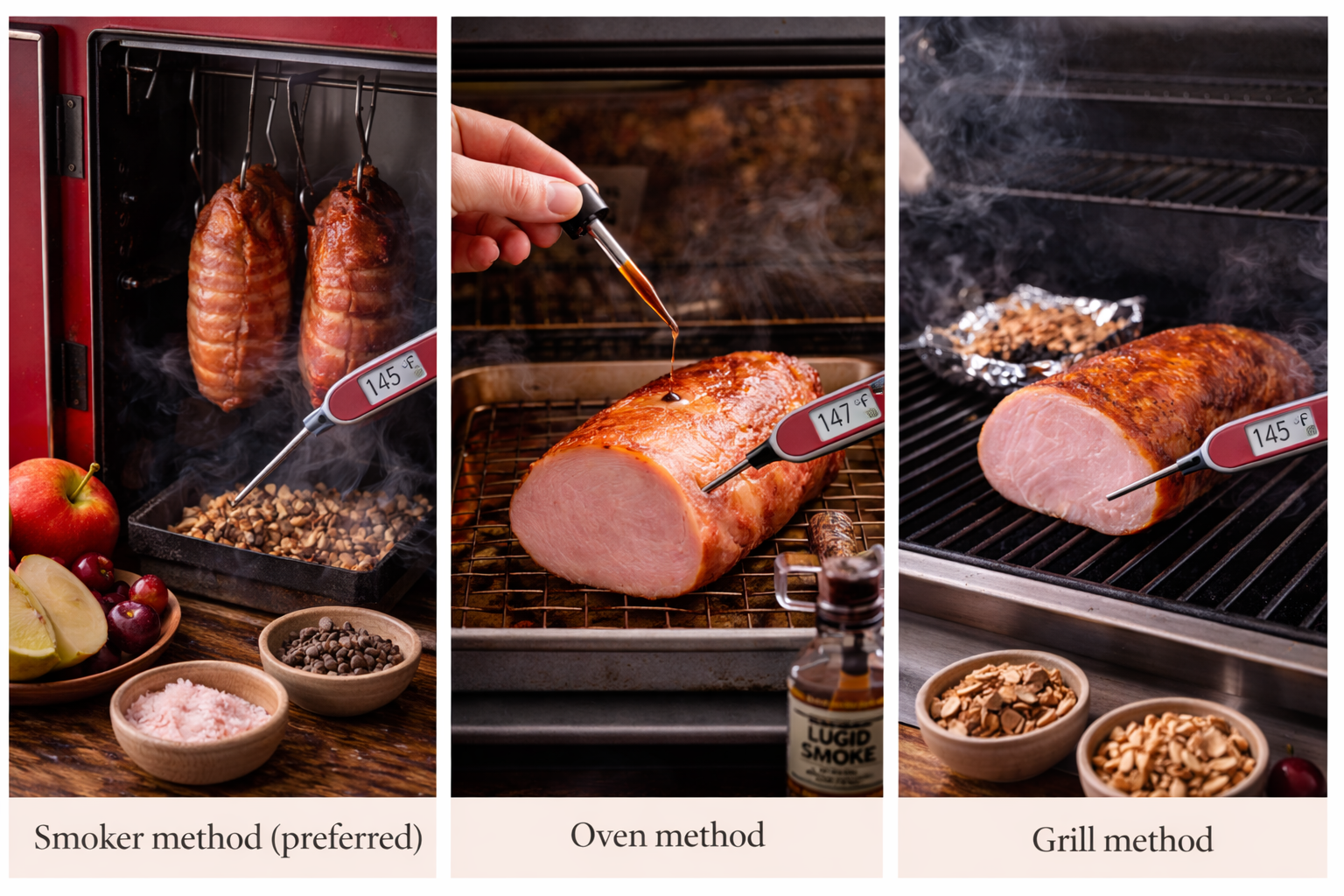
Smoker method (preferred):
Preheat smoker to 200–210°F. This low temperature allows smoke to penetrate gradually without cooking the exterior too fast. Add wood chips at the start — apple, cherry, or maple are the classic choices for Canadian bacon because their mild sweetness complements the maple brine. Add one more small amount of chips after 45 minutes.
Smoke until the internal temperature of the thickest part reads 145°F (63°C). This takes approximately 1.5–3 hours depending on loin diameter and ambient temperature. Use a reliable instant-read thermometer — internal temperature is the only accurate doneness indicator; cook time alone is unreliable.
Allow to rest at room temperature for 15 minutes, then refrigerate. Slice after fully chilled — warm Canadian bacon crumbles when sliced.
Oven method (no smoker required):
Place rinsed, dried loin on a wire rack set over a rimmed baking sheet. Roast at 200–225°F until internal temperature reaches 145–150°F. This takes 2.5–4 hours. No smoke flavor develops in the oven, but the brine delivers most of the character. If desired, add a few drops of liquid smoke to the brine during preparation — use sparingly, as it concentrates during cooking.
Grill method:
Set up for indirect heat, keeping temperature between 200–225°F on the cool side. Add wood chips in a smoker box or foil packet for smoke. Proceed as with the smoker method.
Wood choice matters:
- Applewood: Mildest, slightly sweet — the classic pairing for maple-brined pork
- Cherry: Slightly deeper color, mild fruitiness — excellent for a darker, more complex result
- Maple: Redundant with the brine but produces a very clean, sweet smoke profile
- Hickory or mesquite: Avoid — these are too aggressive for lean loin and produce a harsh, overpowering result
Dry Cure Method — The Alternative for Smaller Batches
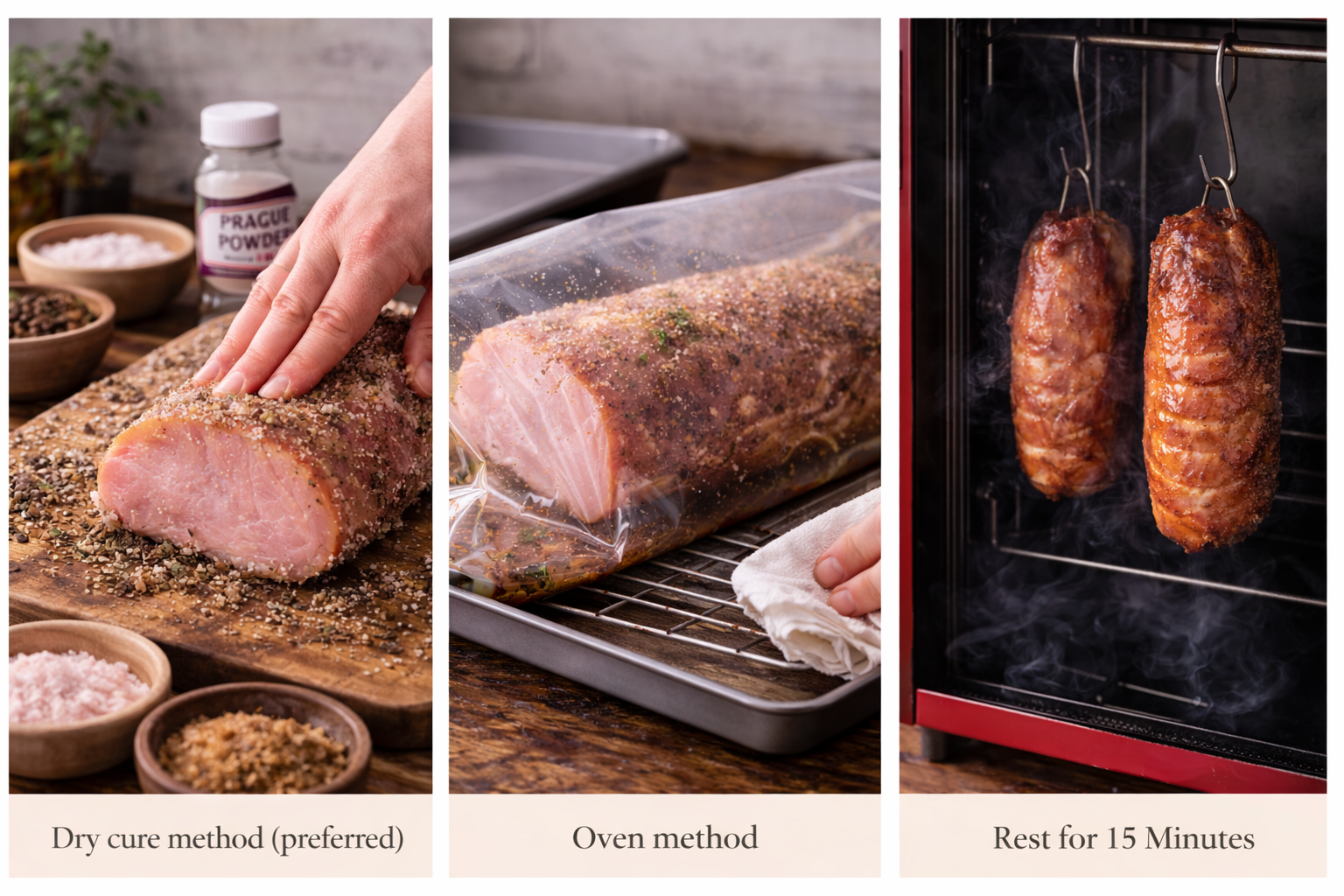
The dry cure approach skips the liquid brine entirely. It’s faster, uses less equipment, and works particularly well for smaller pieces (under 2 lbs) where wet brining a large container isn’t practical.
Dry cure ratio (per pound of pork loin):
- 1 teaspoon kosher salt
- ½ teaspoon brown sugar
- ¼ teaspoon Prague Powder #1
- ¼ teaspoon black pepper
- Optional: ½ teaspoon dried thyme, garlic powder
Combine and rub the entire surface of the loin. Place in a zip-lock bag, press out all air, and seal. Refrigerate for 4–7 days, flipping and redistributing the accumulated liquid daily.
The dry cure pulls moisture from the meat, which then redissolves the cure into a concentrated brine that the meat reabsorbs. The result is a denser, more intensely flavored product with slightly less moisture than the wet-brined version. Dry-cured Canadian bacon slices cleanly and holds up particularly well in high-heat applications like searing and pizza toppings.
After curing, rinse, dry, form the pellicle, and smoke or oven-cook identically to the wet brine method.
Three Recipes Using Your Homemade Canadian Bacon
Recipe 1 — Classic Eggs Benedict With Homemade Canadian Bacon

The benchmark application. Homemade Canadian bacon, with its clean salt and smoke character, elevates Eggs Benedict from a brunch standard to something genuinely impressive.
- Slice Canadian bacon into rounds approximately ½ inch thick.
- Sear in a dry cast iron skillet over medium heat for 2–3 minutes per side until lightly caramelized.
- Serve over toasted English muffins with poached eggs and classic hollandaise (4 egg yolks, 200g clarified butter, lemon juice, cayenne).
The sear is not optional — cold-sliced Canadian bacon lacks the texture contrast that makes this dish work. The caramelization from the maple and brown sugar in the brine accelerates quickly over direct heat, so medium rather than high heat avoids burning.
Recipe 2 — Canadian Bacon and White Bean Soup
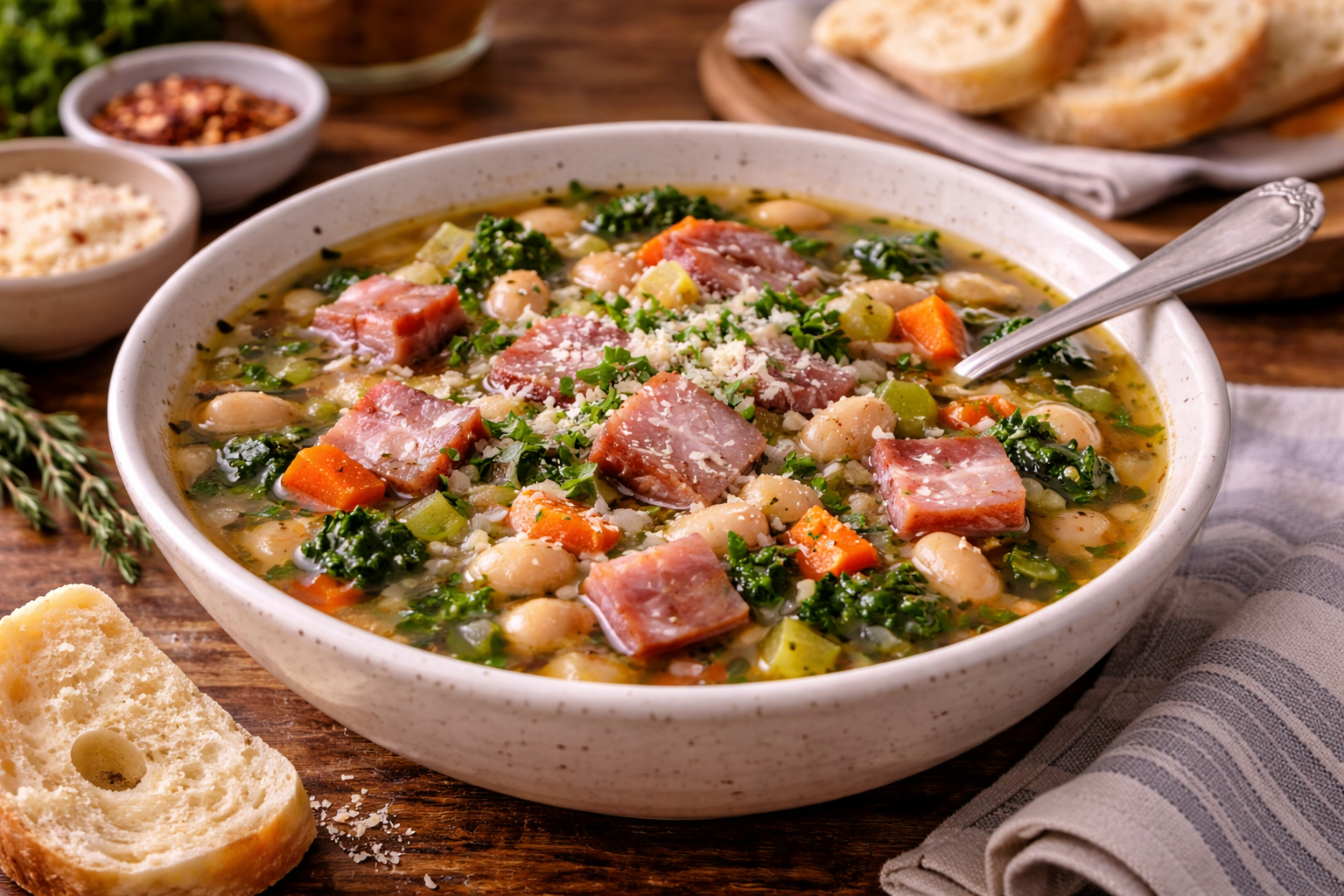
An underused application that works because Canadian bacon’s lower fat content doesn’t overwhelm a brothy soup the way belly bacon would.
- Dice 6 oz of Canadian bacon into ½-inch cubes.
- Sauté in a tablespoon of olive oil with 1 diced onion and 3 garlic cloves until softened.
- Add 2 cans of white cannellini beans (drained), 4 cups chicken stock, 1 tsp smoked paprika, 1 tsp dried rosemary.
- Simmer 20 minutes. Finish with a squeeze of lemon and chopped flat-leaf parsley.
The smoked paprika reinforces the bacon’s smoke character without additional fat. This soup tastes better on day two, making it a strong meal-prep option.
Recipe 3 — Canadian Bacon Breakfast Hash

A direct, satisfying use of sliced or diced Canadian bacon that comes together in under 20 minutes.
- Parboil 3 medium Yukon Gold potatoes (diced small) for 5 minutes. Drain and dry on a paper towel.
- Sear diced Canadian bacon in a cast iron skillet over medium-high until lightly browned. Remove and set aside.
- Add potatoes to the same pan with a tablespoon of butter. Press flat and cook 4–5 minutes without stirring.
- Flip, add ½ diced onion and 1 diced red bell pepper. Cook another 4 minutes.
- Return bacon to pan. Crack 3–4 eggs directly into the hash or serve fried eggs on top.
- Season with black pepper, a dash of hot sauce, and fresh chives.
Nutrition — Canadian Bacon vs. Regular Bacon vs. Ham
The nutritional case for Canadian bacon over regular bacon is clear-cut — this is one of the less contested comparisons in processed meat nutrition.
Per 100g serving (USDA/FoodStruct data):
| Nutrient | Canadian Bacon |
Regular (Belly) Bacon |
Ham (extra lean) |
| Calories | ~146 kcal | ~458 kcal | ~109 kcal |
| Protein | 28g | 36g | 20g |
| Total Fat | 2.8g | 42g | 2.5g |
| Saturated Fat | 1g | ~14g | 0.9g |
| Sodium | 993mg | 2,190mg | ~1,000mg |
| Potassium | 999mg | ~344mg | ~340mg |
| Iron | 0.56mg | ~0.5mg | 1.4mg |
What these numbers mean in practice:
Fat and calories: Canadian bacon contains roughly 3% total fat compared to belly bacon’s 43%. Per typical 2-ounce serving (2 slices), Canadian bacon delivers about 60–80 calories and 2–3g fat. The same weight of regular bacon provides approximately 130–150 calories and 10–12g fat — a meaningful difference for anyone monitoring fat or calorie intake.
Protein: Both are solid protein sources. Canadian bacon at 28g per 100g is competitive with most lean meats. A typical 2-ounce breakfast serving delivers 12–14g protein, covering roughly 20–25% of average daily protein needs.
Sodium — the honest caveat: At 993mg per 100g, Canadian bacon is significantly lower in sodium than regular bacon (2,190mg per 100g), but the absolute amount is still substantial. A 2-ounce serving delivers approximately 500–600mg sodium — roughly 22–26% of the 2,300mg daily limit recommended by dietary guidelines. People managing hypertension or on sodium-restricted diets should treat Canadian bacon as an occasional protein choice rather than a daily staple.
B vitamins and selenium: Canadian bacon provides meaningful amounts of niacin (B3), vitamin B12, and selenium per serving — nutrients important for energy metabolism, red blood cell production, and antioxidant function. These micronutrient contributions are consistent with USDA food data.
Processed meat context: Like all processed red meats, Canadian bacon carries the population-level associations that nutrition researchers consistently report — increased colorectal cancer risk with regular high intake, as classified by the International Agency for Research on Cancer (IARC). This doesn’t mean occasional consumption is clinically dangerous; it means the product belongs in a varied diet alongside whole foods, lean proteins, vegetables, and whole grains — not as an everyday protein anchor.
The homemade advantage: making Canadian bacon at home allows you to control the sodium level directly. Reducing the kosher salt in the brine by 25–30% still produces a properly cured product (the Prague Powder #1 does the safety work) while cutting the sodium content of the finished product meaningfully. Commercial versions have no such flexibility.
Storage and Shelf Life
Refrigerator (unsliced, whole loin): Wrapped tightly in butcher paper, vacuum bag, or plastic wrap, a whole smoked Canadian bacon loin keeps 10–14 days. The pink curing salt extends shelf life well beyond unseasoned smoked pork.
Refrigerator (sliced): Pre-sliced Canadian bacon lasts 3–5 days in an airtight container or sealed bag.
Freezer: Freeze sliced Canadian bacon in portions separated by parchment. Whole loins freeze well for up to 3 months. Thaw overnight in the refrigerator — never at room temperature.
Do not freeze then refreeze after thawing. The texture degrades noticeably on a second freeze cycle, and the safety margin narrows.
Frequently Asked Questions About Canadian Bacon
Q: What’s the difference between Canadian bacon and peameal bacon?
Canadian bacon (back bacon) is brined and smoked. Peameal bacon is brined but not smoked, and is rolled in yellow cornmeal before slicing. Both use pork loin.
Q: Can I use pork tenderloin instead of pork loin?
No. Pork tenderloin is a different, smaller muscle with less fat and lower connective tissue. It cures unevenly and becomes dry after smoking. Use center-cut boneless pork loin.
Q: Is Prague Powder #1 the same as Himalayan pink salt?
Absolutely not. Himalayan pink salt is a mineral salt with no curing properties. Prague Powder #1 is sodium chloride with sodium nitrite (6.25%) and a pink dye. Using Himalayan salt in its place provides zero botulism protection.
Q: How long does homemade Canadian bacon last in the fridge?
Up to 14 days unsliced if properly wrapped. Sliced portions should be used within 3–5 days.
Q: Can I make Canadian bacon without a smoker?
Yes. Oven-roast at 200–225°F until internal temperature reaches 145°F. Add a small amount of liquid smoke to the brine if desired. The result is excellent, just without the smoke ring and smoke aroma.
Q: What internal temperature is safe for Canadian bacon?
145°F (63°C) is the USDA-recommended safe internal temperature for whole pork cuts. Pull it at this temperature and let it rest — carryover cooking will bring it to 147–148°F, which is ideal for juicy, fully-safe Canadian bacon.
Q: Can I cure Canadian bacon without pink curing salt?
Technically yes, but the product won’t be Canadian bacon — it will be smoke-roasted pork. The pink color won’t develop, the cured flavor profile won’t emerge, and the shelf life will be significantly shorter. Keep refrigerated and use within 3–4 days if omitting curing salt.
Q: How is Canadian bacon different from ham?
Both come from pork, but ham is typically made from the hind leg (a larger muscle), uses a longer cure, and has a different flavor profile. Canadian bacon (pork loin) is leaner than most ham varieties, contains less sodium than regular ham, and has a more cylindrical shape suited to round breakfast applications like Eggs Benedict.
Conclusion — Why Homemade Canadian Bacon Is Worth the Five-Day Wait
The practical argument for making Canadian bacon at home rests on three things: control, quality, and cost. Store-bought versions are heavily salted, texturally inconsistent, and loaded with preservatives beyond what the curing process strictly requires. Homemade Canadian bacon, brined for five to seven days in a balanced wet cure and smoked low and slow over applewood, produces a product that genuinely earns its place at every meal it enters.
The curing process is not technically difficult — it’s patient cooking. The brine takes 20 minutes to make. The curing does its own work in the refrigerator. The smoke takes a Sunday afternoon. What you end up with is a full pork loin of lean, tender, properly flavored back bacon that can be sliced, seared, cubed into soups, stacked on pizza, or tucked into a breakfast sandwich — and it keeps for two weeks refrigerated or three months frozen.
From a nutrition standpoint, Canadian bacon’s low fat content (under 3g per 100g), solid protein density (28g per 100g), and meaningful micronutrients make it one of the more defensible processed meat choices for people who want flavor without the caloric weight of belly bacon. The sodium warrants mindfulness, and the processed meat classification warrants moderation — but within a varied, whole-food-based diet, it fits cleanly.
Once you make it from scratch, you’ll find it difficult to go back to the commercial version. That’s not an exaggeration — it’s simply what happens when you control every variable in the brine.